Artwork
Pravira Kneeling at the Feet of Jana
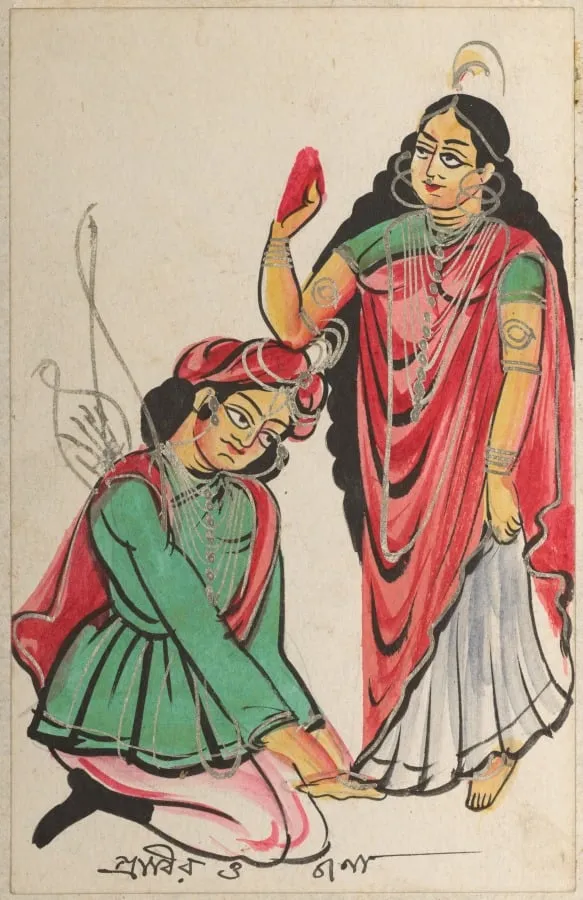
Pravira Kneeling at the Feet of Jana is an unspecified painting by the Patna School of Painting artist Unknown. It dates from 1890 and is held in the collection of the Cleveland Museum of Art.
About this work
Overview
The work titled “Pravira Kneeling at the Feet of Jana” depicts a domestic scene with two female figures rendered in vivid, saturated hues.
The work titled “Pravira Kneeling at the Feet of Jana” depicts a domestic scene with two female figures rendered in vivid, saturated hues. One figure is positioned kneeling, clutching a red fan and extending a hand toward the other’s uncovered foot, while the standing figure is dressed in a long sari of red and green, accented with gold jewelry and a white underskirt, and holds a red cloth. The composition is outlined in dark lines against an unadorned background.
Subject & Meaning
The kneeling woman appears to be presenting an offering or gesture of reverence to the standing woman, whose bare foot is the focal point of the interaction. The use of bright colors and the intimate pose suggest a narrative of devotion, service, or ritual within a private, perhaps household, setting.
Technique & Style
Executed in the flat, decorative manner characteristic of the Kalighat school, the painting employs uniform color planes without modelling or chiaroscuro. Bold outlines define the figures, and the background is reduced to a simple, untextured field, emphasizing the two protagonists and their gestures over spatial realism.
History & Provenance
The piece belongs to the nineteenth‑century Kalighat tradition of Kolkata, a genre that emerged from the bustling Kalighat bathing ghats and catered to a growing urban clientele. Works of this type were typically produced by itinerant painters who combined folk motifs with contemporary social themes.
Context
Kalighat paintings arose during a period of cultural exchange in colonial Bengal, reflecting both indigenous artistic conventions and the influence of European print media. The bright palette and simplified forms align with the school’s aim to convey narrative quickly and accessibly to a diverse audience.
Legacy
Although originally created for a modest market, Kalighat works such as this have been re‑evaluated by scholars for their insight into everyday life and gender relations in nineteenth‑century India, and they continue to inform studies of vernacular visual culture.
Artist & collection

 Domestic Scene
 Giacomo and Cardinal Marco, investing Andrea, Abbot of San Zeno, with his Benefice
 The Nymph of Fontainebleau
 Portrait of a Woman
 Madonna and Child with Saints in the Enclosed Garden
 Venus and Minerva
 Family Group of Four on Sofa
 Wall painting from Room H of the Villa of P. Fannius Synistor at Boscoreale
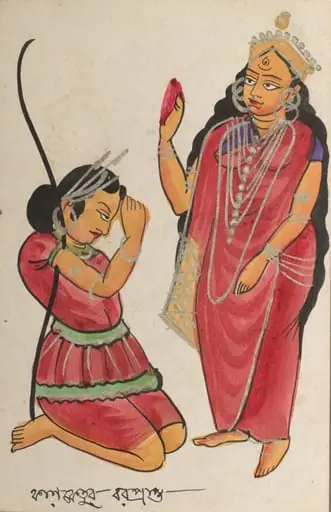 Kalaketu Receiving a Boon from the Goddess Chandi
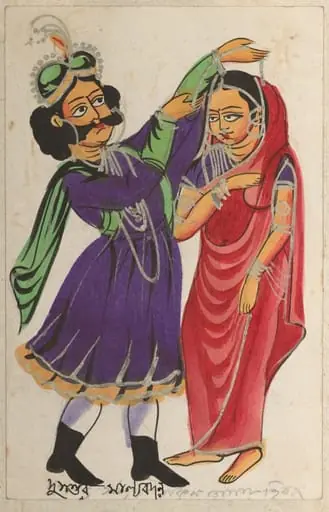 Dusmanta Garlanding Shakumtala
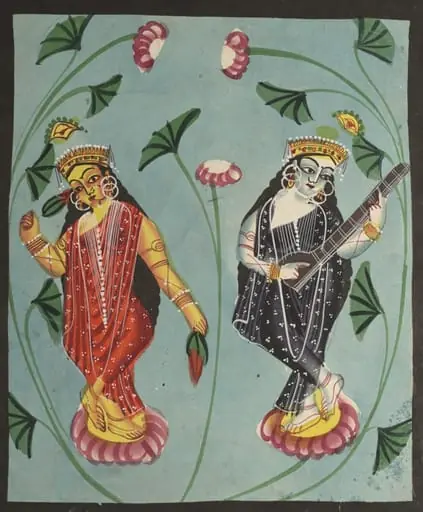 Lakshmi and Sarasvati
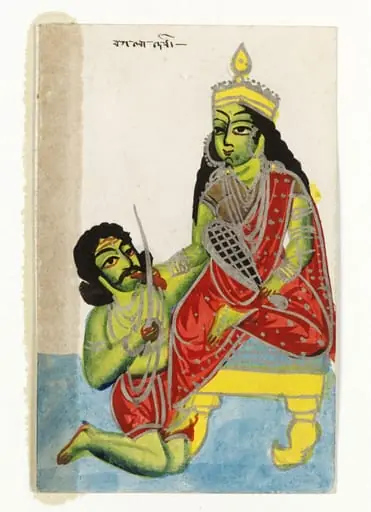 Devi as Bagala
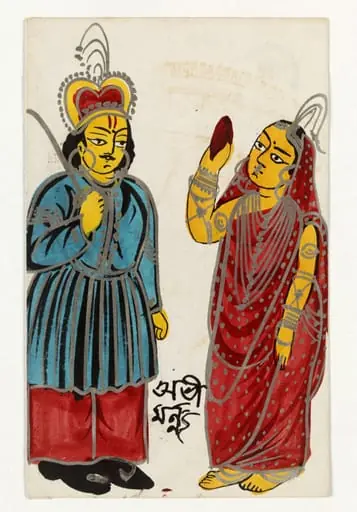 Abhimanyu and Uttara
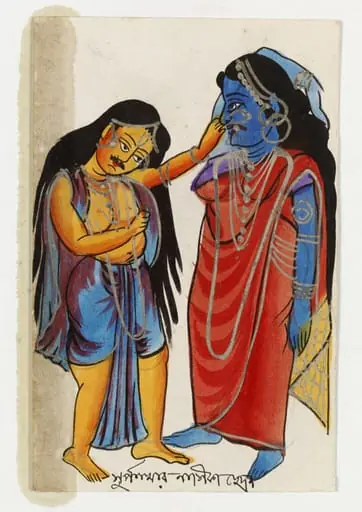 Lakshmana and Surpanakha
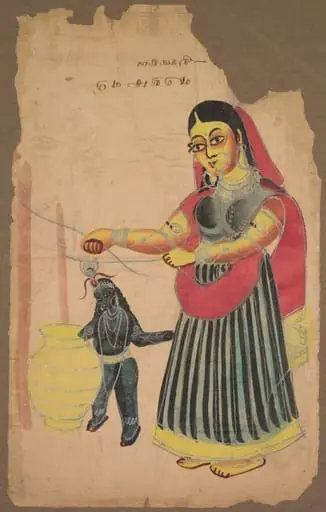 Yasoda with Krishna Churning Butter
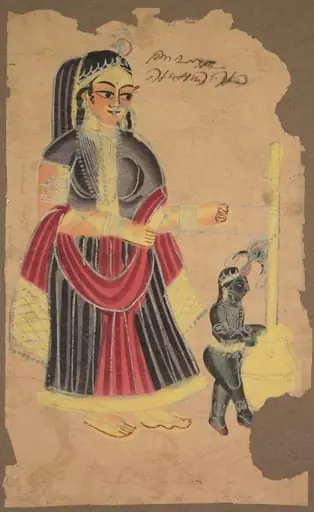 Yasoda and Krishna
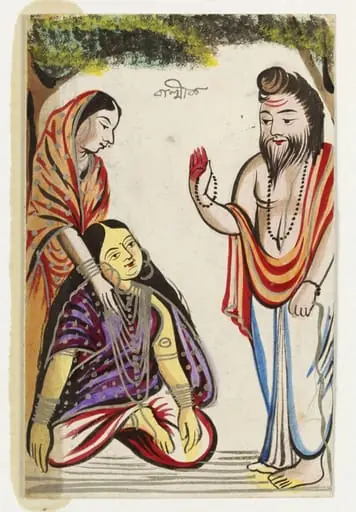 Valmiki and Sita
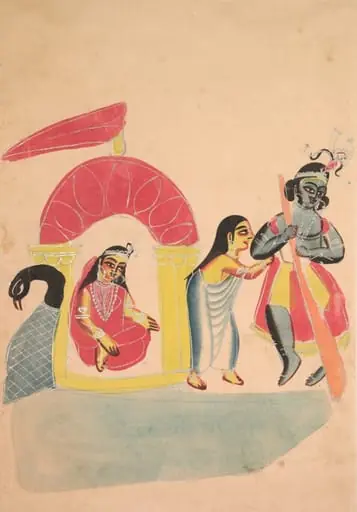 Krishna Ferrying Radha Across the Yamuna River
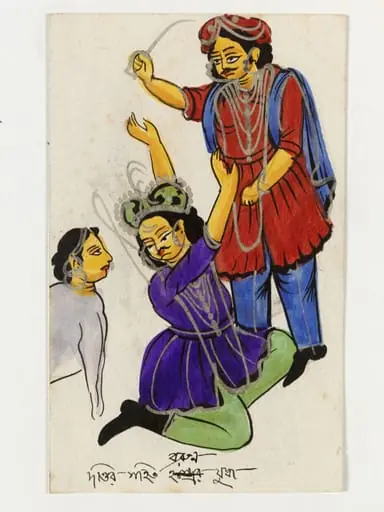 Varuna and Dandin
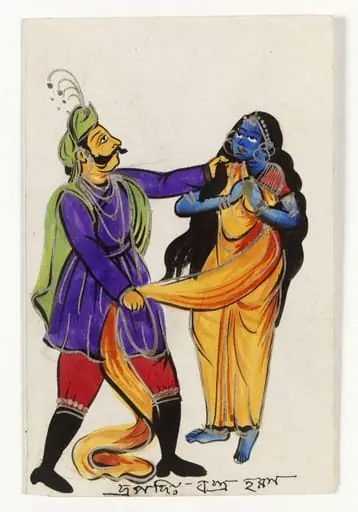 Duhshashana and Draupadi