Artwork
Raja Udai Singh
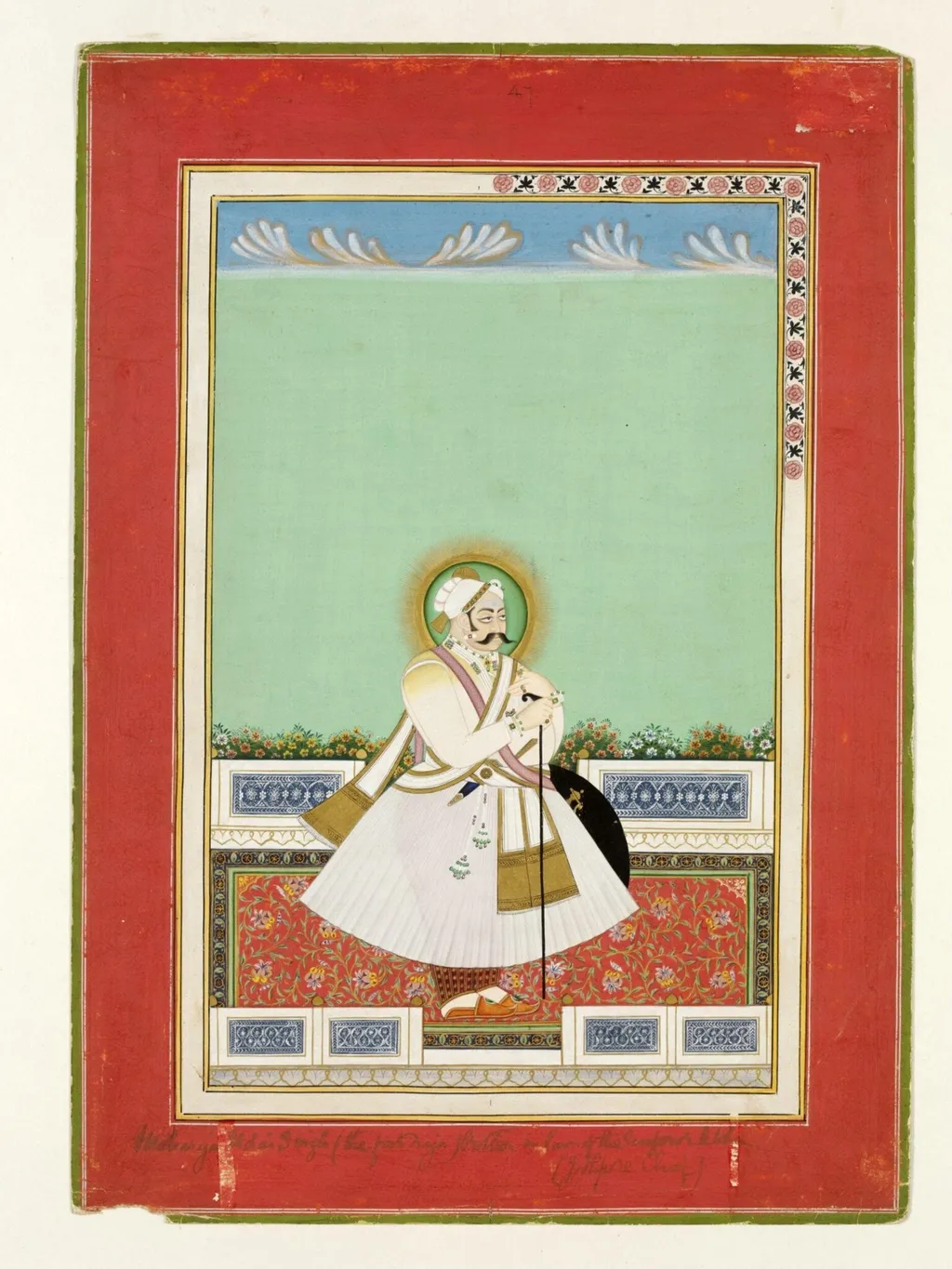
Raja Udai Singh is a paint painting by the Impressionist artist Unknown. It dates from 1890 and is held in the collection of the Victoria and Albert Museum.
About this work
Overview
The subject's softly glowing face contrasts with the vibrant surroundings, suggesting a dignified yet understated representation.
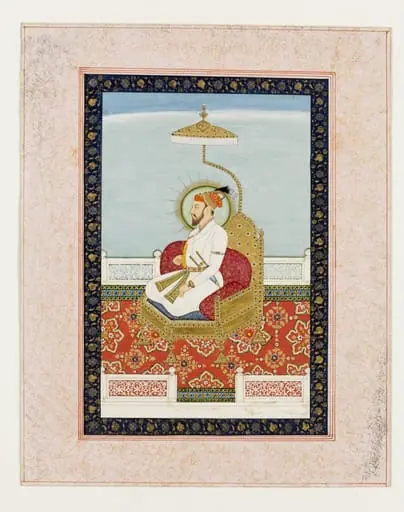
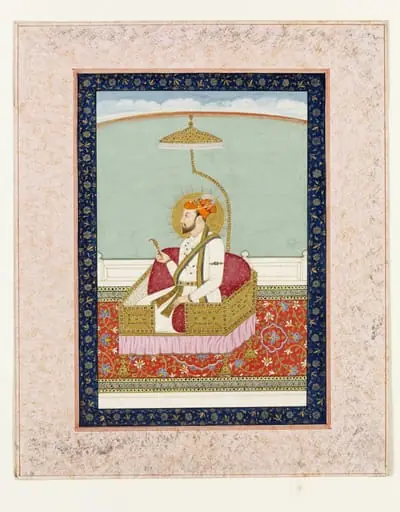
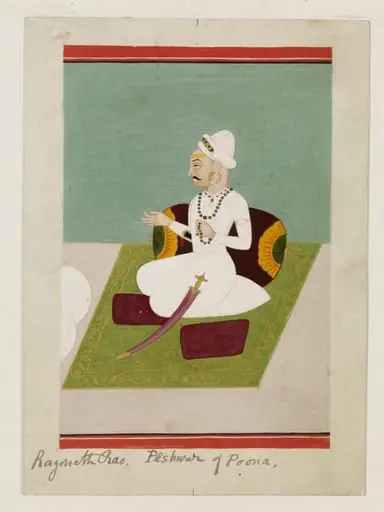
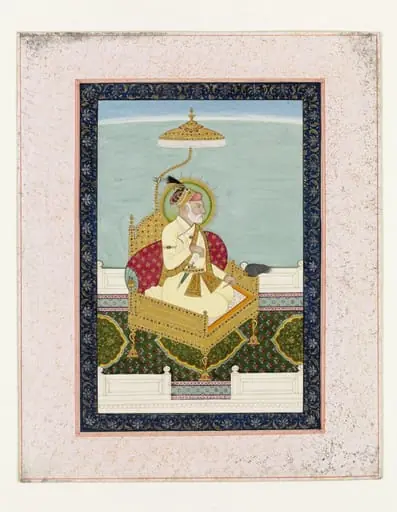
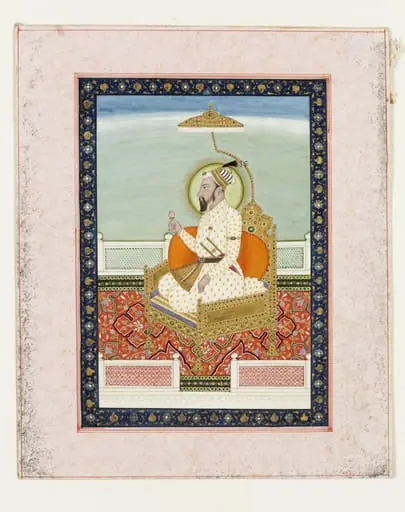
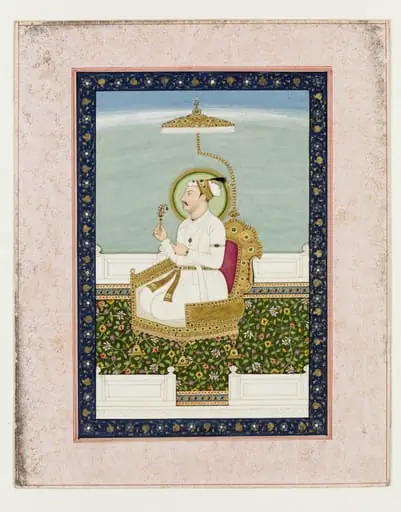
This 1890 opaque watercolour and gold on paper portrait depicts Raja Udai Singh, executed by an unidentified artist. The work features the subject in a white robe, standing on a intricately patterned red-and-gold carpet, holding a fan and a curved object, adorned with a turban and jewelry. A simple green wall with a blue sky and clouds serves as the background, framed by a red border with floral motifs. The subject's softly glowing face contrasts with the vibrant surroundings, suggesting a dignified yet understated representation.
Subject & Meaning
The portrait's subject, Raja Udai Singh, is presented in attire and accessories indicative of his royal status. The fan and curved object (likely a ceremonial item) in his hands further emphasize his rank. The subtle glow around his face may imply reverence or distinguished character, though the overall simplicity suggests a focus on quiet dignity rather than overt opulence.
Technique & Style
The painting utilizes opaque watercolour and gold on paper, characteristic of traditional Indian miniature techniques. The style, noted for its simplicity and clarity, is comparable to examples housed in the Victoria and Albert Museum, hinting at a possible influence or stylistic lineage. The bold color palette and intricate patterns (e.g., the carpet and border) are balanced by the subdued, glowing facial depiction.
History & Provenance
Created in 1890 by an unknown artist, the painting's historical context and ownership history prior to its current location are not specified. The artist's anonymity is common for many works from this period and region.
Context
The work reflects the artistic traditions of its time, blending symbolic royal imagery with the aesthetic preferences of the late 19th century. The use of gold and the specific colour scheme (red, green, blue) suggests an adherence to conventional Indian miniature painting practices.
Legacy
While the painting itself does not have a widely documented impact, it contributes to the broader understanding and appreciation of late 19th-century Indian miniature painting techniques and the visual representation of royal figures during that era.
Artist & collection

 Domestic Scene
 Giacomo and Cardinal Marco, investing Andrea, Abbot of San Zeno, with his Benefice
 The Nymph of Fontainebleau
 Portrait of a Woman
 Madonna and Child with Saints in the Enclosed Garden
 Venus and Minerva
 Family Group of Four on Sofa
 Wall painting from Room H of the Villa of P. Fannius Synistor at Boscoreale