Artwork
Ranjit Singh
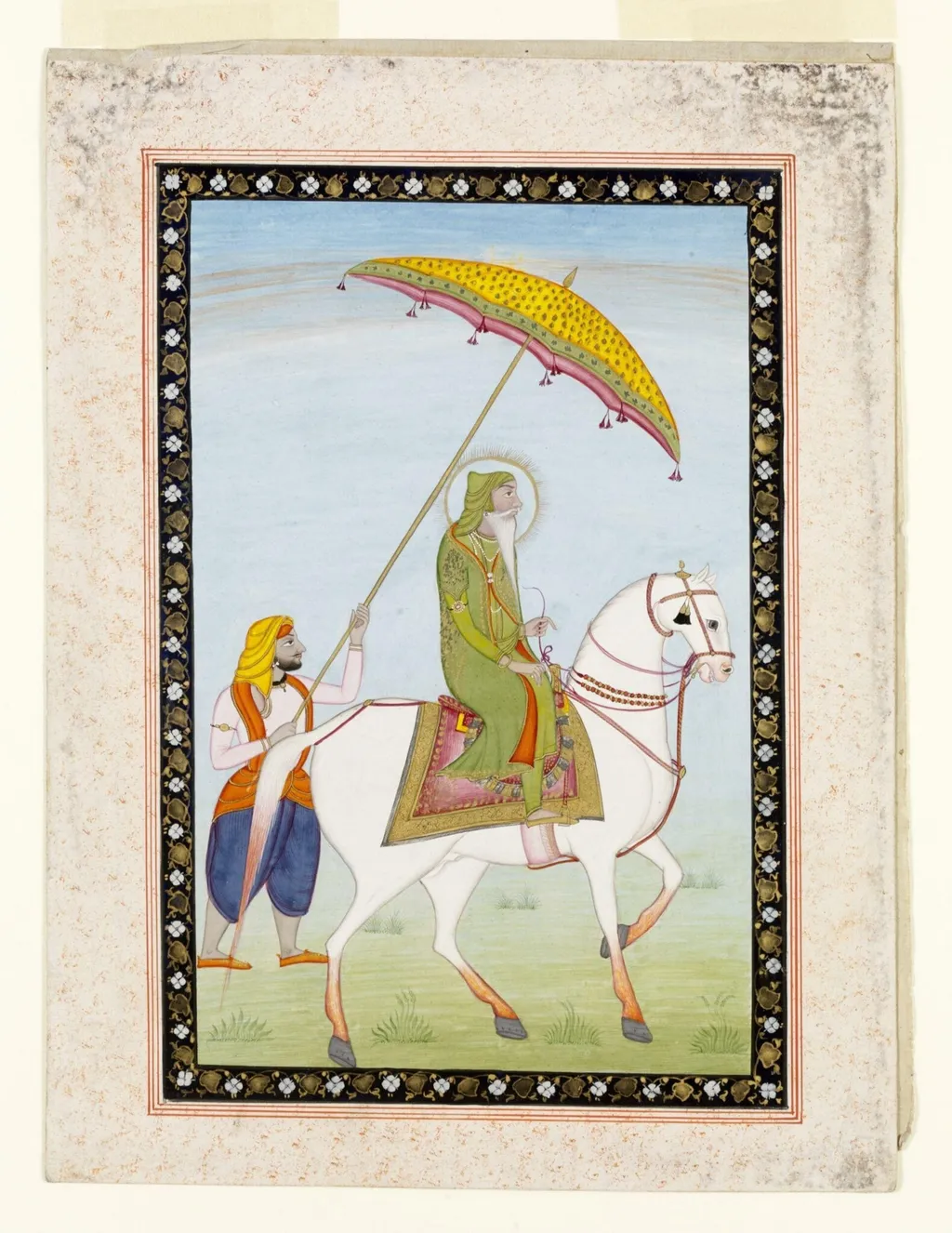
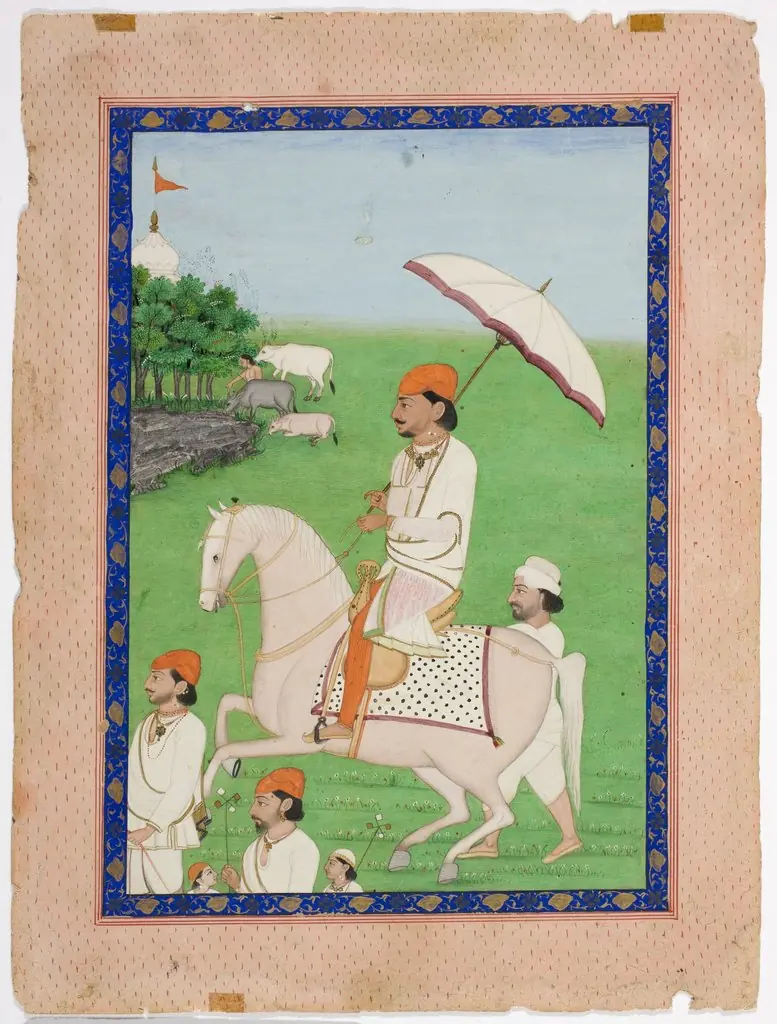
Ranjit Singh is a paint painting by the Patna School of Painting artist Unknown. It dates from 1838 and is held in the collection of the Victoria and Albert Museum.
About this work
Overview
The painting depicts Maharaja Ranjit Singh, the inaugural ruler of the Sikh Empire in the Punjab, rendered in a formal portrait style typical of early 19th‑century Indian court art. Executed around 1838, the work arrived in England with Lord Auckland, the British Governor‑General of India, and entered the Victoria and Albert Museum collection in 1953 through a donation by his great‑nephew O.E. Dickinson.
Subject & Meaning
Ranjit Singh is presented in profile, a compositional choice that conceals his left eye, which had been lost to smallpox in childhood and left his skin scarred. The portrait employs conventional symbols of sovereignty—a luminous halo and a parasol held aloft by an attendant—to affirm his regal authority within the visual language inherited from Mughal court painting.
Technique & Style
The artist adopts Mughal-inspired conventions, employing delicate brushwork and a restrained palette to render the Maharaja’s features and attire. The halo, rendered in subtle gold tones, and the finely detailed parasol contribute to a sense of ceremonial gravitas, while the profile view emphasizes the subject’s dignified bearing.
History & Provenance
The work is believed to have been created during Lord Auckland’s 1838 visit to the Sikh court, a period when diplomatic exchanges often included the gifting of portraiture. After returning to Britain, Auckland retained the painting until it passed to his descendant O.E. Dickinson, who presented it to the V&A in 1953.
Artist & collection

 Domestic Scene
 Giacomo and Cardinal Marco, investing Andrea, Abbot of San Zeno, with his Benefice
 The Nymph of Fontainebleau
 Portrait of a Woman
 Madonna and Child with Saints in the Enclosed Garden
 Venus and Minerva
 Family Group of Four on Sofa
 Wall painting from Room H of the Villa of P. Fannius Synistor at Boscoreale