Artwork
Rao Bikoji
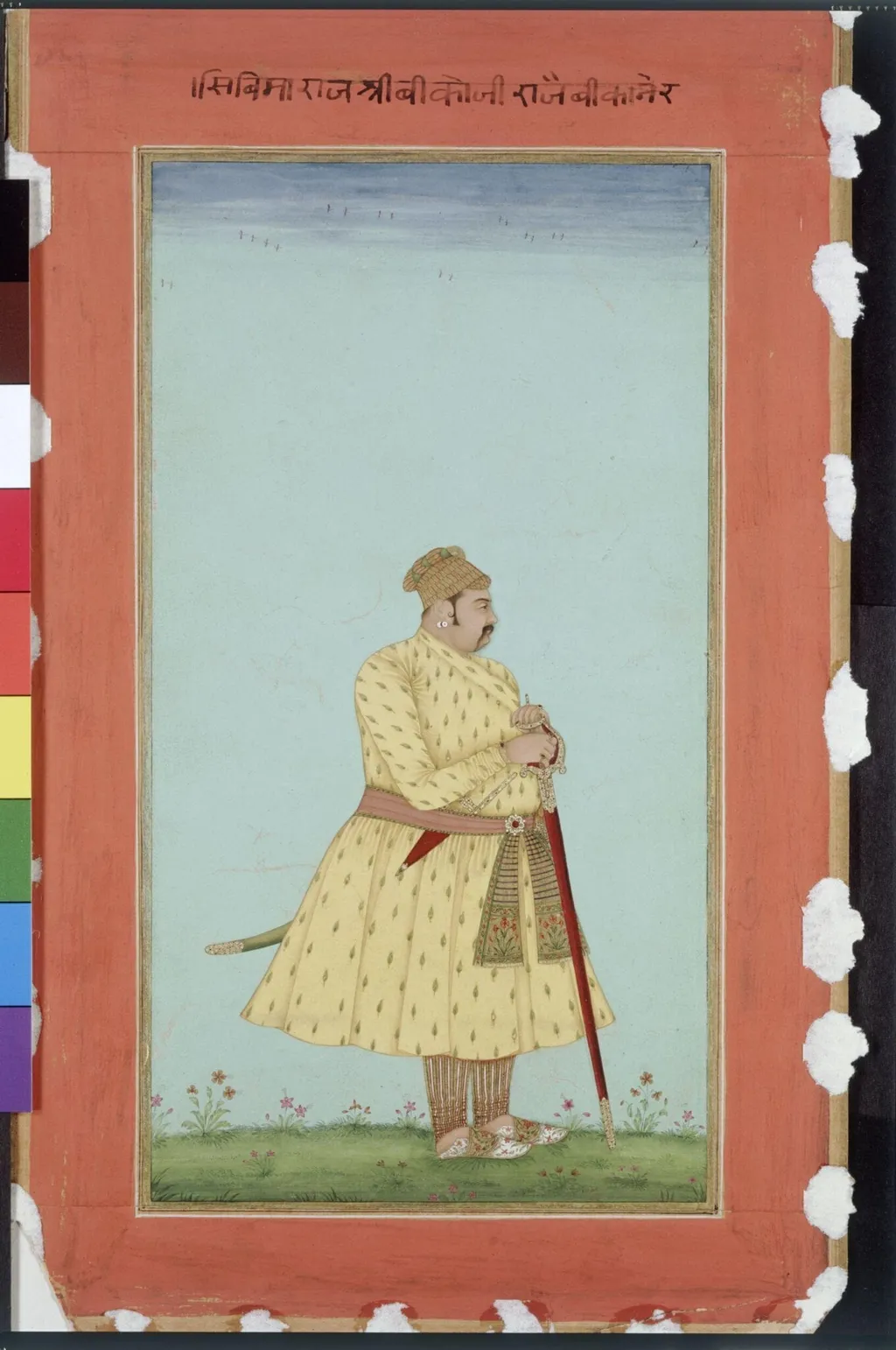
Rao Bikoji is a paint painting by Unknown. It dates from 1850 and is held in the collection of the Victoria and Albert Museum.
About this work
Overview
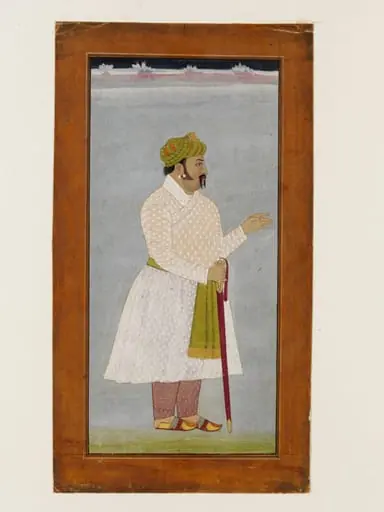
This portrait depicts Rao Bikoji, a 15th-century ruler of Bikaner, rendered in opaque watercolour and gold on paper.
This portrait depicts Rao Bikoji, a 15th-century ruler of Bikaner, rendered in opaque watercolour and gold on paper. The composition emphasizes his regal bearing through formal posture and rich adornment. Executed with precision, the work reflects the courtly painting traditions of western India, where status was conveyed through detailed costume and symbolic objects rather than naturalistic settings.
Subject & Meaning
Rao Bikoji is shown standing calmly, one hand resting on his chest and the other holding a ceremonial staff. His posture suggests authority tempered by composure. The elaborate yellow jama, gold embroidery, and ornate headgear signify his rank and wealth. The inclusion of flowers beneath his feet and the plain blue sky frame him as a figure of stability and sovereignty, reinforcing his role as a legitimate and dignified ruler.
Technique & Style
The painting employs fine brushwork in opaque watercolour, with gold leaf used to highlight fabric patterns, jewellery, and trim. The flat, decorative background and lack of perspective align with regional manuscript traditions. Details like the intricate embroidery on the robe and the texture of the hat demonstrate a focus on surface ornamentation, typical of Rajasthani court art, where visual richness conveyed social hierarchy.
History & Provenance
The painting entered a museum collection in 1912 through acquisition from J. Procter Watson of Bombay, as documented under reference R.P. 1912-5260M. Its prior ownership history is not recorded, but its style and materials suggest it originated in the Bikaner court workshop during or shortly after Rao Bikoji’s lifetime. The red border with inscriptions in an Indic script further anchors it to a specific regional and temporal context.
Context
Created during the early phase of Bikaner’s emergence as a distinct princely state, this portrait reflects the consolidation of local identity under Rajput rulers. Similar works from the period were produced for courtly display, often accompanying genealogical records or ceremonial texts. The emphasis on attire over landscape or narrative situates it within a tradition of portraiture focused on lineage and legitimacy rather than personal biography.
Legacy
This portrait exemplifies the continuity of Rajasthani painting traditions that persisted into the early modern period. Though not widely known outside specialist circles, it contributes to the broader understanding of how regional courts used visual culture to assert authority. Comparable works can be found in institutions such as the Victoria and Albert Museum, where similar stylistic approaches are preserved across multiple collections.
Artist & collection

 Domestic Scene
 Giacomo and Cardinal Marco, investing Andrea, Abbot of San Zeno, with his Benefice
 The Nymph of Fontainebleau
 Portrait of a Woman
 Madonna and Child with Saints in the Enclosed Garden
 Venus and Minerva
 Family Group of Four on Sofa
 Wall painting from Room H of the Villa of P. Fannius Synistor at Boscoreale