Artwork
Rape of Deianeira
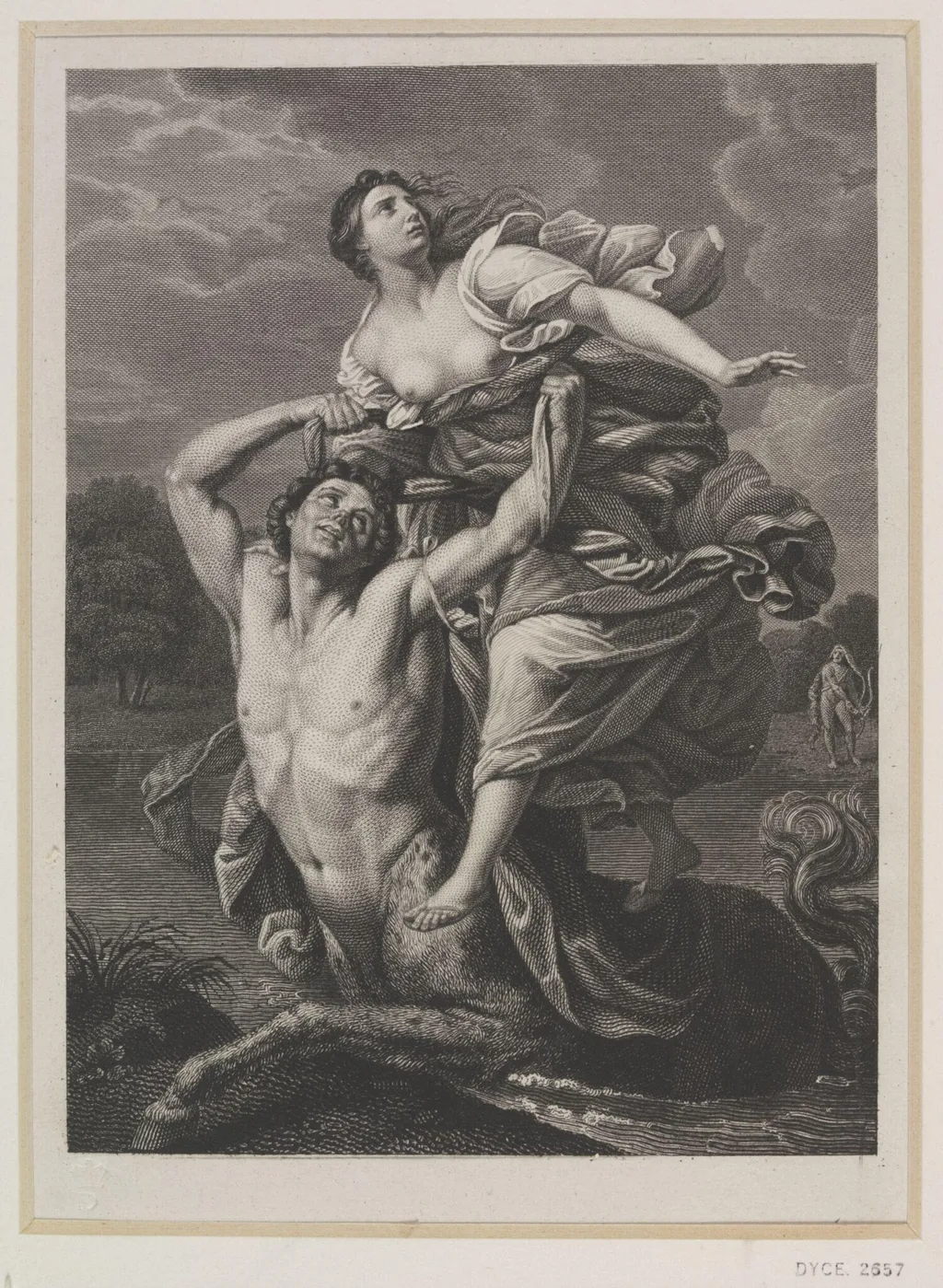
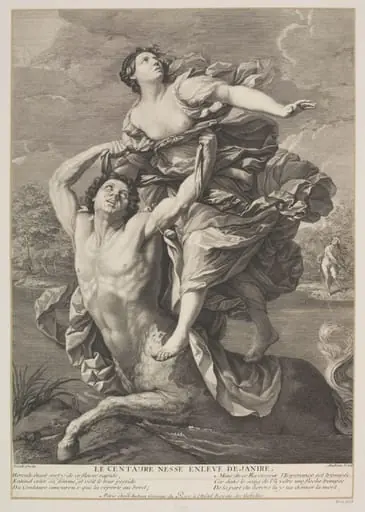
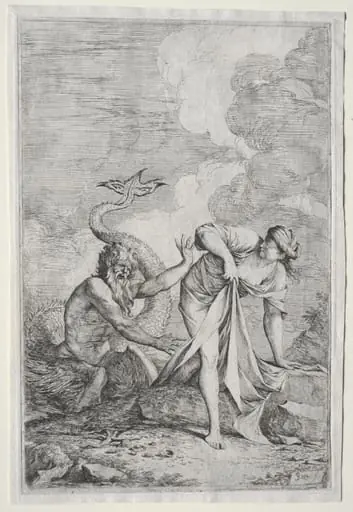
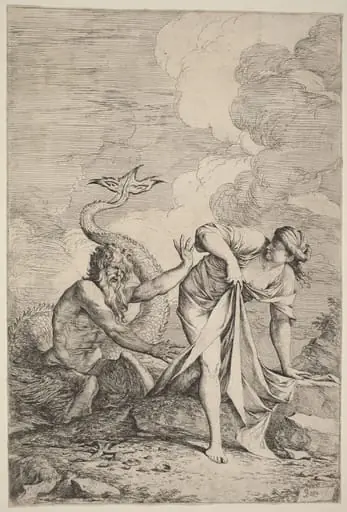
Rape of Deianeira is a print by Unknown. It dates from 1850 and is held in the collection of the Victoria and Albert Museum. This 1850 print is a reproductive engraving by Bervic, translating Guido Reni’s earlier painted composition into monochrome.
About this work
Overview
This 1850 print is a reproductive engraving by Bervic, translating Guido Reni’s earlier painted composition into monochrome. Executed on paper, it captures a moment from Greek myth in which the centaur Nessus carries off Deianeira. The work reflects 19th-century practices of disseminating classical imagery through print, making high art accessible beyond elite collections.
Subject & Meaning
The scene illustrates the abduction of Deianeira by the centaur Nessus, a pivotal moment preceding her tragic fate in the myth of Heracles.
The scene illustrates the abduction of Deianeira by the centaur Nessus, a pivotal moment preceding her tragic fate in the myth of Heracles. Her strained posture and the centaur’s forceful stride convey resistance and violence. The contrast between her vulnerability and his primal energy underscores themes of power, fate, and the perilous intersection of human and wild forces in classical narrative.
Technique & Style
Bervic employed fine-line engraving to render texture and motion, emphasizing the drapery of Deianeira’s robe and the musculature of the centaur. Subtle tonal gradations suggest chiaroscuro, though without the dramatic lighting of Reni’s original. The background landscape is rendered with restrained detail, allowing the central figures to dominate the composition through line and posture.
History & Provenance
The print emerged in mid-19th-century Britain during a surge of interest in classical subjects and reproductive engraving. Bervic, known for translating Old Master paintings into prints, likely produced this for collectors and academies. Its survival suggests it was part of a broader circulation of artistic imagery, though its specific provenance remains undocumented beyond its date and maker.
Context
This print belongs to a tradition of reproductive engravings that made Renaissance and Baroque compositions available to a wider public. In an era before photography, such prints served as educational tools and aesthetic references. The choice of Reni’s subject reflects enduring fascination with mythological drama and the idealized human form in 19th-century visual culture.
Legacy
Though not an original work, the print preserves Reni’s compositional structure for later study and reproduction. It exemplifies how classical narratives were mechanically transmitted across generations, influencing public perception of myth. Today, it stands as a historical artifact of print culture, documenting the mechanisms by which art was shared before modern reproduction technologies.
Artist & collection

 Domestic Scene
 Giacomo and Cardinal Marco, investing Andrea, Abbot of San Zeno, with his Benefice
 The Nymph of Fontainebleau
 Portrait of a Woman
 Madonna and Child with Saints in the Enclosed Garden
 Venus and Minerva
 Family Group of Four on Sofa
 Wall painting from Room H of the Villa of P. Fannius Synistor at Boscoreale