Artwork
Sânta Paraschiva
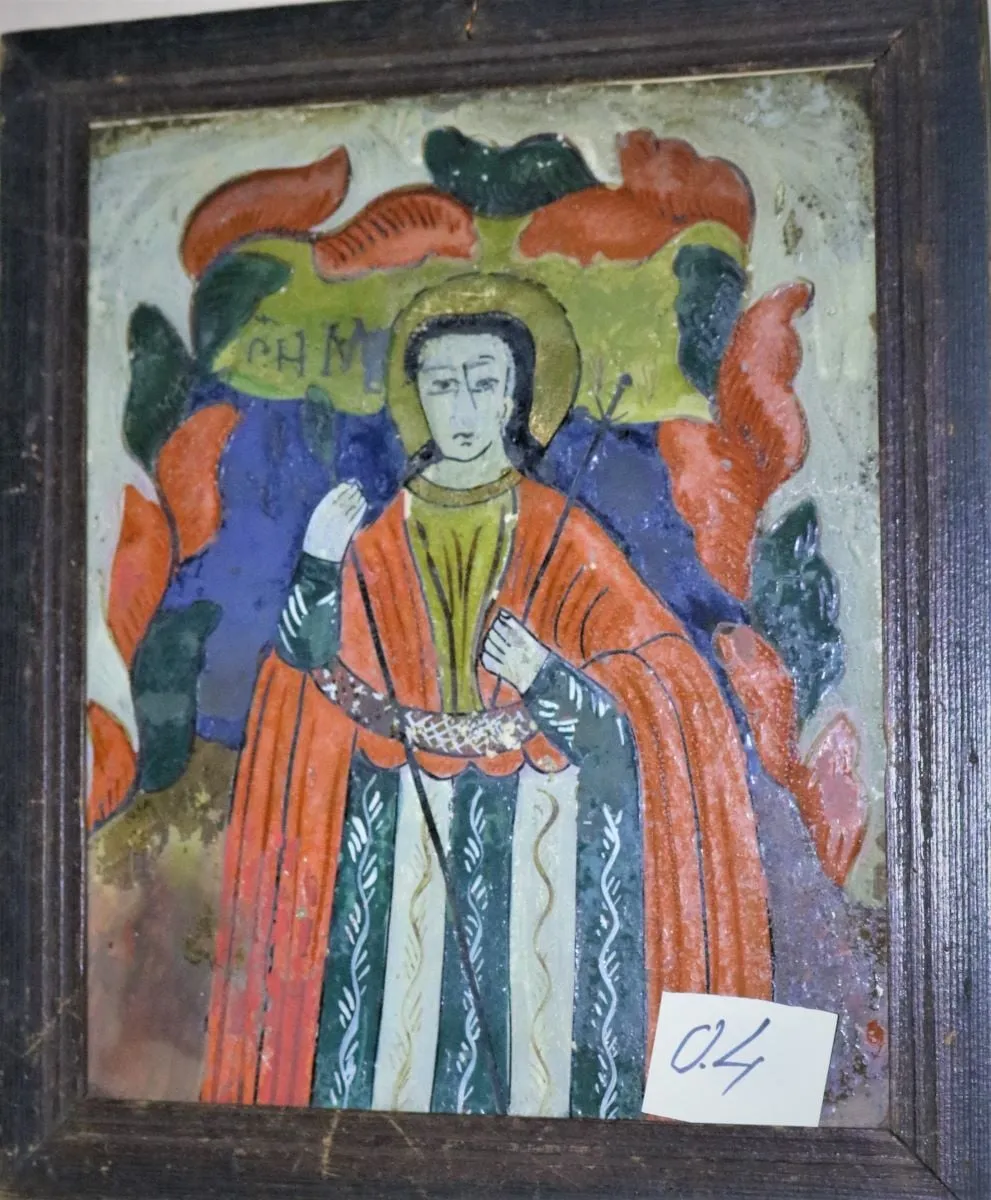
Sânta Paraschiva is a drawing by Unknown. It dates from 1850 and is held in the collection of the Maramureș Ethnography and Folk Art County Museum. This painted image depicts a single religious figure standing against an unadorned background.
About this work
Overview
This painted image depicts a single religious figure standing against an unadorned background. The figure is rendered with minimal modeling, using flat, unmodulated colors and linear outlines that suggest a stylized, non-naturalistic approach. The surface shows signs of age, with visible wear along the edges, indicating prolonged use or exposure.
Subject & Meaning
The central figure is identified as Sânta Paraschiva, a Christian saint venerated in Eastern Orthodox traditions. She holds a small book, symbolizing divine wisdom or scripture. The winged forms above her, marked with the letters 'CHM,' likely represent celestial attendants or symbolic initials tied to her name or devotion, reinforcing her spiritual authority.
Technique & Style
The painting employs a deliberate lack of shading and perspective, relying on bold, flat areas of color—blue, gold, green—to define form. Lines are simplified and sketch-like, particularly in the hands and folds of the robe. This aesthetic aligns with folk or devotional traditions that prioritize symbolic clarity over illusionistic depth.
History & Provenance
The work’s worn edges and stylistic features suggest it was created for private or communal veneration, possibly in a rural Orthodox setting. Its preservation implies continued ritual use, though its exact origin and maker remain undocumented. The presence of the 'CHM' inscription may link it to a specific regional liturgical practice.
Context
This image reflects a broader tradition of Eastern European icon painting that blends religious symbolism with local artistic conventions. Unlike formal church icons, it lacks elaborate gold leaf or intricate detail, pointing to a more modest, possibly homemade or itinerant production context, common among lay devotees.
Legacy
The painting’s simplified forms and symbolic language connect it to enduring folk religious art practices. While not part of the academic canon, it contributes to understanding how sacred imagery was adapted outside institutional settings, preserving devotion through accessible visual language.
Artist & collection
Museum
Maramureș Ethnography and Folk Art County Museum
Continue through works from the same source collection.
 Domestic Scene
 Giacomo and Cardinal Marco, investing Andrea, Abbot of San Zeno, with his Benefice
 The Nymph of Fontainebleau
 Portrait of a Woman
 Madonna and Child with Saints in the Enclosed Garden
 Venus and Minerva
 Family Group of Four on Sofa
 Wall painting from Room H of the Villa of P. Fannius Synistor at Boscoreale
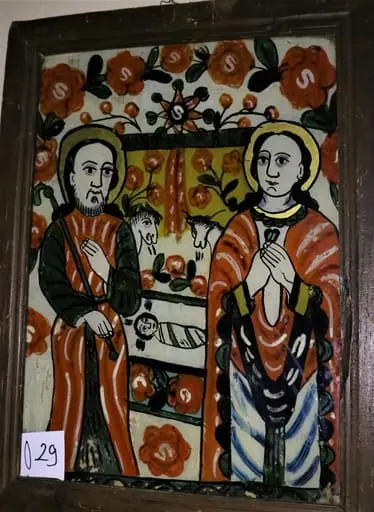 Nașterea
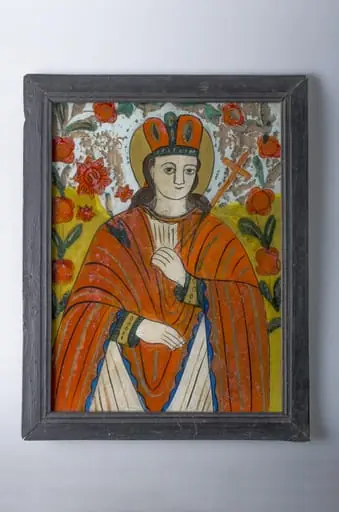 Icoana este pictată pe sticlă, având forma dreptunghiulară. Tema: Sfânta Paraschiva este reprezentată tânără, în veșmântul călugăresc al Sfintelor Cuvioase, purtând în mâna dreaptă crucea și în mâna stângă ramura de palmier. Pe fundalul galben și albastru avem două decoruri vegetale (lujeri cu flori) care completează compoziția. Cromatica: roșu; alb; negru; albastru; verde; galben. Pe spate icoana are o întăritură din lemn pentru protecția sticlei și o agățătoare din sârmă.
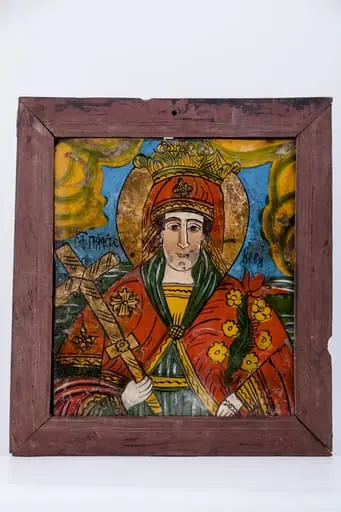 Sfânta Mare Cuvioasă Parascheva de la Iași are crucea în mâna dreaptă și ramură înflorită, cu 6 flori galbene și una roșie în vârf în mâna stângă. Este îmbrăcată în veșmânt roșu vermillon, cu interiorul căptușit cu verde și galben. Peste maforionul roșu, sfânta cuvioasă are aureolă. Fondul icoanei este cerul albastru regal, cu o arcadă de lumină galbenă, în registrul superior și bronziu, în jurul chipului și aureolei Sfintei Paraschiva și o alternanță de câmpuri verzi, dispuse paralel, în registrul mediu și inferior. Este o icoană cu aer cald, tomnatic, de octombrie 14, Praznicul Sfintei Cuvioase Parascheva. Inscripția din româno-chirilică se traduce Sf Paraschiva. Cromatica este armonioasă: roșu vermillon, albastru regal, verde văratic și forest, brun-cafeniu, negru, galben chihlimbar, ocru, bronziu, gri, negru, alb. Icoana este din Țara Oltului.
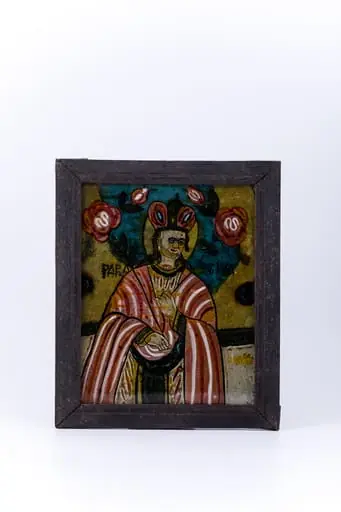 Sfânta Mare Cuvioasă Parascheva de la Iași are crucea brun-neagră în mâna stângă, binecuvântând, și o ramură de finic verde, nuanța de brad în mâna dreaptă. Este îmbrăcată în veșmânt roșu vermillon-trandafiriu cu dungi albe, cu interiorul căptușit cu verde-mușchi de pădure și modele galbene. Sacosul este alb-crem cu danteluță, guleraș și dungi galbene. Sfânta Cuvioasă are părul negru lung, lăsat pe umeri, coroană roșie cu verde-brad și aureolă brun-bronzie. Fondul icoanei este cerul albastru cobalt în registrul superior-mijloc și un câmp crem-galben, ancadrator întregii compoziții. Întreaga compoziție iconografică este încadrată de un chenar decorativ fitomorf, format dintr-o ghirlandă de 2 ruje mari roșii vermillon, 2 boboci de măceș, cu frunze verzi. În registrul inferior este un spațiu crem-nisipiu, sable. Inscripția din româno-chirilică se traduce Paraschiva. Cromatica este armonioasă: roșu vermillon-trandafiriu, albastru cobalt-ceruleum, verde brad, mușchi de pădure, bej-crem, bronziu, galben-solar, negru, alb zinc. Icoana este din Nordul Transilvaniei, Nicula.
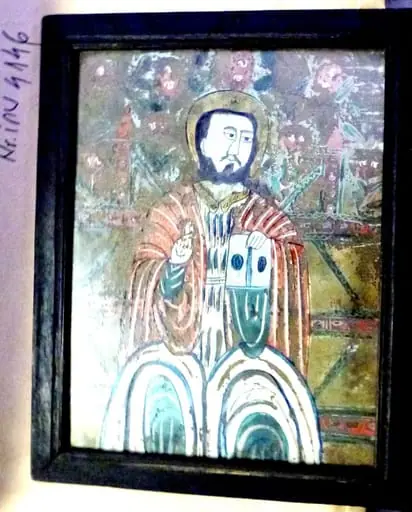 Isus invatator
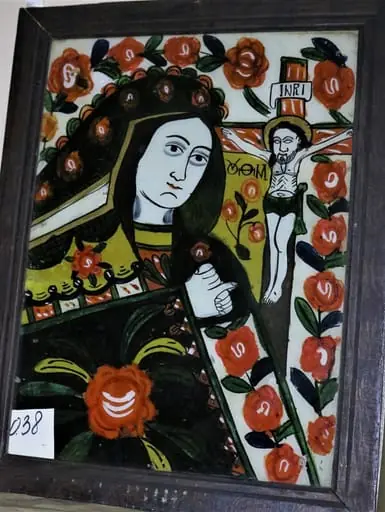 Maria Îndurerată
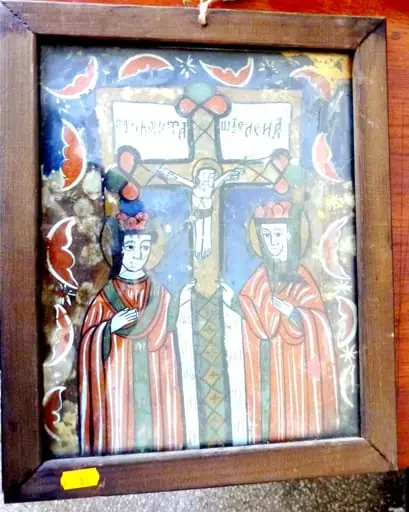 lada de haine
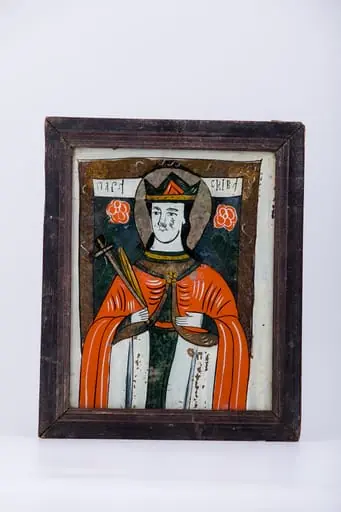 Sfânta Mare Cuvioasă Parascheva de la Iași are crucea brun-bronzie și o ramură de finic galbenă în mâna dreaptă. Este îmbrăcată în veșmânt roșu vermillon, cu interiorul căptușit cu albastru-gri-antracit și brun-bronziu. Sacosul este alb-zinc cu danteluță și guleraș verde-galben. Sfânta Cuvioasă are părul negru lung, lăsat pe umeri, coroană roșie cu verde-brad și aureolă. Fondul icoanei este cerul albastru ultramarin bleu-marin întunecat. Întreaga compoziție iconografică este încadrată de un chenar decorativ geomatrizant brun-bronziu, cu linia șerpuitoare, specifică centrului de la Nicula. Fondul de ansamblu al icoanei este alb-zinc. Inscripția din româno-chirilică se traduce Paraschiva. Cromatica este armonioasă: roșu vermillon, albastru ultramarin bleumarin, verde forest, bej-crem, bronziu, negru, alb zinc. Icoana este din Nordul Transilvaniei, Nicula.