Artwork
Saraswati
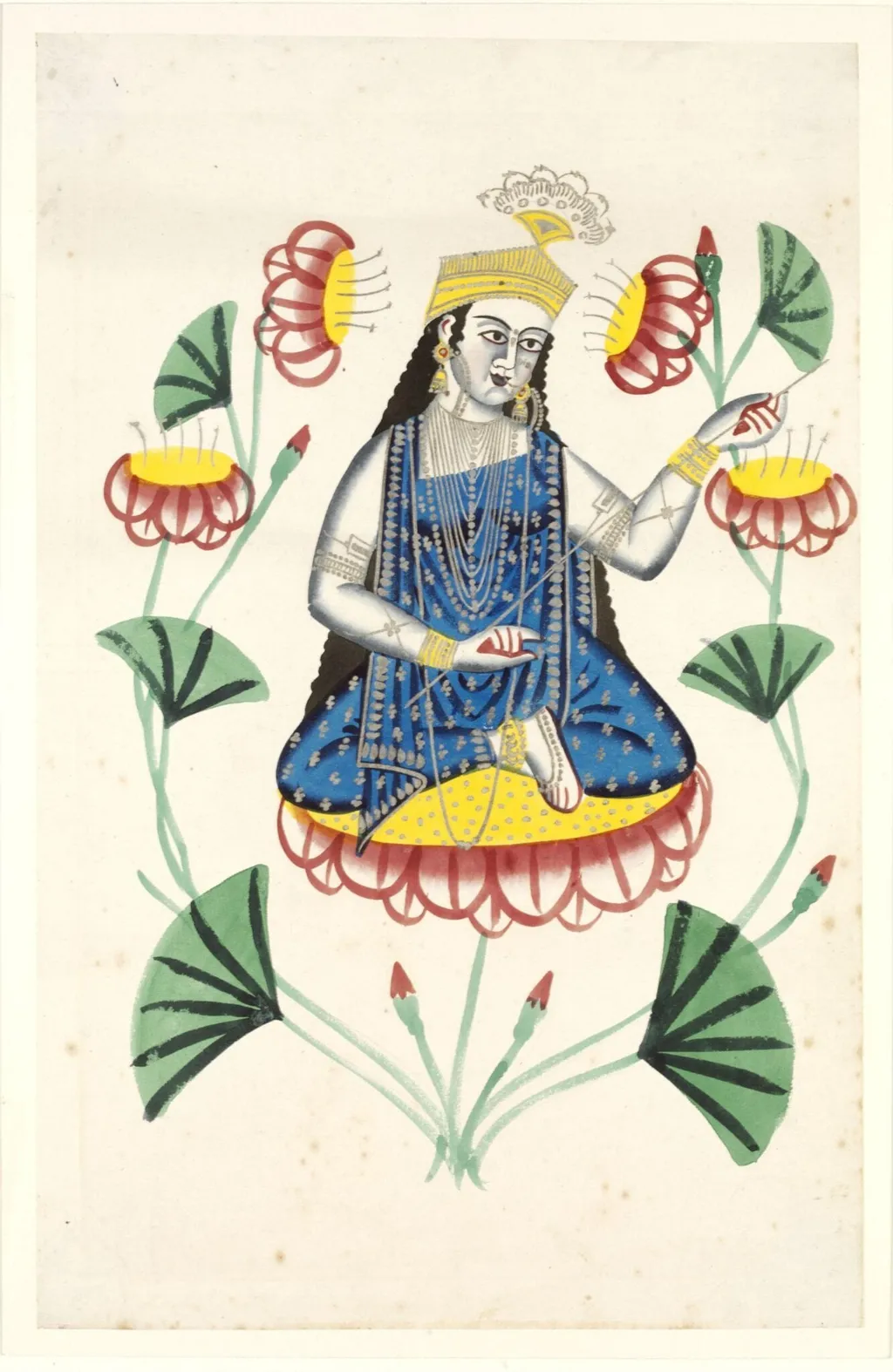
Saraswati is a paint painting by the Romanticist artist Unknown. It dates from 1830 and is held in the collection of the Victoria and Albert Museum.
About this work
Overview
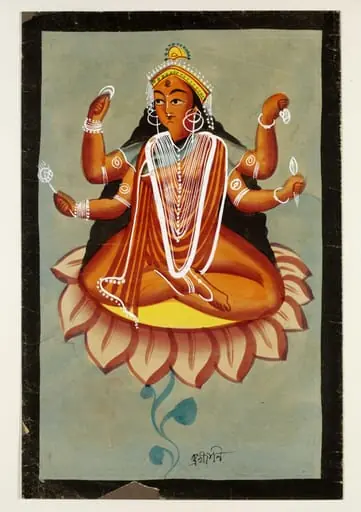
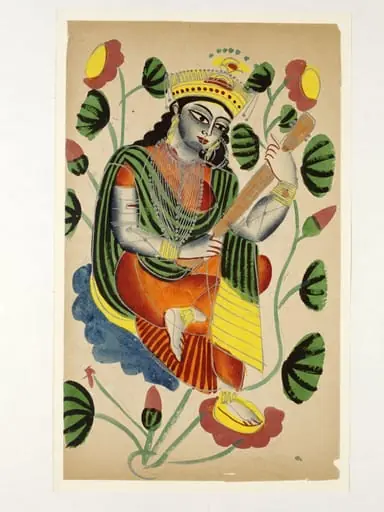
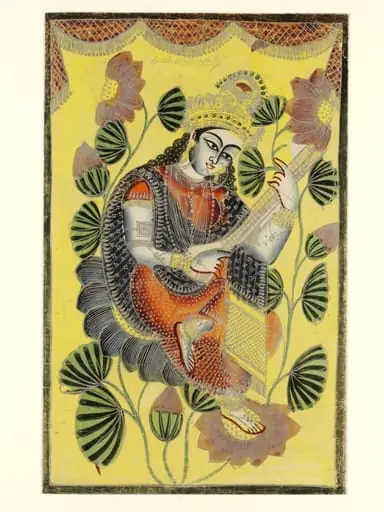
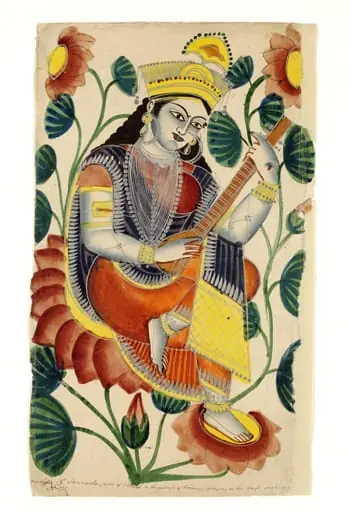
The work is an early nineteenth‑century painting portraying the Hindu deity Saraswati, goddess of learning and the arts. Rendered in opaque watercolour on paper, the figure sits cross‑legged upon a red lotus, surrounded by additional blooming lotuses and verdant stems. The composition is framed by vivid pink and yellow flowers, creating a decorative, flattened visual field.
Subject & Meaning
Saraswati is shown in a calm pose, her dark hair modestly adorned, wearing a blue salwaar‑kameez with gold trim and a yellow skirt, complemented by a gold headpiece. In her hands she holds a yellow book and a stringed instrument, symbols of knowledge and music, while a long silver‑toned stem rests diagonally across her lap, an atypical attribute whose significance remains uncertain.
Technique & Style
The artist employed opaque watercolour on paper, applying bold, flat washes of colour without modelling or chiaroscuro.
The artist employed opaque watercolour on paper, applying bold, flat washes of colour without modelling or chiaroscuro. This approach yields a graphic quality, emphasizing pattern over three‑dimensional illusion. The palette—rich blues, golds, reds, and bright florals—creates a striking visual contrast, while the lack of shading aligns the piece with decorative traditions rather than realistic portraiture.
History & Provenance
Created around 1830, the painting reflects a period when Indian religious iconography was being recorded for colonial audiences. Though the artist’s identity is unknown, the work entered the collection of the Victoria and Albert Museum, where it is catalogued among other South Asian devotional images, providing insight into cross‑cultural artistic exchange of the era.
Artist & collection

 Domestic Scene
 Giacomo and Cardinal Marco, investing Andrea, Abbot of San Zeno, with his Benefice
 The Nymph of Fontainebleau
 Portrait of a Woman
 Madonna and Child with Saints in the Enclosed Garden
 Venus and Minerva
 Family Group of Four on Sofa
 Wall painting from Room H of the Villa of P. Fannius Synistor at Boscoreale