Artwork
Saraswati
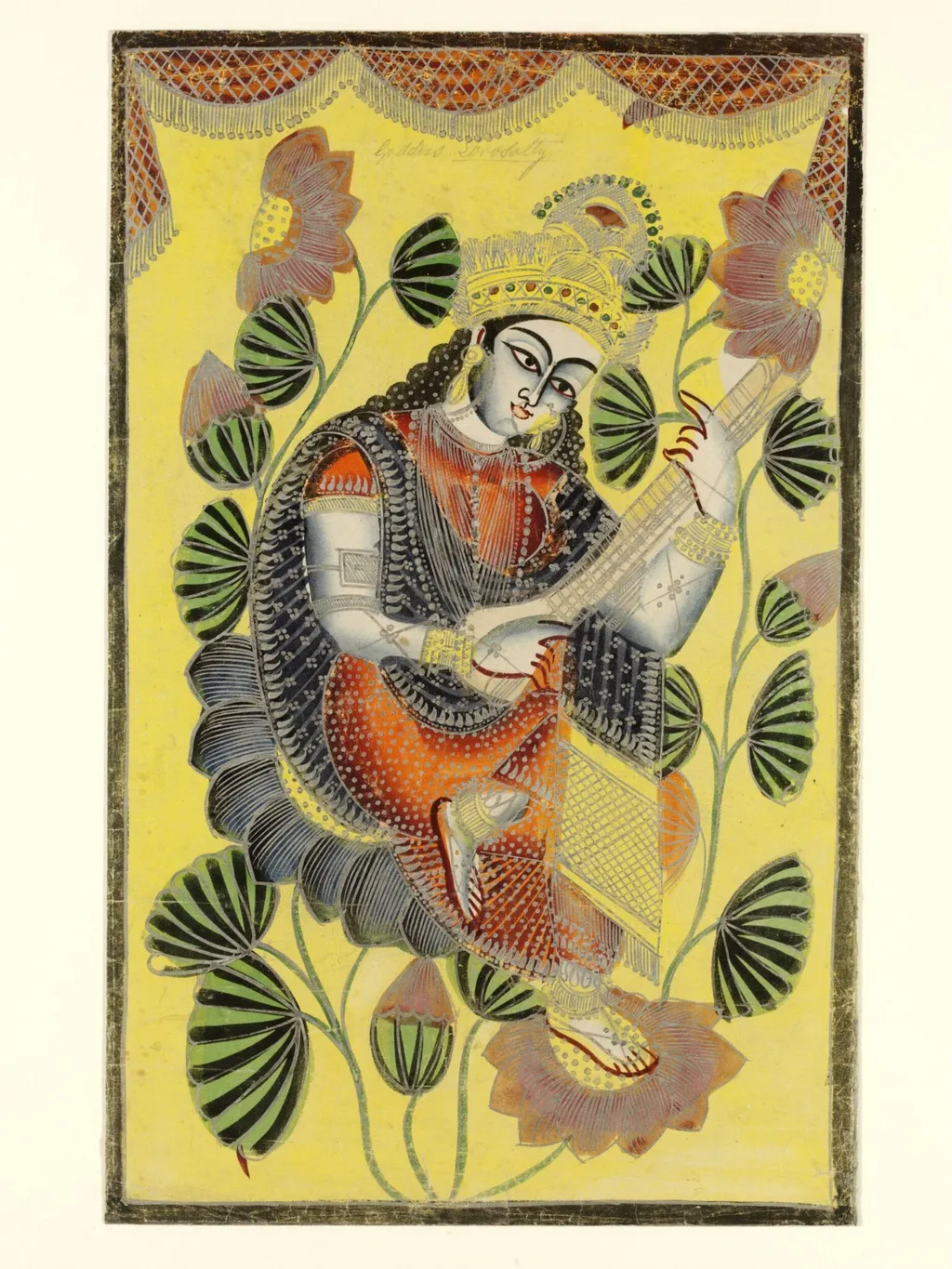
Saraswati is a paint painting by the Impressionist artist Unknown. It dates from 1860 and is held in the collection of the Victoria and Albert Museum.
About this work
Overview
The use of metallic detailing on her garments is characteristic of Kalighat workshops, where affordability and visual impact guided material choices.
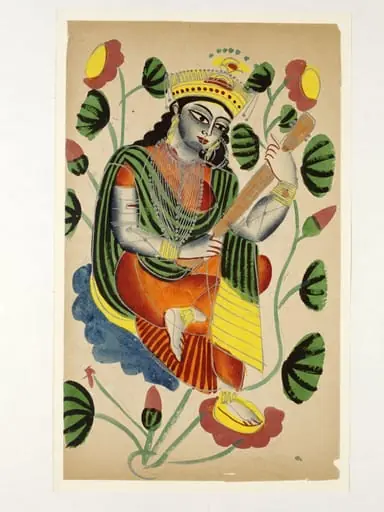
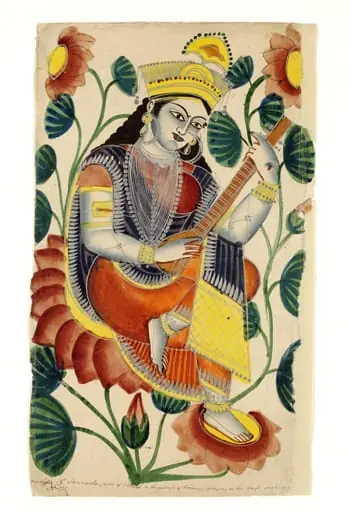
This painting portrays the Hindu goddess Saraswati, depicted in the Kalighat style that emerged in 19th-century Calcutta. Executed in opaque watercolour with tin alloy accents on paper, it reflects the commercial art traditions of the period. The composition centers on the deity seated amid floral motifs, rendered with bold outlines and flat, saturated hues. The use of metallic detailing on her garments is characteristic of Kalighat workshops, where affordability and visual impact guided material choices.
Subject & Meaning
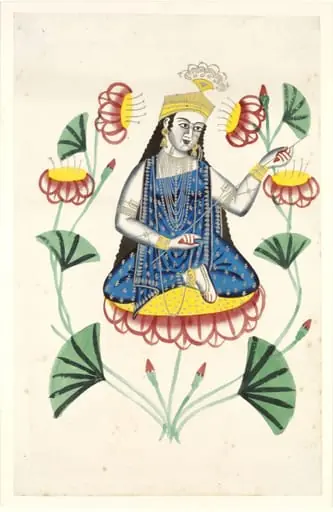
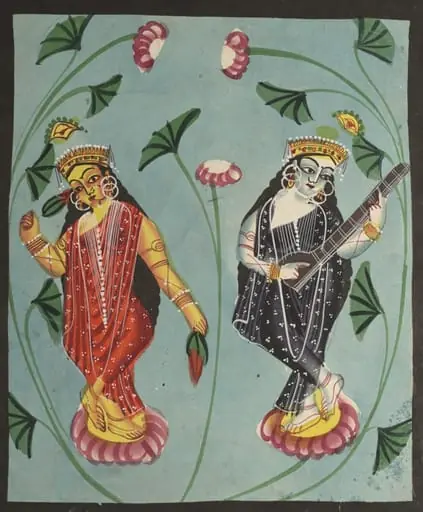
Saraswati, the goddess of knowledge, music, and the arts, is shown seated on a lotus, symbolizing purity and spiritual insight. She holds a vina, an instrument representing harmony and creative expression. Her calm demeanor and the surrounding blossoms reinforce themes of intellectual serenity. Though traditionally associated with Brahma, her iconography here aligns with popular 19th-century devotional imagery, emphasizing accessibility and cultural resonance over theological precision.
Technique & Style
The artist employed swift, confident brushwork to define forms with minimal detail, a hallmark of Kalighat painting. Flat areas of vivid red, orange, and gold dominate the figure’s attire, while the background is a uniform yellow, enhancing contrast. Tin alloy was applied as fine dots and lines to simulate embroidery, adding luminosity without costly materials. Flowers are rendered with dense, stylized patterns in black, red, and green, contributing rhythmic energy to the composition.
History & Provenance
Created in Calcutta during the 1800s, this work likely originated in a Kalighat bazaar studio catering to pilgrims and urban patrons. These paintings were mass-produced on inexpensive paper, often sold as devotional objects or souvenirs. The integration of metallic pigments suggests a workshop familiar with both traditional iconography and evolving consumer tastes. Its survival reflects the durability of the medium and continued interest in Hindu deities among collectors.
Context
Kalighat paintings arose near the Kalighat temple in Calcutta, responding to the influx of pilgrims and the rise of urban middle-class culture. Artists adapted classical Hindu iconography into simplified, eye-catching formats suitable for reproduction. This piece reflects a moment when religious imagery intersected with commercial art, blending spiritual symbolism with aesthetic trends shaped by colonial urban life and emerging print culture.
Legacy
The Kalighat style influenced later Indian modernist movements by demonstrating how traditional subjects could be reimagined through bold, graphic means. Though initially dismissed as folk art, these works are now recognized for their visual economy and cultural insight. This painting contributes to a broader understanding of how devotional imagery evolved in response to social change, preserving religious themes through accessible, everyday art forms.
Artist & collection

 Domestic Scene
 Giacomo and Cardinal Marco, investing Andrea, Abbot of San Zeno, with his Benefice
 The Nymph of Fontainebleau
 Portrait of a Woman
 Madonna and Child with Saints in the Enclosed Garden
 Venus and Minerva
 Family Group of Four on Sofa
 Wall painting from Room H of the Villa of P. Fannius Synistor at Boscoreale