Artwork
Sarasvati, the goddess of learning, speech and music
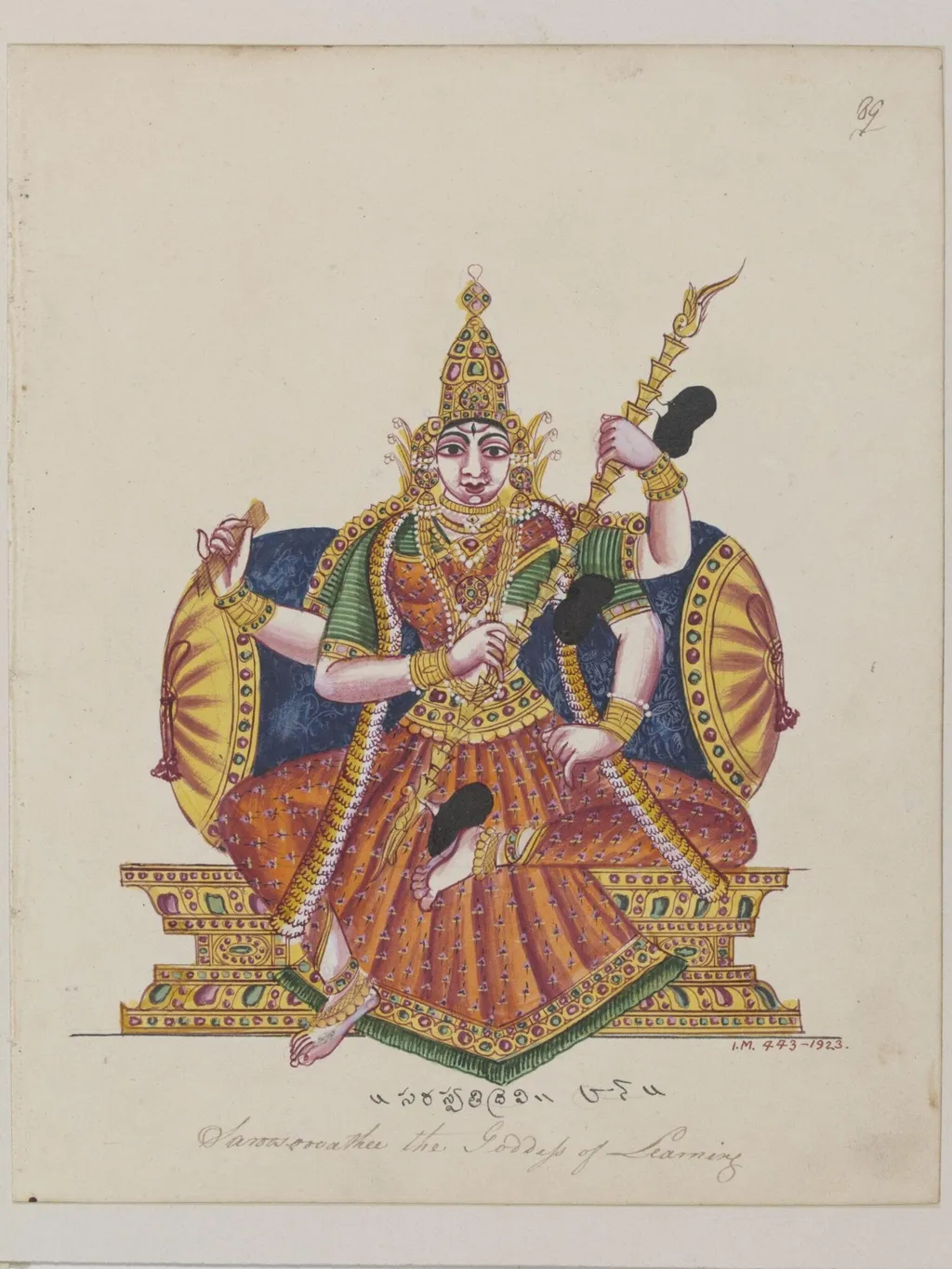
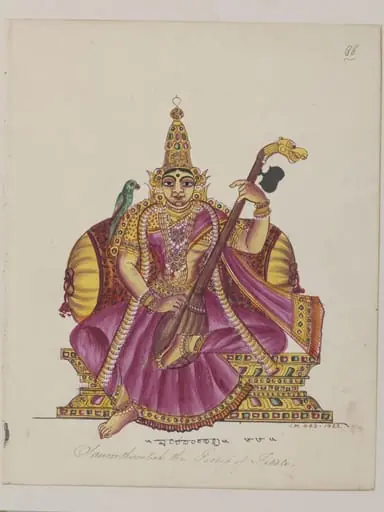
Sarasvati, the goddess of learning, speech and music is a paint painting by the Romanticist artist Unknown. It dates from 1825 and is held in the collection of the Victoria and Albert Museum. This early nineteenth‑century South Indian painting is one of a hundred illustrations of Hindu deities produced in 1825.
About this work
Overview
This early nineteenth‑century South Indian painting is one of a hundred illustrations of Hindu deities produced in 1825. It depicts the goddess Sarasvati, traditionally associated with learning, speech and music, seated on an elaborately carved throne. The composition balances vibrant hues and intricate detailing, presenting the deity in a richly adorned setting.
Subject & Meaning
Sarasvati is shown holding a rudra vina, a stringed instrument linked to divine music, and a palm‑leaf manuscript, symbols of knowledge and artistic expression. The presence of a drum and a small object in her other hand reinforces her role as patron of the arts and spoken word, embodying the convergence of scholarly and musical pursuits.
Technique & Style
The work employs fine line drawing and dense ornamental patterns reminiscent of textile embroidery. A palette of bright reds, golds and greens accentuates the figure’s garments, while heavy jewelry and a towering, jewel‑set crown convey regal authority. The gilded staff and book are rendered with precise brushwork, highlighting the artist’s skill in rendering material texture.
History & Provenance
Created as part of a commissioned series of one hundred deity portraits in 1825, the painting reflects a period of heightened interest in documenting Hindu iconography for both local and colonial audiences. Its provenance traces back to South Indian workshops before entering museum collections, where it now serves as a reference for nineteenth‑century devotional art.
Context
Such works contributed to the broader visual culture that informed both Indian and European understandings of Hindu deities.
The depiction aligns with contemporary devotional practices that emphasized visual representations of divine attributes. By integrating musical instruments and literary symbols, the image illustrates the integrated nature of worship, where art, music, and scholarship were seen as pathways to the divine. Such works contributed to the broader visual culture that informed both Indian and European understandings of Hindu deities.
Artist & collection

 Domestic Scene
 Giacomo and Cardinal Marco, investing Andrea, Abbot of San Zeno, with his Benefice
 The Nymph of Fontainebleau
 Portrait of a Woman
 Madonna and Child with Saints in the Enclosed Garden
 Venus and Minerva
 Family Group of Four on Sofa
 Wall painting from Room H of the Villa of P. Fannius Synistor at Boscoreale