Artwork
Sfânta Treime (Sfânta Troiță, Filoxenia, Cina de la Mamvri)
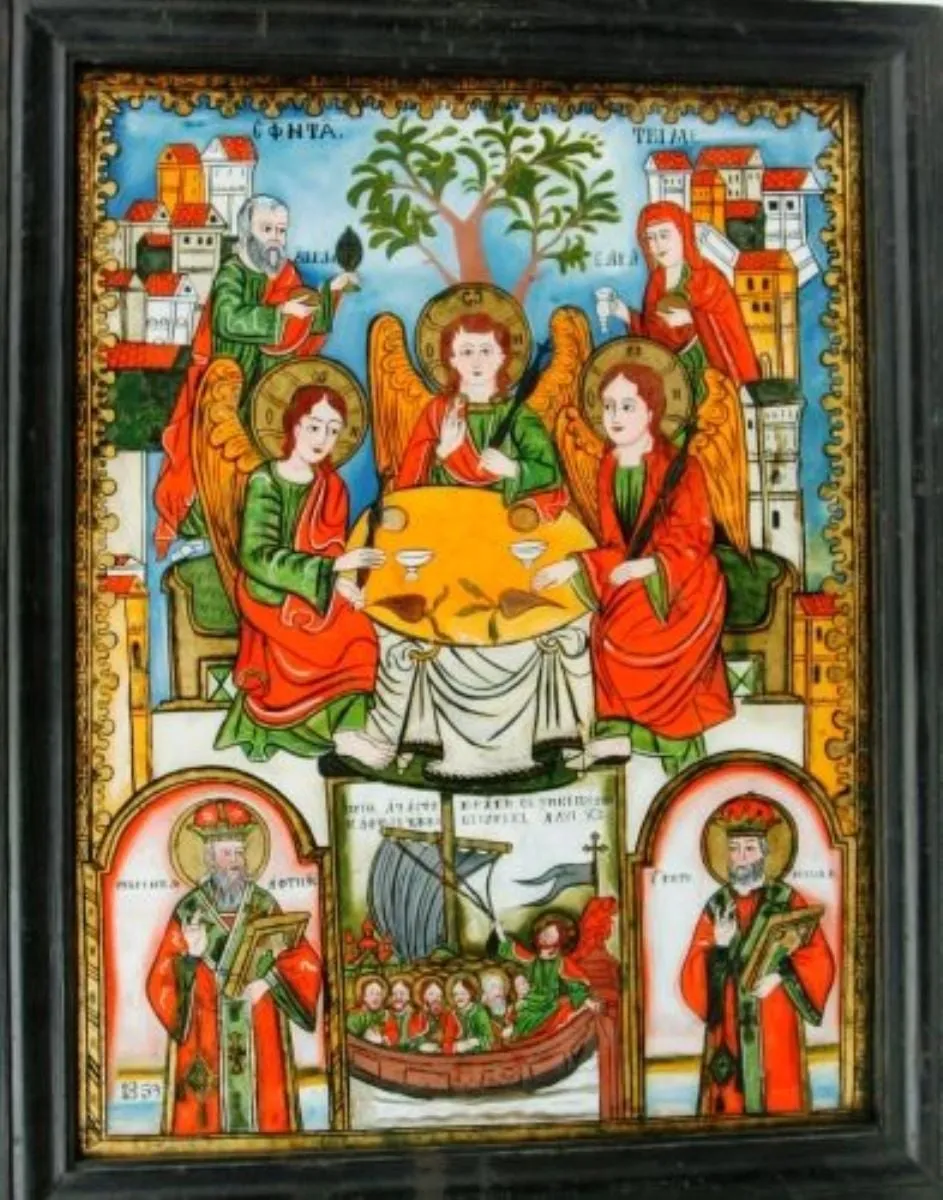
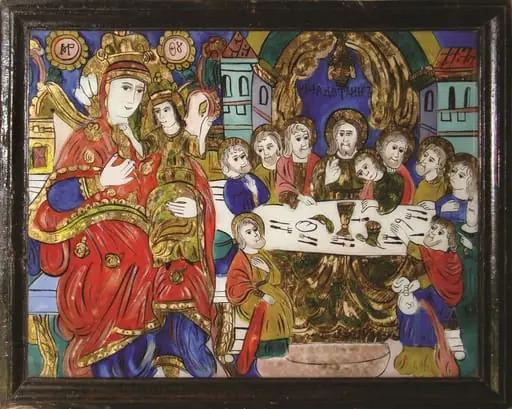
Sfânta Treime (Sfânta Troiță, Filoxenia, Cina de la Mamvri) is a drawing by the Impressionist artist Unknown. It dates from 1859 and is held in the collection of the Romanian Peasant Museum. The work depicts a luminous yellow table encircled by four winged figures in flowing garments of green, red, orange and red.
About this work
Overview
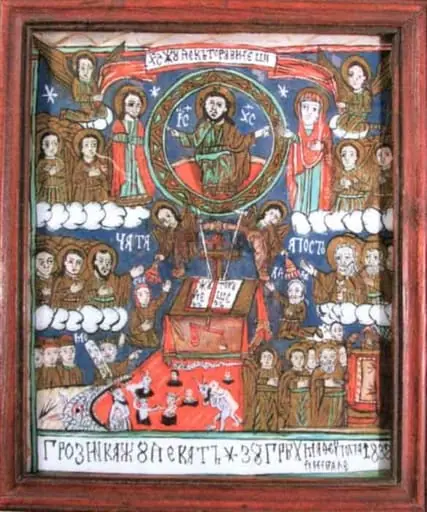
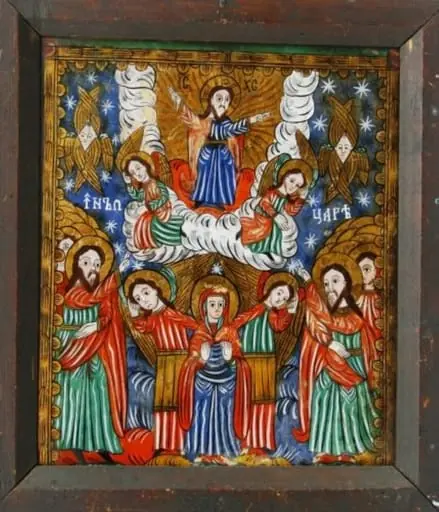
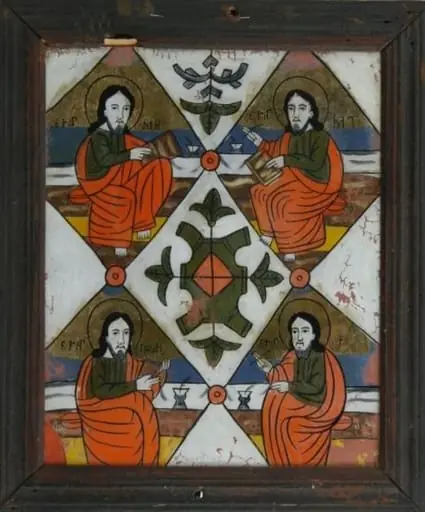
The work depicts a luminous yellow table encircled by four winged figures in flowing garments of green, red, orange and red. A haloed presence hovers above, arms outstretched, while a bearded man in green stands to the left. Beneath the central scene, three smaller vignettes show figures in boats and two men holding books, set against a distant town with towers and a solitary tree.
Subject & Meaning
The central gathering suggests a sacred banquet or liturgical assembly, with the winged figures evoking angels or saints. The haloed figure above implies a divine or Christological presence, and the bearded man may represent a prophet or saint. The lower panels, featuring boat travelers and scholars with books, introduce themes of pilgrimage and learning that complement the celestial gathering.
Technique & Style
Rendered in a bright palette dominated by yellow, the composition balances vivid colors with delicate line work. The figures are stylized with elongated forms and fluid drapery, creating a sense of movement. The background town and tree are rendered with softened edges, giving the scene an ethereal, floating quality.
History & Provenance
The piece is known under several titles—Sfânta Treime, Sfânta Troiță, Filoxenia, and Cina de la Mamvri—indicating multiple attributions or exhibition histories. No further details about its creation date, artist, or ownership are provided in the source material.
Context
The imagery aligns with Eastern Orthodox iconography, where the Holy Trinity, saints, and communal feasts are common motifs. The inclusion of boats and books reflects traditional narrative elements that link the sacred with everyday life, a practice seen in medieval and post‑Byzantine visual culture.
Artist & collection

 Domestic Scene
 Giacomo and Cardinal Marco, investing Andrea, Abbot of San Zeno, with his Benefice
 The Nymph of Fontainebleau
 Portrait of a Woman
 Madonna and Child with Saints in the Enclosed Garden
 Venus and Minerva
 Family Group of Four on Sofa
 Wall painting from Room H of the Villa of P. Fannius Synistor at Boscoreale