Artwork
St. Anthony Falls from Across the River
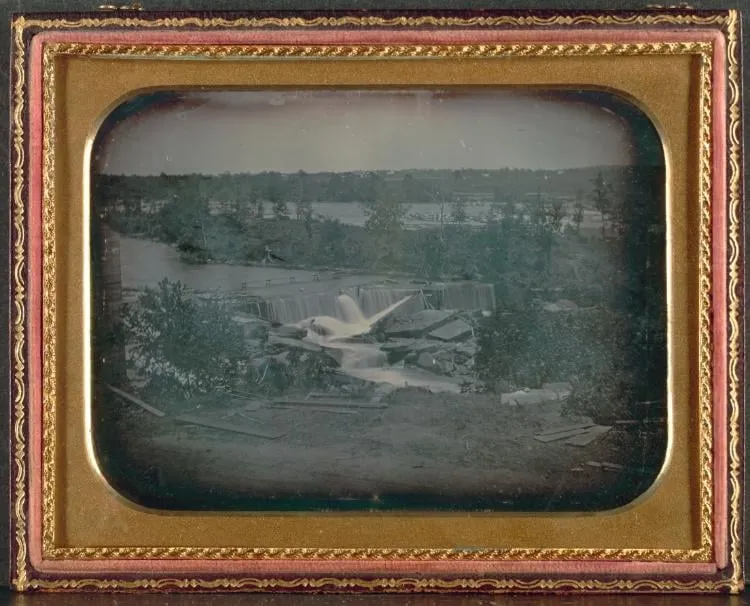
St. Anthony Falls from Across the River is a photography by the Romanticist artist Unknown. It dates from 1854 and is held in the collection of the Cleveland Museum of Art. Taken around 1853, this daguerreotype captures St.
About this work
The person who took it caught the exact shape of the falls—something paintings couldn’t do as fast.
You see a black-and-white picture of St. Anthony Falls, the big waterfall on the Mississippi River in Minneapolis. The water crashes over jagged rocks between steep cliffs.
This photo was taken around 1853, when cameras were brand new. The person who took it caught the exact shape of the falls—something paintings couldn’t do as fast. It’s one of the earliest photos of this spot, before the city grew up around it.
If you like early American scenes, look up the subject america.
Overview
Taken around 1853, this daguerreotype captures St. Anthony Falls on the Mississippi River in Minneapolis, one of the earliest photographic records of the site. The image’s sharp detail reflects the technical novelty of the medium, freezing the falls in a moment before industrial development transformed the landscape. The photographer’s identity remains unknown, but the image stands as a precise visual record of a natural feature then still largely untouched by urban expansion.
Subject & Meaning
The falls, the only major waterfall along the Mississippi River, are depicted in their raw, unaltered state—water cascading over bedrock between high limestone bluffs. Named by Father Louis Hennepin in 1680, the site held both geographic and cultural significance. The photograph preserves its appearance prior to the construction of mills and dams, making it a quiet testament to a landscape soon to be reshaped by industrial needs.
Technique & Style
As a daguerreotype, the image was produced on a silver-plated copper sheet, requiring long exposure times and meticulous handling. Despite these limitations, the photographer achieved remarkable clarity in rendering the falls’ texture and the river’s motion, a feat uncommon in early photography. The monochrome tones emphasize form and contrast, highlighting the jagged rock formations and the force of the water with unusual precision.
History & Provenance
The photograph was made shortly before the 1850s surge of milling activity that altered the falls’ natural flow. Its survival is notable, as many early daguerreotypes were lost or degraded. Though its original owner and purpose are undocumented, its existence suggests an interest in documenting the region’s natural features before they vanished under industrial growth.
Context
In the early 1850s, Minneapolis was a small settlement on the edge of the frontier. The falls represented both a natural landmark and a potential power source. While artists had previously depicted the site through sketches, photography offered a new kind of fidelity. This image emerged at the threshold between wilderness and industry, capturing a fleeting moment in the region’s environmental history.
Legacy
The photograph endures as a primary visual reference for the falls’ pre-industrial condition. It informs historical and geological studies of the Mississippi and serves as a benchmark for understanding how human intervention reshaped natural landmarks. As one of the earliest known photographs of the site, it anchors later narratives of urban development in the Upper Midwest.
Artist & collection

 Domestic Scene
 Giacomo and Cardinal Marco, investing Andrea, Abbot of San Zeno, with his Benefice
 The Nymph of Fontainebleau
 Portrait of a Woman
 Madonna and Child with Saints in the Enclosed Garden
 Venus and Minerva
 Family Group of Four on Sofa
 Wall painting from Room H of the Villa of P. Fannius Synistor at Boscoreale
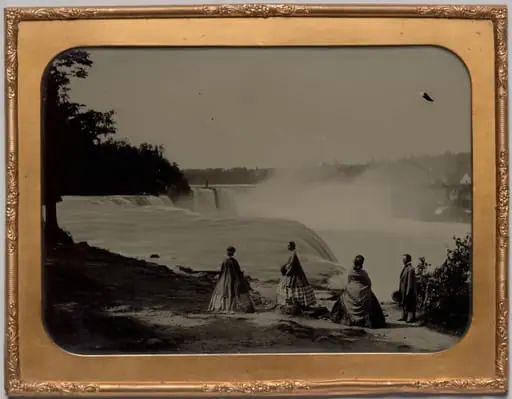 Niagara Falls with well-dressed group
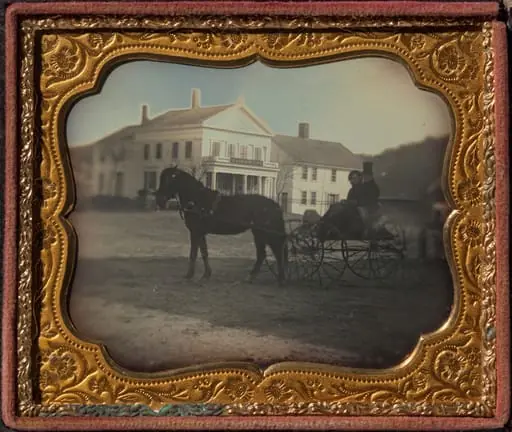 Solomon Clark Spelman and Martha W. Spelman in front of S.C. Spelman General Store, Hampden, MA
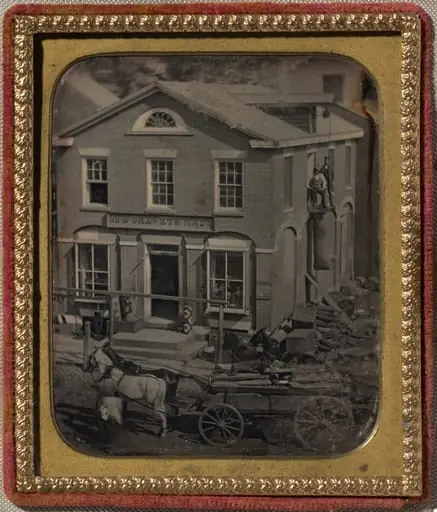 Construction of the John Stewart Store
 Hunting Party with Badger, Loire Valley, France
 Homestead with picket fence and flowers
 Symonds Yat
 Crowd with sleigh in front of LL & ER Smith store
 Summer Day on Conesus Lake
 Shimla. Sir Hugh Rose's Bungalow at Mahasso
 Shimla. The Church Through the Trees, from Jakko
 View from the Lawn, Dennicanniby
 Prize Horse in winter, Chemung County, New York