Artwork
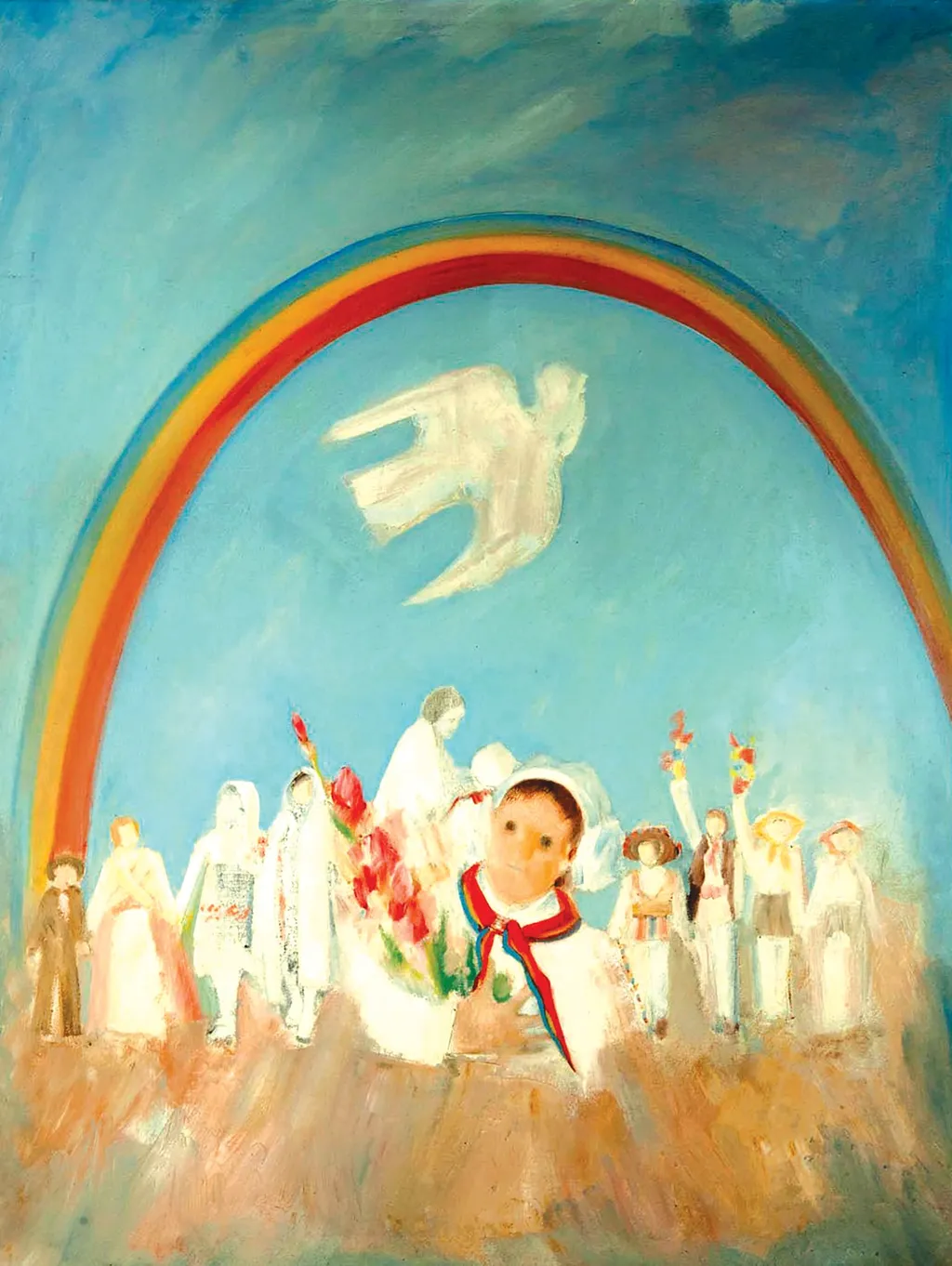
Tablou „Omagiul copiilor”, semnat indescifrabil dreapta sus, ulei/pânză. Tabloul o înfățișază pe Elena Ceaușescu, în plan secund, înconjurată de un grup de copii sub un cer albastru cu un curcubeu în culorile tricolorului; deasupra grupului zboară porumbelul alb, porumbelul păcii. În prim plan o fată în uniformă de pionier cu un buchet de flori în brațe. Comandat de comitetul Județean de Partid Caraș Severin, oferit Elenei Ceaușescu cu ocazia aniverării zilei de naștere, ianuarie 1979.
Tablou „Omagiul copiilor”, semnat indescifrabil dreapta sus, ulei/pânză. Tabloul o înfățișază pe Elena Ceaușescu, în plan secund, înconjurată de un grup de copii sub un cer albastru cu un curcubeu în culorile tricolorului; deasupra grupului zboară porumbelul alb, porumbelul păcii. În prim plan o fată în uniformă de pionier cu un buchet de flori în brațe. Comandat de comitetul Județean de Partid Caraș Severin, oferit Elenei Ceaușescu cu ocazia aniverării zilei de naștere, ianuarie 1979. is a print by Unknown. It dates from 1850 and is held in the collection of the National Museum of Romanian History.
About this work
Overview
This oil on canvas painting was commissioned in early 1979 by the Caraș-Severin County Party Committee as a birthday tribute to Elena Ceaușescu.
This oil on canvas painting was commissioned in early 1979 by the Caraș-Severin County Party Committee as a birthday tribute to Elena Ceaușescu. It depicts her positioned slightly behind a group of children beneath a sky featuring a rainbow in the national colors. A white dove hovers above the scene, while a girl in a pioneer uniform stands in the foreground holding flowers. The artist’s signature is illegible, and the work remains attributed to an unknown hand.
Subject & Meaning
The composition centers on Elena Ceaușescu as a maternal figure within a carefully staged scene of childhood innocence. The children, the pioneer girl, and the symbolic dove and rainbow collectively evoke ideals of state-sponsored harmony, peace, and ideological continuity. The imagery aligns with socialist realism’s emphasis on collective loyalty and the regime’s cultivation of a cult of personality around the First Lady.
Technique & Style
The painting employs a conventional socialist realist style: idealized figures, soft lighting, and a balanced, hierarchical composition. Colors are muted yet deliberate, with the rainbow’s tricolor hues subtly reinforcing national identity. The background sky and dove are rendered with symbolic clarity rather than naturalism, prioritizing ideological messaging over individual expression or atmospheric depth.
History & Provenance
Created in January 1979 for Elena Ceaușescu’s birthday, the work was presented by the local party committee as a ceremonial gift. Its origin reflects the widespread practice of commissioning state-approved art to honor regime figures. After 1989, the painting’s whereabouts became unclear, and it has not been publicly exhibited or cataloged in major institutions, remaining a private or archival artifact.
Context
During the late 1970s, Romania’s regime intensified its use of visual propaganda to reinforce loyalty and mythologize the Ceaușescus. Artworks like this one were produced en masse, blending folk motifs with socialist iconography. The inclusion of the pioneer uniform and dove reflects standardized symbols promoted in schools and media to associate youth with state ideology and pacifist rhetoric.
Legacy
The painting exemplifies the state’s instrumentalization of art to construct a fabricated narrative of benevolent leadership. After the 1989 revolution, such works were largely removed from public view, neither celebrated nor systematically preserved. Today, it survives as a quiet testament to the mechanisms of political imagery under authoritarian rule, studied more for its historical function than its aesthetic merit.
Artist & collection

 Domestic Scene
 Giacomo and Cardinal Marco, investing Andrea, Abbot of San Zeno, with his Benefice
 The Nymph of Fontainebleau
 Portrait of a Woman
 Madonna and Child with Saints in the Enclosed Garden
 Venus and Minerva
 Family Group of Four on Sofa
 Wall painting from Room H of the Villa of P. Fannius Synistor at Boscoreale