Artwork
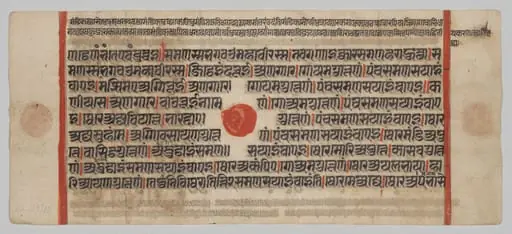
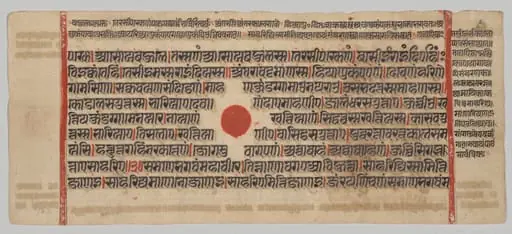
Text, Folio 10 (recto), from a Kalpa-sutra
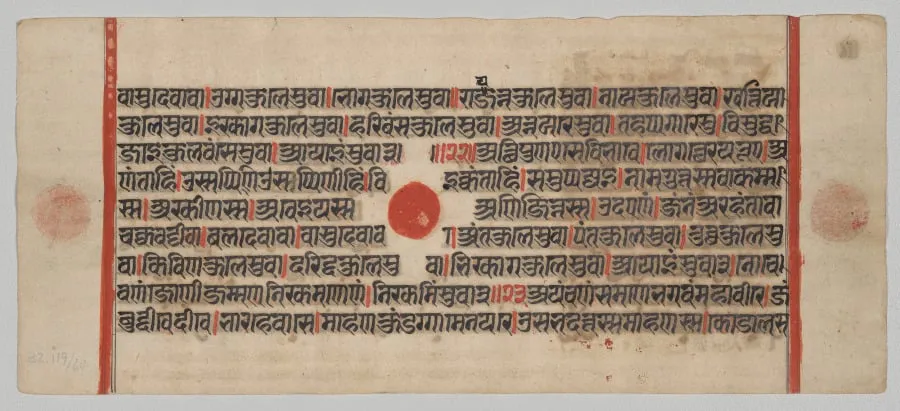
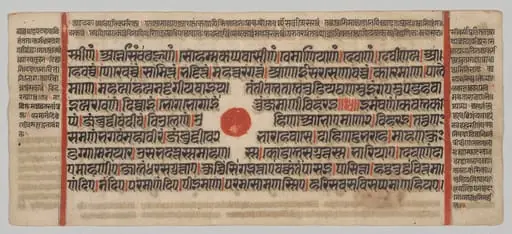
Text, Folio 10 (recto), from a Kalpa-sutra is an unspecified painting by the Mughal Painting artist Unknown. It dates from 1488 and is held in the collection of the Cleveland Museum of Art. The work is a painted folio containing a passage of text set against a light‑tan ground.
About this work
Overview
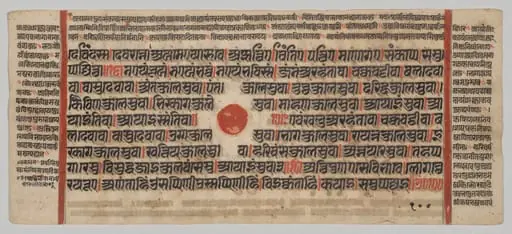
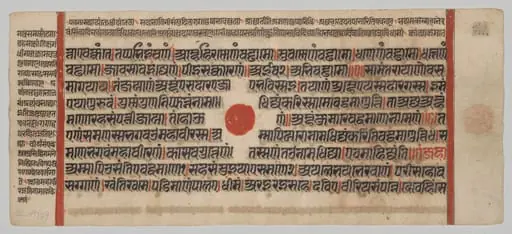
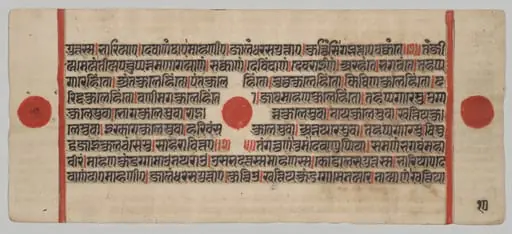
The work is a painted folio containing a passage of text set against a light‑tan ground. The script is rendered in black ink, while red elements frame and punctuate the composition, creating a modest yet deliberate visual hierarchy.
Subject & Meaning
The central focus is a block of text in an unidentified language, presented in a highly ornamental hand. The surrounding red lines and central circle serve as decorative markers, suggesting a ritual or scholarly context rather than a purely narrative illustration.
Technique & Style
Executed with fine brushwork, the calligraphic strokes display intricate flourishes typical of manuscript illumination. The red pigments, applied in linear and circular forms, contrast with the monochrome script, highlighting the piece’s emphasis on visual ornamentation within a textual medium.
History & Provenance
Identified as folio 10 (recto) from a Kalpa‑sutra, the sheet belongs to a larger collection of Buddhist doctrinal texts. Its materiality—painted on a beige substrate—indicates a manuscript tradition that combined textual transmission with artistic embellishment.
Context
The piece reflects a broader tradition of integrating decorative typography into religious manuscripts, a practice that persisted across Asian cultures. While not directly linked to the European Renaissance, its emphasis on elaborate lettering parallels global trends in manuscript art.
Artist & collection

 Domestic Scene
 Giacomo and Cardinal Marco, investing Andrea, Abbot of San Zeno, with his Benefice
 The Nymph of Fontainebleau
 Portrait of a Woman
 Madonna and Child with Saints in the Enclosed Garden
 Venus and Minerva
 Family Group of Four on Sofa
 Wall painting from Room H of the Villa of P. Fannius Synistor at Boscoreale