Artwork
Text, Folio 8 (recto), from a Kalpa-sutra
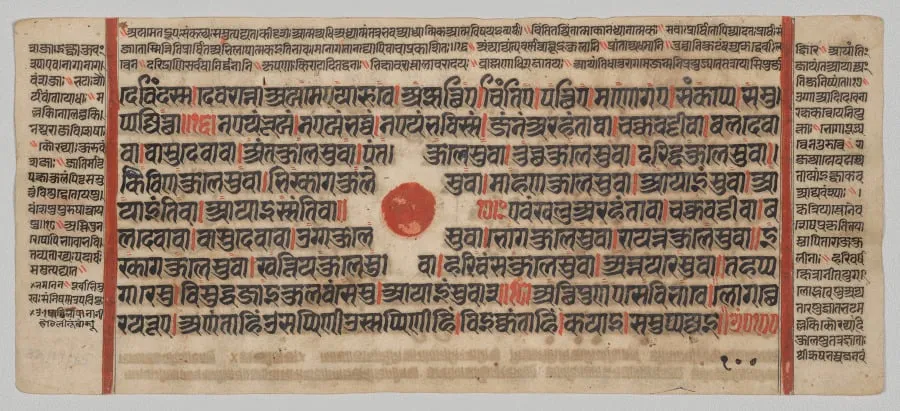
Text, Folio 8 (recto), from a Kalpa-sutra is an unspecified painting by the Mughal Painting artist Unknown. It dates from 1488 and is held in the collection of the Cleveland Museum of Art. This folio features densely packed handwritten text in red and black ink, arranged in vertical columns across a rectangular page.
About this work
Overview
The script’s precision and spacing reflect a disciplined scribal tradition, though its cultural origin is misattributed in the visual note.
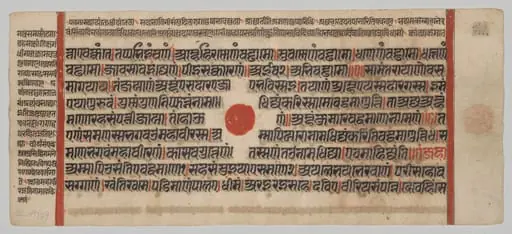
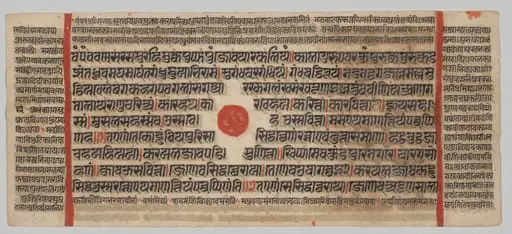
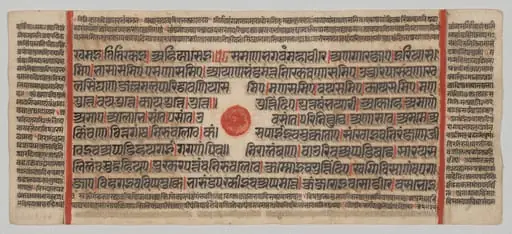
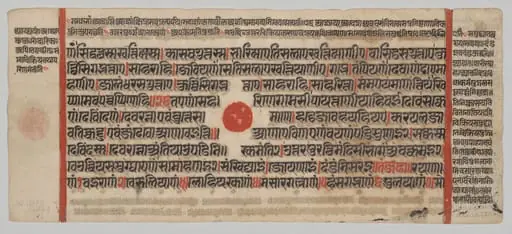
This folio features densely packed handwritten text in red and black ink, arranged in vertical columns across a rectangular page. A small red circle with a central dot appears near the center, contrasting with the uniform script. Thin red borders frame the top and bottom edges, suggesting the page was once part of a bound manuscript. The script’s precision and spacing reflect a disciplined scribal tradition, though its cultural origin is misattributed in the visual note.
Subject & Meaning
The content consists of religious or liturgical text, likely from a Jain Kalpa-sutra manuscript, used in ritual recitation. The central red circle may mark a section divider, a mnemonic device, or a symbolic representation of the cosmos or spiritual focus. Its placement invites contemplative reading, guiding the eye amid the textual density typical of devotional manuscripts in western India.
Technique & Style
The script is executed with fine brushes, using mineral-based inks in red and black, applied with consistent pressure and alignment. Letters are tightly spaced, maximizing space without compromising legibility. The red border frames the text as a sacred enclosure, a convention in Jain and early Indian manuscript culture. The absence of illustration emphasizes textual authority over visual ornamentation.
History & Provenance
Though mischaracterized as Renaissance, this folio originates from a 15th-century Jain manuscript produced in Gujarat or Rajasthan. Such texts were copied by monastic scribes for temple use or elite patrons. The page’s survival suggests it was preserved in a religious archive or private collection, later separated from its original codex, possibly during colonial-era acquisitions.
Context
Jain manuscripts like this were produced in scriptoria attached to temples or monasteries, where scribes followed strict protocols for copying sacred texts. The use of red ink for headings or symbols was standard, aiding navigation in long recitations. Unlike European illuminated manuscripts, Jain texts prioritized textual purity, minimizing figural imagery to avoid spiritual distraction.
Legacy
This folio exemplifies the enduring scribal practices of Jain communities, preserving doctrinal continuity through meticulous hand-copying. Its survival offers insight into pre-modern literacy, devotional discipline, and the material culture of religious transmission. Modern scholars rely on such fragments to reconstruct textual lineages and regional scribal traditions across western India.
Artist & collection

 Domestic Scene
 Giacomo and Cardinal Marco, investing Andrea, Abbot of San Zeno, with his Benefice
 The Nymph of Fontainebleau
 Portrait of a Woman
 Madonna and Child with Saints in the Enclosed Garden
 Venus and Minerva
 Family Group of Four on Sofa
 Wall painting from Room H of the Villa of P. Fannius Synistor at Boscoreale
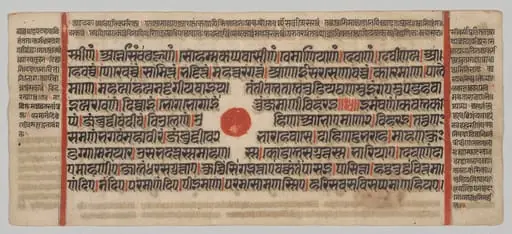 Text, folio 6 (recto), from a Kalpa-sutra
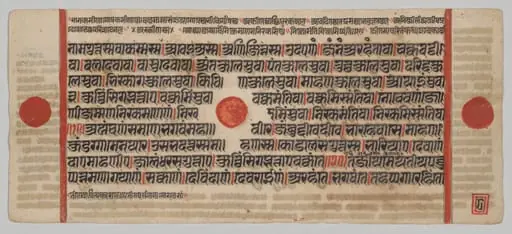 Text, Folio 8 (verso), from a Kalpa-sutra
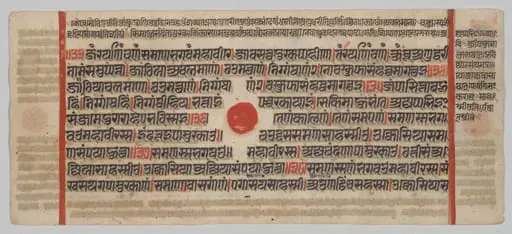 Text, Folio 42 (recto), from a Kalpa-sutra
 Text, Folio 34 (recto), from a Kalpa-sutra
 Text, Folio 32 (recto), from a Kalpa-sutra
 Text, Folio 38 (recto), from a Kalpa-sutra
 Text, folio 11 (recto), from a Kalpa-sutra
 Text, Folio 35 (recto), from a Kalpa-sutra
 Text, Folio 10 (recto), from a Kalpa-sutra
 Text, Folio 58 (recto), from a Kalpa-sutra