Artwork
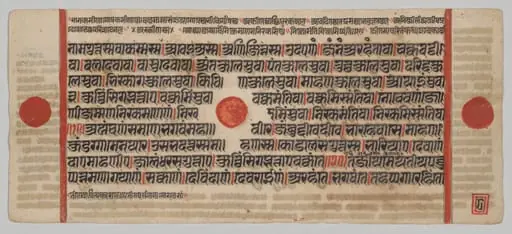
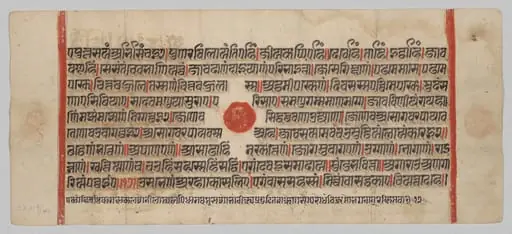
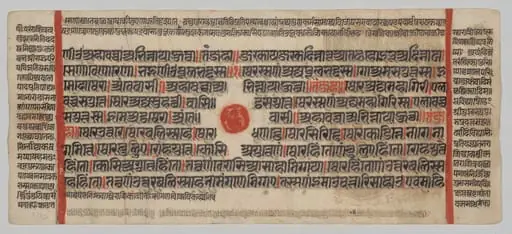
Text, folio 6 (recto), from a Kalpa-sutra
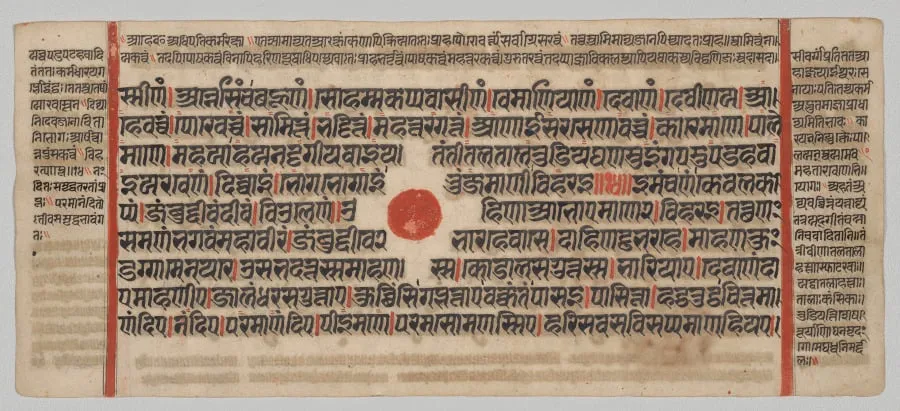
Text, folio 6 (recto), from a Kalpa-sutra is an unspecified painting by the Mughal Painting artist Unknown. It dates from 1488 and is held in the collection of the Cleveland Museum of Art. This folio comes from a manuscript of the Kalpa-sutra, a Jain religious text.
About this work
Overview
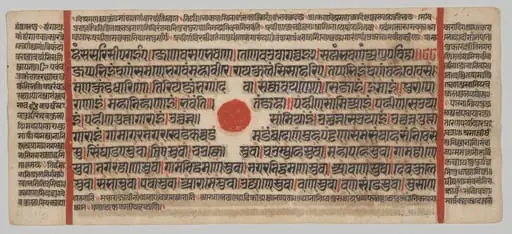
It features densely written black ink script on a yellowish-brown parchment surface, with select words marked in red for emphasis.
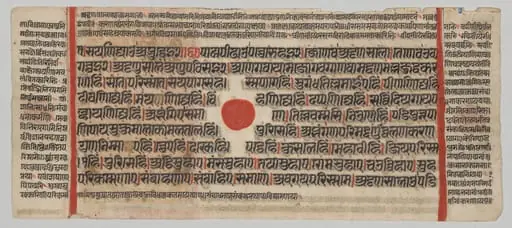
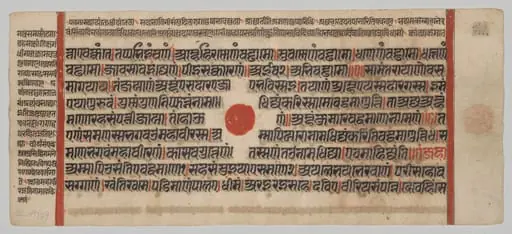
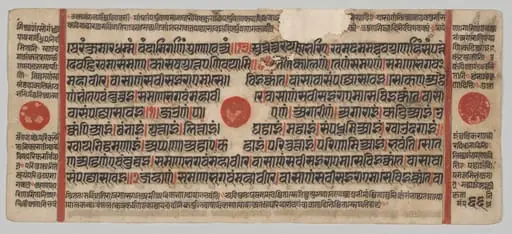
This folio comes from a manuscript of the Kalpa-sutra, a Jain religious text. It features densely written black ink script on a yellowish-brown parchment surface, with select words marked in red for emphasis. Two vertical red lines frame the text block, and a central red circle anchors the composition. Though dated to the Renaissance era, its style reflects Indian manuscript traditions rather than European ones.
Subject & Meaning
The text is written in Prakrit, the liturgical language of Jainism, containing teachings and biographies of the Tirthankaras. The red circle likely signifies a sacred pause or structural division within the narrative. Highlighted words may denote key doctrinal phrases, guiding recitation or meditation. The design prioritizes ritual function over ornamentation, aligning with Jain ascetic values.
Technique & Style
The script is executed in a precise, angular calligraphic hand typical of western Indian Jain manuscripts. Ink was applied with a reed pen, and red accents were added using mineral pigments. The page’s muted palette and restrained decoration reflect a monastic aesthetic focused on textual clarity. No illustrations appear, distinguishing it from more elaborate Jain codices.
History & Provenance
Produced in Gujarat or Rajasthan between the 15th and 17th centuries, this folio was likely part of a larger devotional manuscript used in monastic settings. Its survival suggests careful handling within Jain communities. The absence of a known artist is typical, as such works were often created anonymously by scribes affiliated with temples or religious orders.
Context
While contemporaneous with European Renaissance art, this folio belongs to a distinct South Asian tradition of religious bookmaking. Unlike Western illuminated manuscripts, it avoids figural imagery and gold leaf, emphasizing textual purity. Its production coincided with the flourishing of Jain scholarly networks in western India, where manuscript copying was an act of piety.
Legacy
Folios like this preserve the continuity of Jain liturgical practice over centuries. They serve as primary sources for linguistic, religious, and paleographic study. Today, such manuscripts are held in institutional collections, valued not for aesthetic novelty but for their role in sustaining religious memory and textual transmission.
Artist & collection

 Domestic Scene
 Giacomo and Cardinal Marco, investing Andrea, Abbot of San Zeno, with his Benefice
 The Nymph of Fontainebleau
 Portrait of a Woman
 Madonna and Child with Saints in the Enclosed Garden
 Venus and Minerva
 Family Group of Four on Sofa
 Wall painting from Room H of the Villa of P. Fannius Synistor at Boscoreale