Artwork
Text, Folio 27 (recto), from a Kalpa-sutra
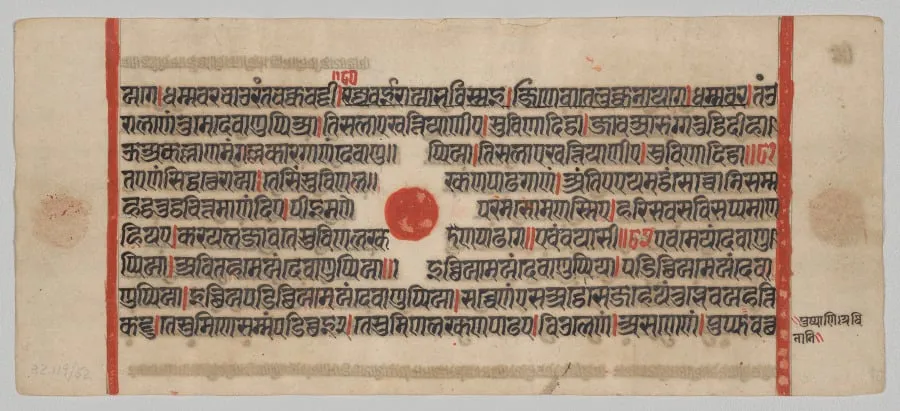
Text, Folio 27 (recto), from a Kalpa-sutra is an unspecified painting by the Mughal Painting artist Unknown. It dates from 1488 and is held in the collection of the Cleveland Museum of Art.
About this work
Overview
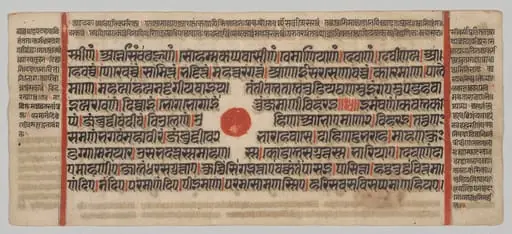
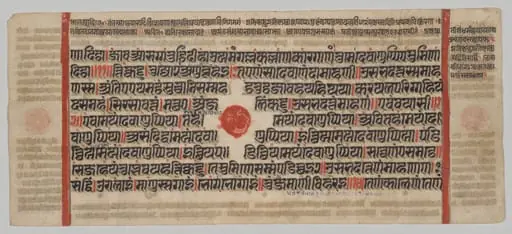
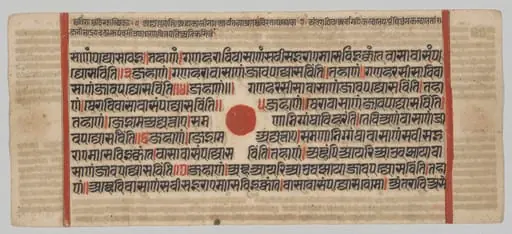
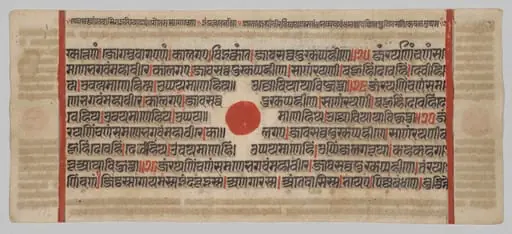
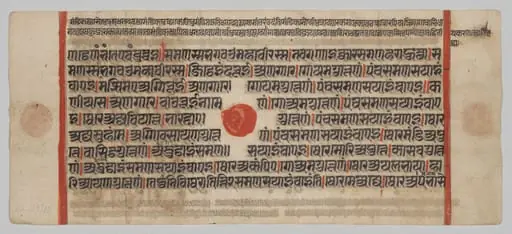
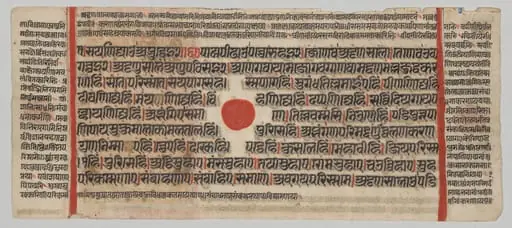
This folio is a handwritten page from a Kalpa-sutra, a Jain religious manuscript containing narratives about the lives of spiritual teachers.
This folio is a handwritten page from a Kalpa-sutra, a Jain religious manuscript containing narratives about the lives of spiritual teachers. Executed on light brown paper with red border lines, the text is rendered in black ink, with select words emphasized in red. A small red circle with a central dot appears near the center, possibly serving as a marker for liturgical or structural significance within the textual sequence.
Subject & Meaning
The Kalpa-sutra preserves teachings and biographies of Jain Tirthankaras, particularly Parshvanatha and Mahavira. This folio likely contains passages recited during ritual observances or used for doctrinal instruction. The red annotations may denote sacred names, key doctrinal points, or liturgical divisions, guiding the reader’s focus during recitation and reinforcing the text’s spiritual authority.
Technique & Style
The script is a regional variant of Devanagari, carefully inscribed with a fine brush or reed pen. Ink contrasts sharply against the muted paper, while red highlights are applied with precision. The red circle with a central dot is a distinctive visual device, possibly indicating a pause, a sacred syllable, or a marker for oral recitation—reflecting a tradition where written text and spoken performance are deeply intertwined.
History & Provenance
This folio originates from a manuscript produced in western India, likely between the 14th and 16th centuries, during a period of active Jain manuscript production. It was part of a codex used in monastic communities for study and ritual. Its survival suggests careful preservation, though its specific provenance prior to modern collection remains undocumented.
Context
Jain manuscripts like this were created by skilled scribes within temple or monastic settings, often commissioned by wealthy patrons. Unlike illuminated Christian texts, Jain books emphasized textual purity over elaborate imagery; decoration was restrained, serving functional and devotional purposes. The use of red for emphasis aligns with broader South Asian scribal traditions that marked sacred or critical passages.
Legacy
This folio exemplifies the enduring Jain commitment to preserving sacred texts through meticulous hand-copying. While later printing technologies replaced such manuscripts, the aesthetic and ritual discipline of these works continue to inform contemporary Jain practices. Its visual language—minimal, deliberate, and spiritually charged—remains a quiet counterpoint to more ornate manuscript traditions elsewhere.
Artist & collection

 Domestic Scene
 Giacomo and Cardinal Marco, investing Andrea, Abbot of San Zeno, with his Benefice
 The Nymph of Fontainebleau
 Portrait of a Woman
 Madonna and Child with Saints in the Enclosed Garden
 Venus and Minerva
 Family Group of Four on Sofa
 Wall painting from Room H of the Villa of P. Fannius Synistor at Boscoreale