Artwork
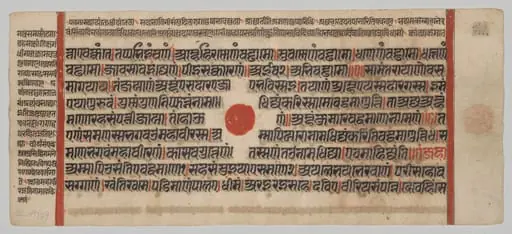
Text, Folio 41 (recto), from a Kalpa-sutra
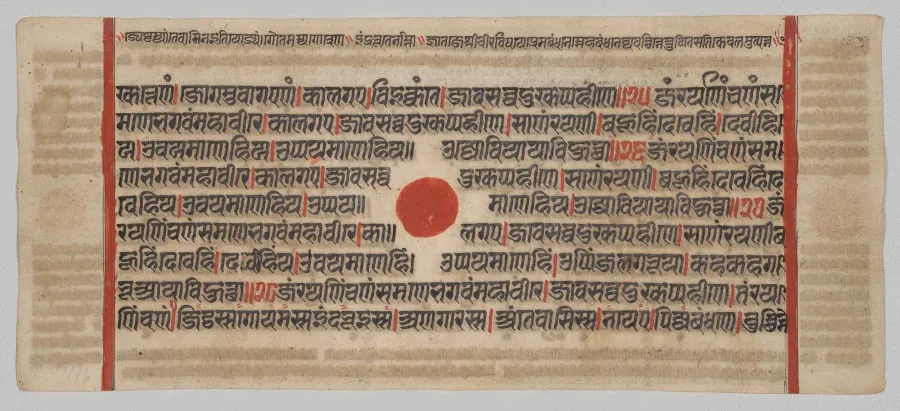
Text, Folio 41 (recto), from a Kalpa-sutra is an unspecified painting by the Mughal Painting artist Unknown. It dates from 1488 and is held in the collection of the Cleveland Museum of Art. This folio originates from a Kalpa-sutra manuscript, a Jain religious text written in an early medieval Indian script.
About this work
Overview
Its design reflects the disciplined aesthetics of manuscript production in western India, where textual accuracy and symbolic emphasis were equally valued.
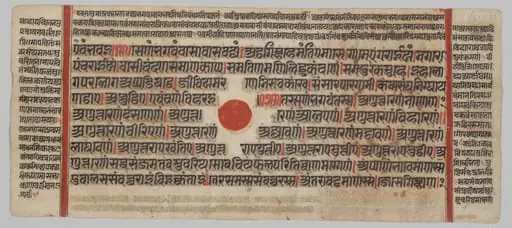
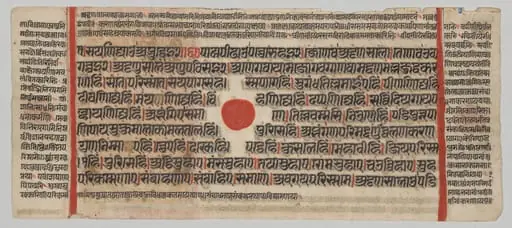
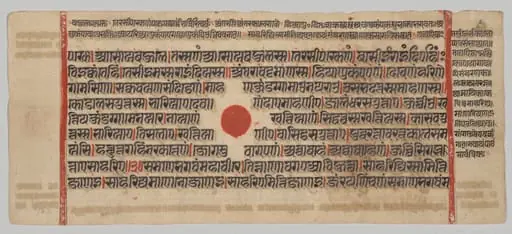
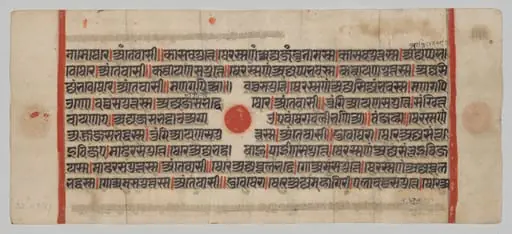
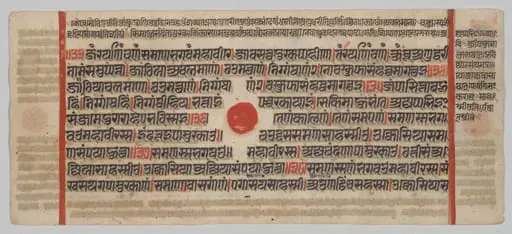
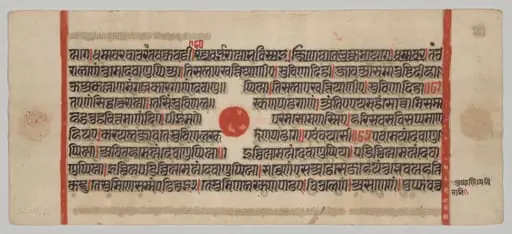
This folio originates from a Kalpa-sutra manuscript, a Jain religious text written in an early medieval Indian script. The page features densely arranged lines of reddish-brown ink on a pale, aged surface, framed by a bold red border. A central red circle interrupts the text, serving as a visual marker rather than decorative flourish. Its design reflects the disciplined aesthetics of manuscript production in western India, where textual accuracy and symbolic emphasis were equally valued.
Subject & Meaning
The content is part of the Kalpa-sutra, a canonical Jain scripture detailing the lives of the Tirthankaras, particularly Mahavira. The central red circle likely denotes a significant doctrinal passage, a structural division, or a ritual pause point for recitation. Such markers guided oral transmission and meditative reading, reinforcing the sacred nature of the text through visual hierarchy rather than illustration.
Technique & Style
The script is executed in a precise, cursive form typical of early Gujarati or Saurashtran calligraphy. Ink was applied with a reed pen, and the red border and central circle were likely drawn with a brush using vermilion pigment. The uniformity of the lines and the absence of illumination suggest a focus on textual integrity over ornamental display, characteristic of Jain scribal traditions prioritizing clarity and reverence.
History & Provenance
This folio was likely produced in the 14th or 15th century in western India, possibly in Gujarat or Rajasthan, regions known for Jain manuscript production. It was part of a larger codex, now dispersed, with other folios held in museum and private collections. Its survival reflects the careful preservation practices of Jain communities, who treated texts as embodiments of spiritual authority.
Context
Jain manuscripts of this period were created by monastic scribes under strict ritual conditions, often commissioned by lay patrons seeking merit. The Kalpa-sutra was recited annually during Paryushana, the most important Jain festival. The minimal use of color and absence of figural imagery align with Jain principles of non-attachment and the avoidance of idolatry, emphasizing the word as sacred.
Legacy
Folios like this remain vital to the study of Jain literary and artistic traditions. They provide insight into the transmission of religious knowledge before print culture and illustrate the enduring value placed on handwritten scripture. Contemporary scholars and conservators continue to analyze these pages to reconstruct textual lineages and understand regional scribal practices.
Artist & collection

 Domestic Scene
 Giacomo and Cardinal Marco, investing Andrea, Abbot of San Zeno, with his Benefice
 The Nymph of Fontainebleau
 Portrait of a Woman
 Madonna and Child with Saints in the Enclosed Garden
 Venus and Minerva
 Family Group of Four on Sofa
 Wall painting from Room H of the Villa of P. Fannius Synistor at Boscoreale