Artwork
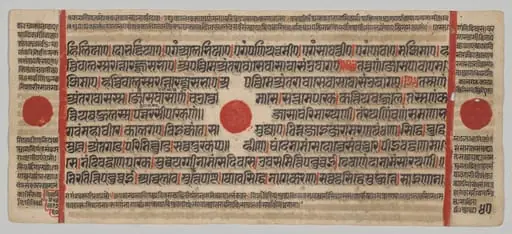
Text, Folio 6 (verso), from a Kalpa-sutra
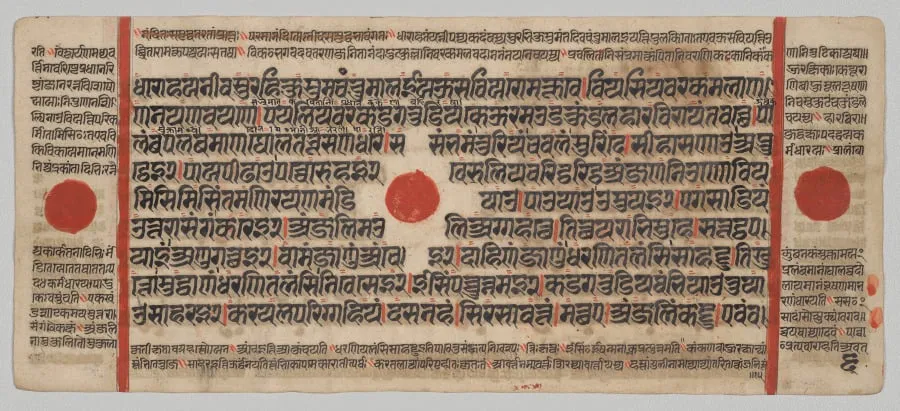
Text, Folio 6 (verso), from a Kalpa-sutra is an unspecified painting by the Mughal Painting artist Unknown. It dates from 1488 and is held in the collection of the Cleveland Museum of Art. This folio comes from a manuscript of the Kalpa-sutra, a Jain religious text.
About this work
Overview
This folio comes from a manuscript of the Kalpa-sutra, a Jain religious text. The page is dominated by dense, angular black script arranged in orderly rows, with two small red circles centered on the surface. A narrow red border frames the text, and the paper shows signs of age through a yellowed tone and physical wear, suggesting frequent use over time.
Subject & Meaning
The red circles likely serve as markers for significant passages, possibly indicating sacred names, doctrinal divisions, or liturgical cues. Their placement interrupts the textual flow without disrupting it, implying a deliberate system of visual guidance for readers engaged in recitation or study. The script’s precision reflects the importance of textual accuracy in Jain tradition.
Technique & Style
The writing is executed in a sharp, compact script typical of medieval Jain manuscript production. Ink is applied with controlled precision, and the red circles, made with mineral pigment, contrast sharply against the aged paper. The use of a single border and minimal decoration aligns with Jain aesthetic values favoring restraint and clarity over ornamentation.
History & Provenance
The folio’s worn condition indicates prolonged handling, likely in a monastic or scholarly setting. Its survival suggests careful preservation despite regular use. While its exact origin is undocumented, similar manuscripts are associated with western Indian Jain communities between the 14th and 16th centuries, where such texts were central to religious practice.
Context
The Kalpa-sutra contains biographies of Jain Tirthankaras and monastic rules. Manuscripts like this were not merely read but recited aloud in ritual settings, requiring clear, legible script and visual cues for correct recitation. The red markers functioned as mnemonic aids, helping readers navigate complex passages during communal observances.
Legacy
This folio exemplifies the enduring Jain commitment to textual preservation through meticulous hand-copying. Its design influenced later manuscript traditions in South Asia, where functional typography and symbolic markers became standard. Today, such pages are studied for their linguistic, artistic, and religious significance within early Indian book culture.
Artist & collection

 Domestic Scene
 Giacomo and Cardinal Marco, investing Andrea, Abbot of San Zeno, with his Benefice
 The Nymph of Fontainebleau
 Portrait of a Woman
 Madonna and Child with Saints in the Enclosed Garden
 Venus and Minerva
 Family Group of Four on Sofa
 Wall painting from Room H of the Villa of P. Fannius Synistor at Boscoreale
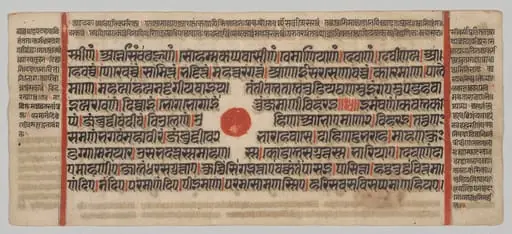 Text, folio 6 (recto), from a Kalpa-sutra
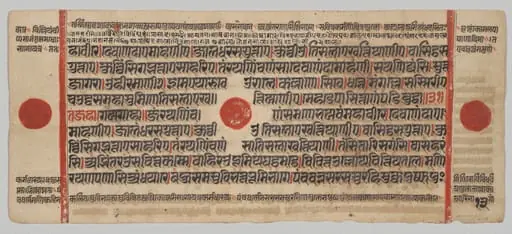 Text, Folio 13 (verso), from a Kalpa-sutra
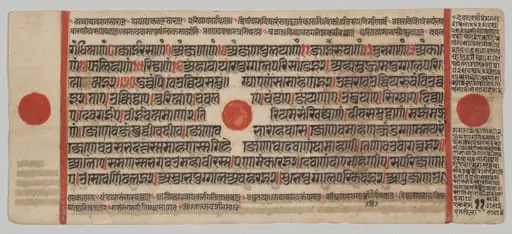 Text, Folio 11 (verso), from a Kalpa-sutra
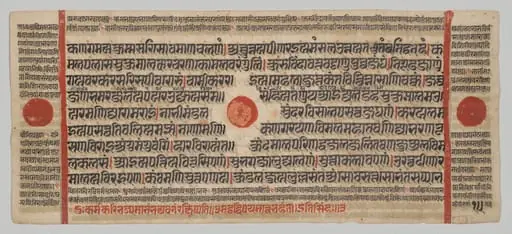 Text, Folio 15 (verso), from a Kalpa-sutra
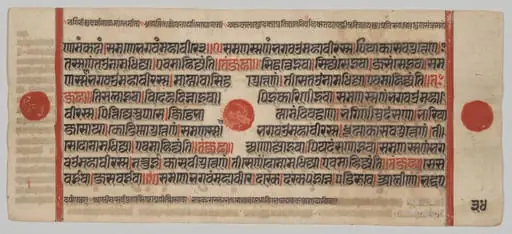 Text, Folio 34 (verso), from a Kalpa-sutra
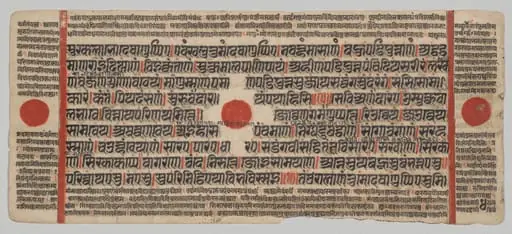 Text, Folio 4 (verso), from a Kalpa-sutra
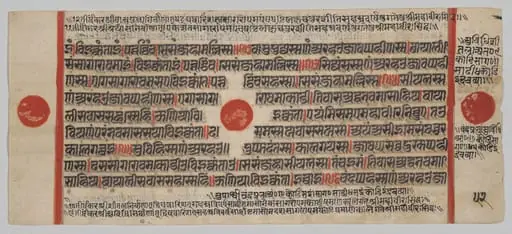 Text, Folio 52 (verso), from a Kalpa-sutra
 Text, Folio 40 (verso), from a Kalpa-sutra