Artwork
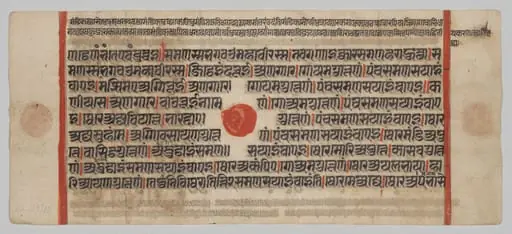
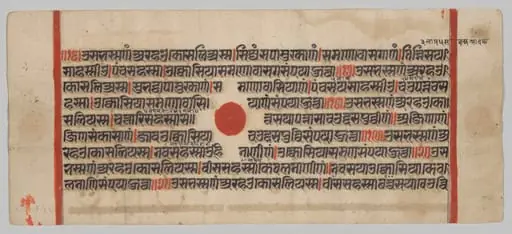
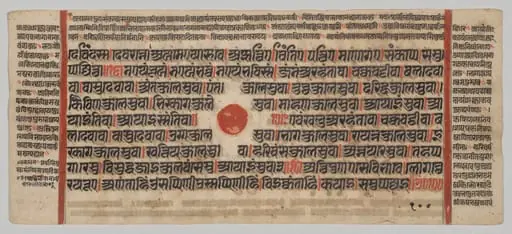
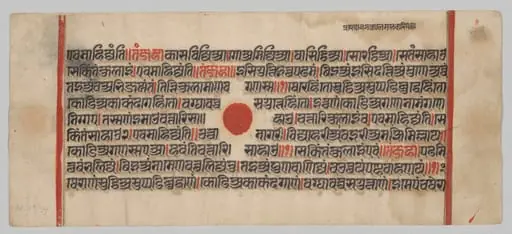
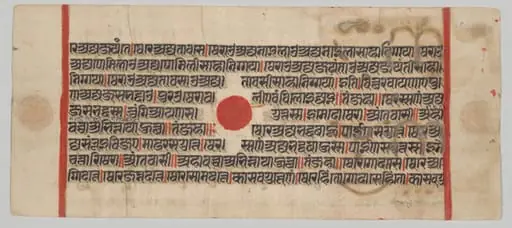
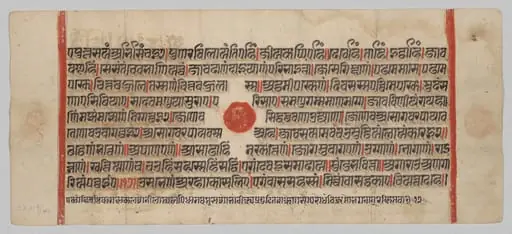
Text, Folio 62 (recto), from a Kalpa-sutra
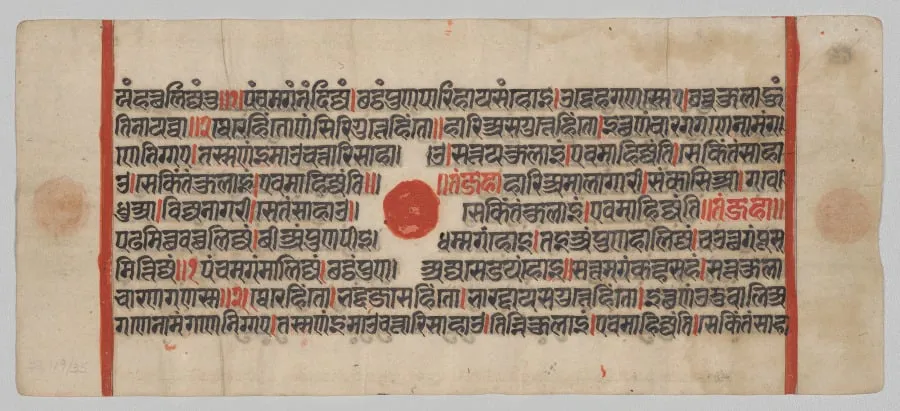
Text, Folio 62 (recto), from a Kalpa-sutra is an unspecified painting by the Mughal Painting artist Unknown. It dates from 1488 and is held in the collection of the Cleveland Museum of Art. The work titled “Text, Folio 62 (recto), from a Kalpa‑sutra” is a manuscript page rendered as a painted document.
About this work
Overview
The work titled “Text, Folio 62 (recto), from a Kalpa‑sutra” is a manuscript page rendered as a painted document. It consists of densely set black ink script on aged paper, accented with red pigment that outlines the margins and forms a central circular seal. The paper exhibits a browned, weathered surface typical of centuries‑old South Asian manuscripts.
Subject & Meaning
The page contains a passage from a Kalpa‑sutra, a genre of Buddhist literature dealing with monastic discipline and ritual practice. The text is written in an Indian script, most likely Sanskrit, and the red circular mark functions as a seal indicating a significant or authoritative section within the sutra.
Technique & Style
The scribe employed fine black ink for the main body of the text, applying it in tight horizontal lines that maximize the use of space. Red pigment, applied with a brush, outlines the page’s edges and creates the central seal, a common decorative convention in Indian manuscript illumination that balances textual clarity with visual emphasis.
Context
Kalpa‑sutras were produced in monastic centers across the Indian subcontinent from the early medieval period onward. The manuscript’s material qualities—hand‑made paper, natural inks, and red sealing—reflect the broader South Asian scribal tradition, which developed independently of contemporary European Renaissance practices despite occasional cross‑cultural exchanges.
Artist & collection

 Domestic Scene
 Giacomo and Cardinal Marco, investing Andrea, Abbot of San Zeno, with his Benefice
 The Nymph of Fontainebleau
 Portrait of a Woman
 Madonna and Child with Saints in the Enclosed Garden
 Venus and Minerva
 Family Group of Four on Sofa
 Wall painting from Room H of the Villa of P. Fannius Synistor at Boscoreale