Artwork
Text, Folio 74 (verso), from a Kalpa-sutra
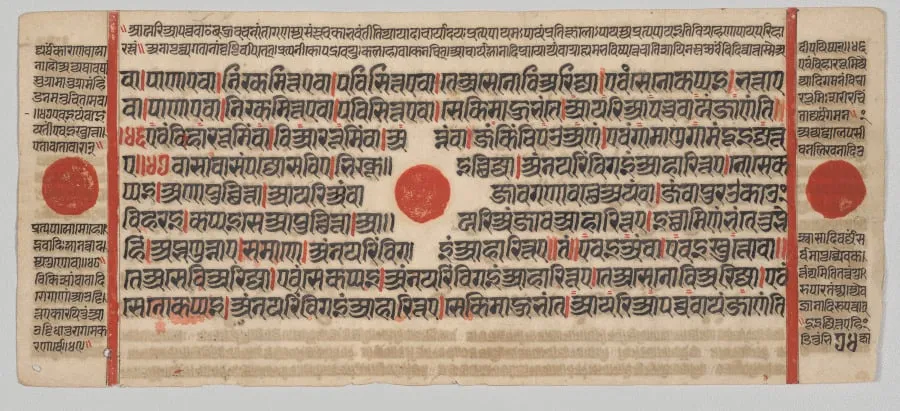
Text, Folio 74 (verso), from a Kalpa-sutra is an unspecified painting by the Mughal Painting artist Unknown. It dates from 1488 and is held in the collection of the Cleveland Museum of Art. This folio is part of a manuscript from the Kalpa-sutra tradition, a Jain religious text.
About this work
Overview
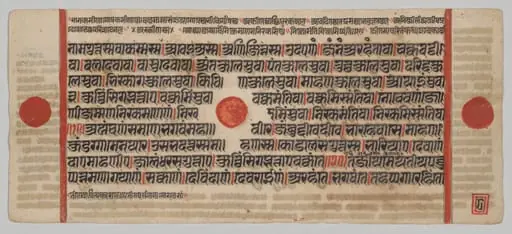
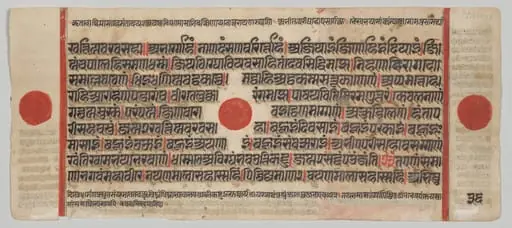
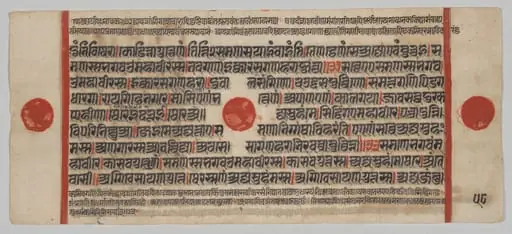
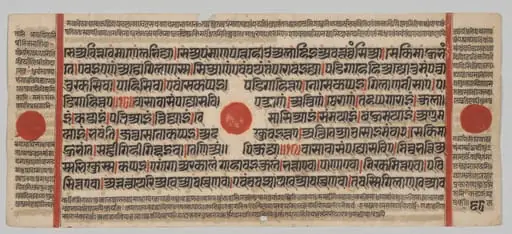
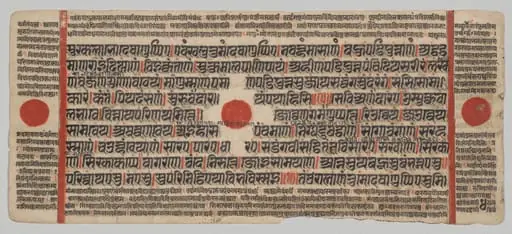
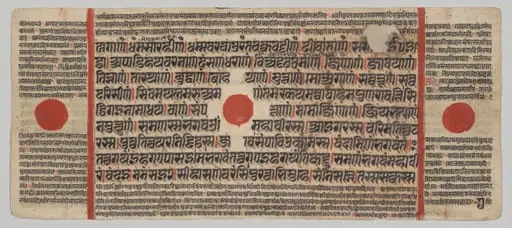
The page features handwritten script in an early Indic language, likely Prakrit or Sanskrit, rendered in black ink with selective red accents.
This folio is part of a manuscript from the Kalpa-sutra tradition, a Jain religious text. The page features handwritten script in an early Indic language, likely Prakrit or Sanskrit, rendered in black ink with selective red accents. Decorative red circles flank the text, framing it symmetrically. The paper shows signs of age—yellowing, minor tears, and edge damage—consistent with centuries of handling and storage in monastic libraries.
Subject & Meaning
The text contains passages from the Kalpa-sutra, detailing the lives and teachings of Jain Tirthankaras, particularly Mahavira. The red highlights emphasize key doctrinal phrases or names, guiding ritual recitation. The circular marks may denote liturgical pauses or symbolic representations of cosmic order, reinforcing the spiritual rhythm of the text. This page served as a devotional aid, not merely a record.
Technique & Style
The script is executed in a meticulous, cursive style typical of western Indian manuscript traditions, with fine penwork and subtle flourishes. Red ink, derived from vermilion or cinnabar, was applied with precision to mark important terms. The layout balances textual density with visual spacing, and the use of color follows established iconographic conventions rather than decorative whim. No figural imagery is present, adhering to Jain textual emphasis.
History & Provenance
The folio likely originated in Gujarat or Rajasthan between the 14th and 16th centuries, produced in a Jain monastic scriptorium. Its condition suggests repeated use in liturgical settings before being archived. It entered modern collections through early 20th-century acquisitions, possibly from temple or private Jain holdings. No documented provenance exists prior to its museum cataloging.
Context
Manuscripts like this were central to Jain religious practice, copied by trained scribes over generations. Unlike contemporary European illuminated texts, Jain manuscripts avoided figural representation, focusing instead on the sanctity of the written word. The use of red for emphasis and circular markers reflects regional stylistic norms, distinct from both Islamic and Hindu scribal traditions of the same period.
Legacy
This folio exemplifies the enduring Jain commitment to textual preservation and aesthetic restraint. Its survival offers insight into pre-modern scribal practices and devotional culture. While not widely known outside specialist circles, it remains a key artifact for understanding the material history of Jainism and the evolution of South Asian manuscript art.
Artist & collection

 Domestic Scene
 Giacomo and Cardinal Marco, investing Andrea, Abbot of San Zeno, with his Benefice
 The Nymph of Fontainebleau
 Portrait of a Woman
 Madonna and Child with Saints in the Enclosed Garden
 Venus and Minerva
 Family Group of Four on Sofa
 Wall painting from Room H of the Villa of P. Fannius Synistor at Boscoreale
 Text, Folio 28 (verso), from a Kalpa-sutra
 Text, Folio 73 (verso), from a Kalpa-sutra
 Text, Folio 65 (verso), from a Kalpa-sutra
 Text, Folio 8 (verso), from a Kalpa-sutra
 Text, Folio 36 (verso), from a Kalpa-sutra
 Text, Folio 58 (verso), from a Kalpa-sutra
 Text, Folio 68 (verso), from a Kalpa-sutra
 Text, Folio 4 (verso), from a Kalpa-sutra
 Text, Folio 7 (verso), from a Kalpa-sutra