Artwork
The false Mansur punished before the judge and expelled from the city, from a Tuti-nama (Tales of a Parrot): Seventeenth Night
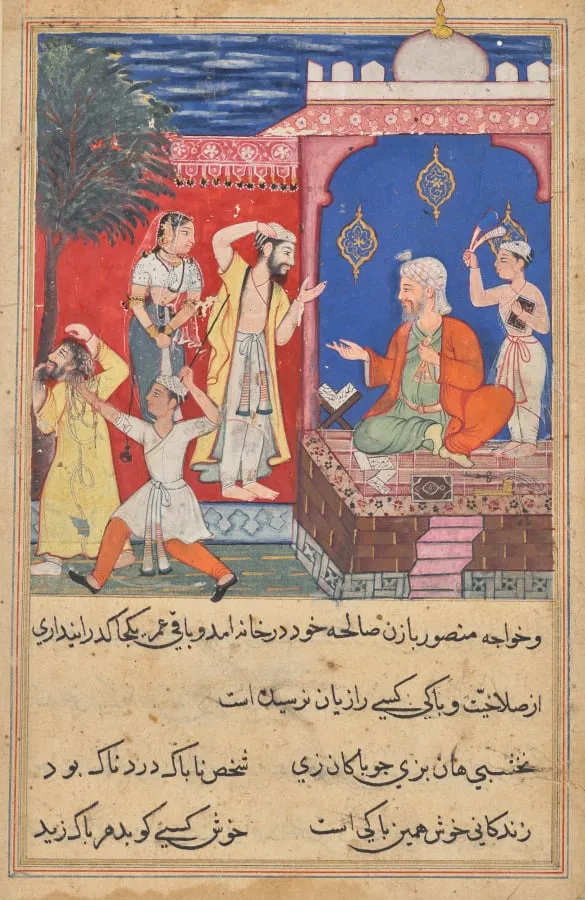
The false Mansur punished before the judge and expelled from the city, from a Tuti-nama (Tales of a Parrot): Seventeenth Night is an unspecified painting by the Mughal Painting artist Unknown. It dates from 1560 and is held in the collection of the Cleveland Museum of Art. The miniature illustrates a courtroom scene in which the genuine merchant Mansur confronts an impostor who has taken his place.
About this work
The story is about a merchant tricked by an imposter—here, the real merchant and his wife watch as the fake is punished.
You see a crowded courtroom: a judge in red robes sits on a platform, a turbaned man and woman stand before him, and guards drag a second man away by his hair, his turban unraveling.
This painting comes from a book of parrot tales told to a Mughal emperor. The story is about a merchant tricked by an imposter—here, the real merchant and his wife watch as the fake is punished. The bright colors and tiny details show how people dressed and acted in 1500s India.
To see more paintings like this, look up Mughal India, court of Akbar (reigned 1556–1605).
Overview
The miniature illustrates a courtroom scene in which the genuine merchant Mansur confronts an impostor who has taken his place. Mansur, accompanied by his wife, presents their case before a seated judge, while the fraudulent figure is being seized and led away by guards.
Subject & Meaning
The narrative, drawn from a parrot tale recited to a Mughal ruler, depicts the restoration of justice: the true merchant reclaims his identity, and the impostor suffers public punishment, underscoring themes of truth, authority, and moral order in 16th‑century Indian society.
Technique & Style
Executed in the miniature tradition of Mughal painting, the work employs vivid pigments and meticulous detailing to render textiles, jewelry, and facial expressions. The composition balances a crowded foreground with a structured architectural backdrop, characteristic of courtly visual culture of the period.
Context
Created for a manuscript of the Tuti‑nama, a collection of moral stories presented to Emperor Akbar, the painting reflects the fusion of Persian artistic conventions with Indian motifs that defined Mughal visual art during the late 1500s.
Legacy
As a visual record of Mughal courtly life, the piece offers scholars insight into contemporary dress, legal proceedings, and narrative illustration, contributing to the broader understanding of cultural exchange in early modern South Asia.
Artist & collection

 Domestic Scene
 Giacomo and Cardinal Marco, investing Andrea, Abbot of San Zeno, with his Benefice
 The Nymph of Fontainebleau
 Portrait of a Woman
 Madonna and Child with Saints in the Enclosed Garden
 Venus and Minerva
 Family Group of Four on Sofa
 Wall painting from Room H of the Villa of P. Fannius Synistor at Boscoreale
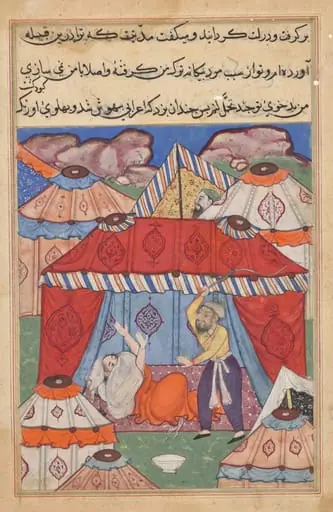 The disguised Arab, substituting for Habbaza, is whipped by her husband for refusing a bowl of milk, from a Tuti-nama (Tales of a Parrot): Twenty-fourth Night
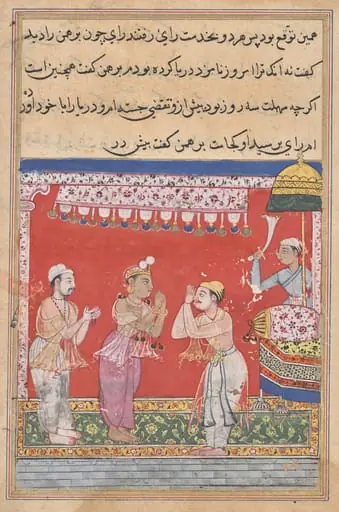 The king of the Ocean, having assumed human form, arrives at the court of the Raja, from a Tuti-nama (Tales of a Parrot): Eleventh Night
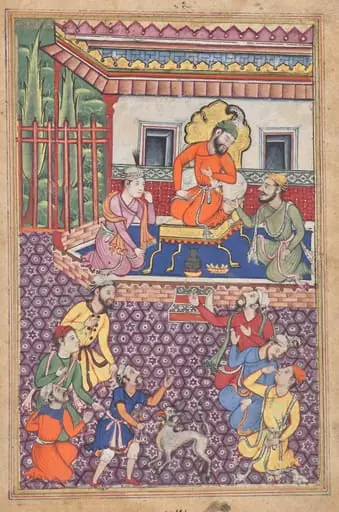 The court of the Raja of Ujjain, from a Tuti-nama (Tales of a Parrot): Forty-sixth Night
 The magician, disguised as a Brahman, visits the king of Babylon, from a Tuti-nama (Tales of a Parrot): Thirty-fifth Night
 The king gives his daughter in marriage to the pious man’s son, from a Tuti-nama (Tales of a Parrot): Fifty-second Night