Artwork
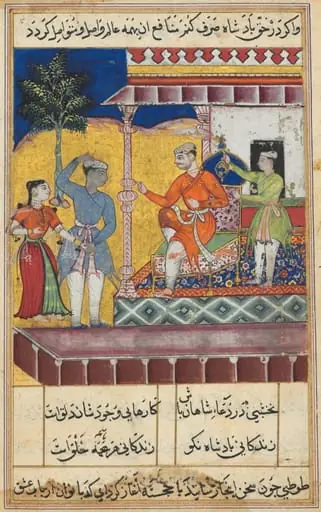
The magician, disguised as a Brahman, visits the king of Babylon, from a Tuti-nama (Tales of a Parrot): Thirty-fifth Night
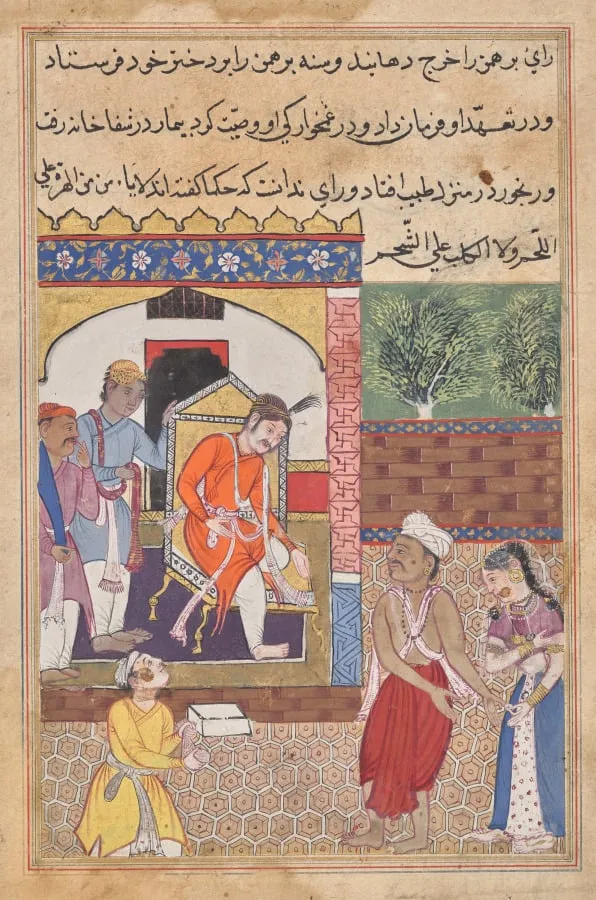
The magician, disguised as a Brahman, visits the king of Babylon, from a Tuti-nama (Tales of a Parrot): Thirty-fifth Night is an unspecified painting by the Mughal Painting artist Unknown. It dates from 1560 and is held in the collection of the Cleveland Museum of Art.
About this work
The artist hid clues in the details—like the way the woman’s sari drapes—that show off Mughal court life.
You see a king on a throne, a woman in a blue robe, and a man in a turban bowing. Bright colors, tiny patterns, and gold leaf make the scene feel rich.
This painting comes from a book of parrot tales made for Emperor Akbar. Some think the king is actually Akbar himself, playing a role from the story. The artist hid clues in the details—like the way the woman’s sari drapes—that show off Mughal court life.
To see more like this, look up Mughal India, court of Akbar (reigned 1556–1605).
Overview
The miniature illustrates a scene from the Tuti‑nama, a collection of parrot tales, in which a disguised magician, posing as a Brahman, presents a transformed woman to the king of Babylon. The ruler, seated on an elevated throne, receives the two visitors and consents to place the woman temporarily in his harem as a favor to the Brahman.
Subject & Meaning
The narrative depicts the king’s acquiescence to a deceptive request, highlighting themes of illusion and courtly intrigue. The story’s twist—where the king is outwitted by his own daughter, her lover, and the magician—adds a moral dimension about the vulnerability of power, even for a sovereign identified with the historic city of Babylon.
Technique & Style
Executed in the Mughal miniature tradition, the work employs bright pigments, intricate patterning, and gold leaf to convey opulence. The figures are rendered with delicate line work; the woman’s blue robe and the turbaned man’s posture are stylized yet convey a sense of movement and deference.
History & Provenance
The painting is part of a manuscript commissioned for Emperor Akbar (r. 1556–1605). Scholars have noted that the seated ruler may be a portrait of Akbar himself, adopting the title of the ancient king of Babylon to associate his reign with historic grandeur. The identification, however, remains debated among specialists.
Context
Mughal patrons often used literary illustrations to reflect courtly values and to project imperial authority. By aligning himself with Babylon—a symbol of ancient power in the Islamic world—Akbar could reinforce his own legitimacy while engaging with popular storytelling traditions.
Artist & collection

 Domestic Scene
 Giacomo and Cardinal Marco, investing Andrea, Abbot of San Zeno, with his Benefice
 The Nymph of Fontainebleau
 Portrait of a Woman
 Madonna and Child with Saints in the Enclosed Garden
 Venus and Minerva
 Family Group of Four on Sofa
 Wall painting from Room H of the Villa of P. Fannius Synistor at Boscoreale
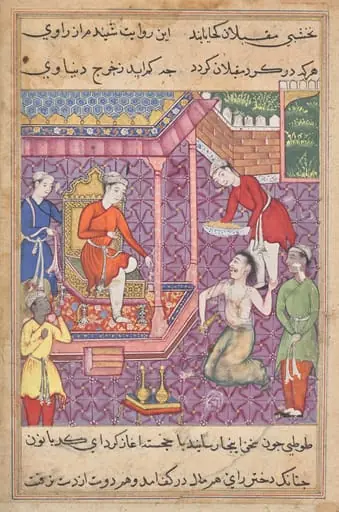 The magician disguised as a Brahman returns to claim his “daughter-in-law,” from a Tuti-nama (Tales of a Parrot): Thirty-fifth Night
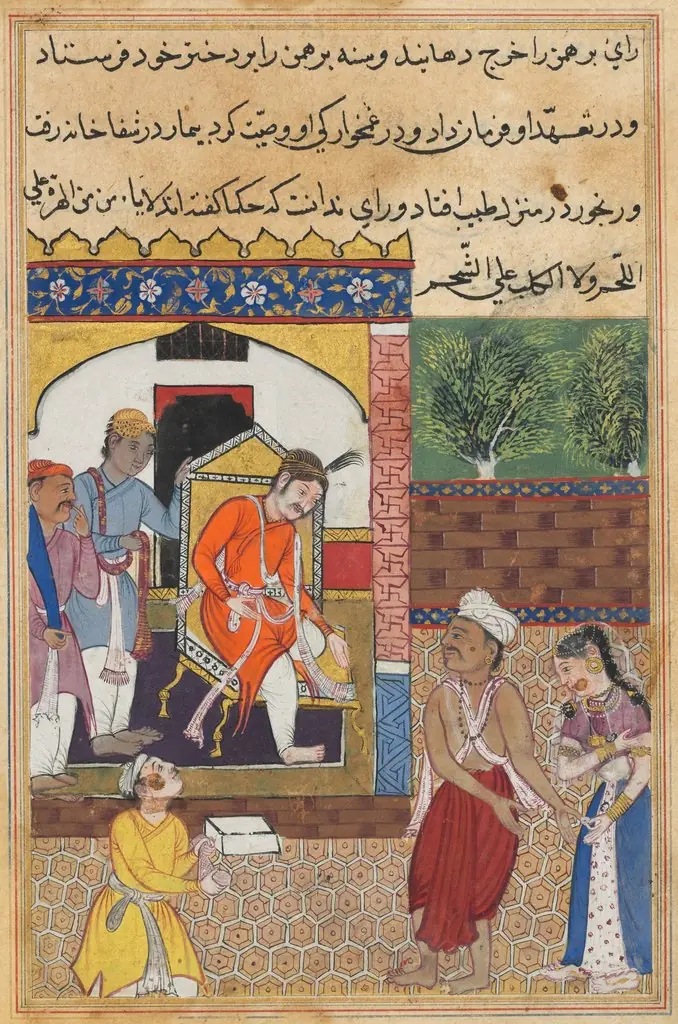 The magician, disguised as a Brahman, visits the king of Babylon, from a Tuti-nama (Tales of a Parrot): Thirty-fifth Night
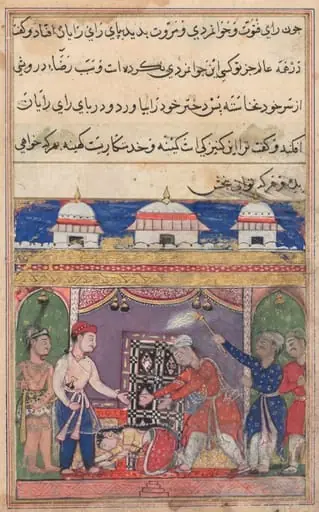 The king of Bahilistan offers his daughter to the King of Kings, from a Tuti-nama (Tales of a Parrot): Seventh Night
 The rejuvenated old man and the daughter of the king of the jinns take leave of the King of Kings, from a Tuti-nama (Tales of a Parrot): Seventh Night