Artwork
The Four Evangelists: St. Luke
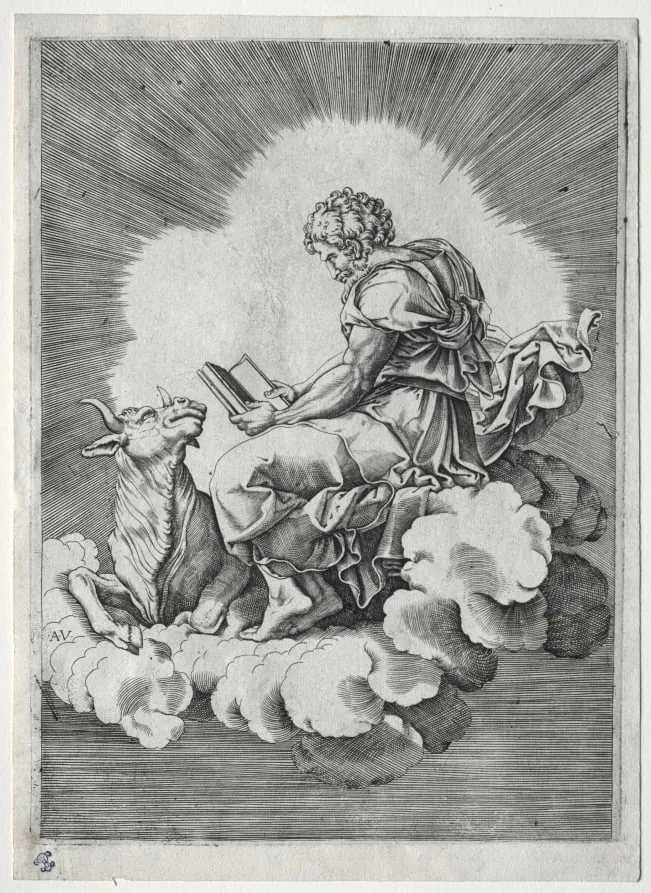
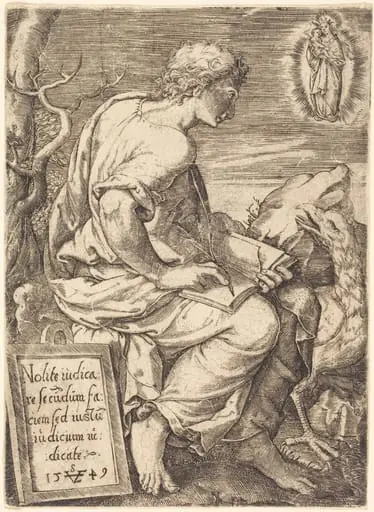
The Four Evangelists: St. Luke is a print by the Renaissance artist Unknown. It dates from 1518 and is held in the collection of the Cleveland Museum of Art. The Four Evangelists: St.
About this work
The artist used thin layers of paint to create soft shadows, a method common in early 1500s Italy.
A man in red robes sits at a desk, writing in a book while an ox watches over his shoulder. The room is dark, with light falling only on his face and hands.
This painting is one of four panels showing the Gospel writers. Each evangelist has a symbol—Luke’s is the ox. The artist used thin layers of paint to create soft shadows, a method common in early 1500s Italy.
To see more works like this, look up Italy, 16th century.
Overview
The Four Evangelists: St. Luke is a 16th-century Italian print depicting the Gospel writer in a contemplative setting, distinguished by its use of chiaroscuro and symbolic details.
Subject & Meaning
St. Luke, identified by his attribute the ox, is shown engrossed in writing, emphasizing his role as an evangelist. The ox symbolizes sacrifice and patience, underscoring the themes of his Gospel.
Technique & Style
The artist employed thin paint layers to achieve soft, nuanced shadows, characteristic of early 16th-century Italian artistic practices, heightened by the strategic use of light on the subject's face and hands.
History & Provenance
Part of a quartet of panels, each dedicated to a Gospel writer, this work originates from 16th-century Italy, though specific artist and location details are not provided.
Context
Created during a period of religious and artistic flourishing in Italy, the piece reflects the era's devotional themes and emerging techniques in painting.
Artist & collection

 Domestic Scene
 Giacomo and Cardinal Marco, investing Andrea, Abbot of San Zeno, with his Benefice
 The Nymph of Fontainebleau
 Portrait of a Woman
 Madonna and Child with Saints in the Enclosed Garden
 Venus and Minerva
 Family Group of Four on Sofa
 Wall painting from Room H of the Villa of P. Fannius Synistor at Boscoreale