Artwork
The Swansea Altarpiece
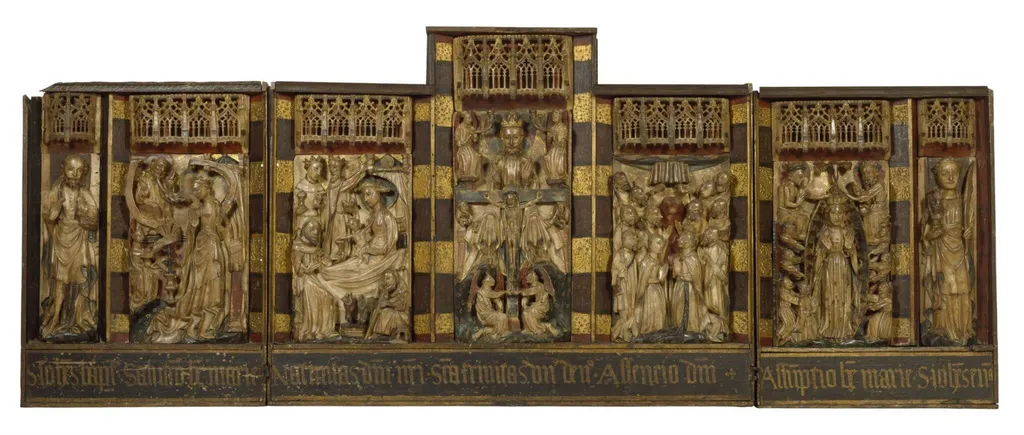
The Swansea Altarpiece is a work on paper by the Renaissance artist Unknown. It dates from 1460 and is held in the collection of the Victoria and Albert Museum.
About this work
Overview
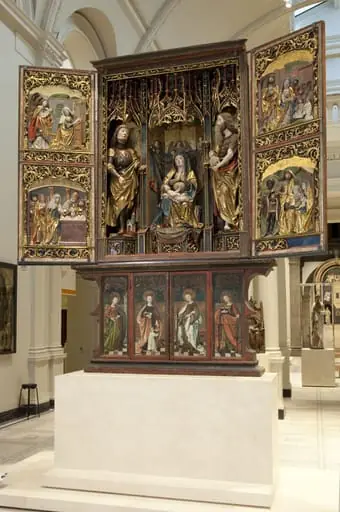
Designed for placement behind an altar, it served liturgical and instructional purposes, visually reinforcing biblical narratives during Mass.
The Swansea Altarpiece is a late 15th-century English devotional panel, constructed from carved alabaster set within a wooden frame. Designed for placement behind an altar, it served liturgical and instructional purposes, visually reinforcing biblical narratives during Mass. Though its maker remains unknown, it reflects the widespread production of alabaster altarpieces in England during this period, particularly in the Midlands, where quarries supplied material for both domestic and international markets.
Subject & Meaning
The altarpiece depicts scenes from the Life of Christ and the Virgin Mary, following a conventional iconographic program common in medieval English altarpieces. These narratives were intended to guide the faithful in contemplation and prayer, aligning visual imagery with the liturgical readings performed before the altar. The selection of episodes likely emphasized themes of redemption, divine motherhood, and sacrifice, central to Catholic devotion of the time.
Technique & Style
Carved from alabaster—a soft, fine-grained gypsum—the panels were shaped with precision and left largely unpainted to highlight the stone’s natural, luminous tone, particularly for flesh areas. The figures were secured within a wooden structure using lead wire, a standard method for assembling multi-panel altarpieces. While the surface retains traces of original polychromy, the carving emphasizes clarity of form over atmospheric depth, distinguishing it from later Renaissance techniques like sfumato.
History & Provenance
Produced between 1450 and 1500, the altarpiece was likely commissioned by a wealthy patron or religious institution in southern England. It remained in local use until the Reformation, after which many such works were dispersed or destroyed. The piece entered the Victoria and Albert Museum’s collection in the 19th century, having survived through private or institutional preservation, though its exact path from church to museum remains undocumented.
Context
During the 14th to early 16th centuries, England became a major center for alabaster carving, with workshops in Tutbury and Chellaston supplying altarpieces across Europe. Demand came not only from monasteries and cathedrals but also from urban merchants seeking private devotional objects. The Swansea Altarpiece exemplifies this commercialized piety, where religious art was both a spiritual tool and a commodity, exported as far as Spain and Iceland.
Legacy
Though no longer in its original ecclesiastical setting, the Swansea Altarpiece stands as a representative example of late medieval English devotional art. Its survival offers insight into the scale of alabaster production, the visual language of pre-Reformation worship, and the craftsmanship of anonymous artisans. Today, it contributes to scholarly understanding of how religious imagery functioned in daily spiritual life before the upheavals of the 16th century.
Artist & collection

 Domestic Scene
 Giacomo and Cardinal Marco, investing Andrea, Abbot of San Zeno, with his Benefice
 The Nymph of Fontainebleau
 Portrait of a Woman
 Madonna and Child with Saints in the Enclosed Garden
 Venus and Minerva
 Family Group of Four on Sofa
 Wall painting from Room H of the Villa of P. Fannius Synistor at Boscoreale