Artwork
Theatre de L'Ambigu Comique
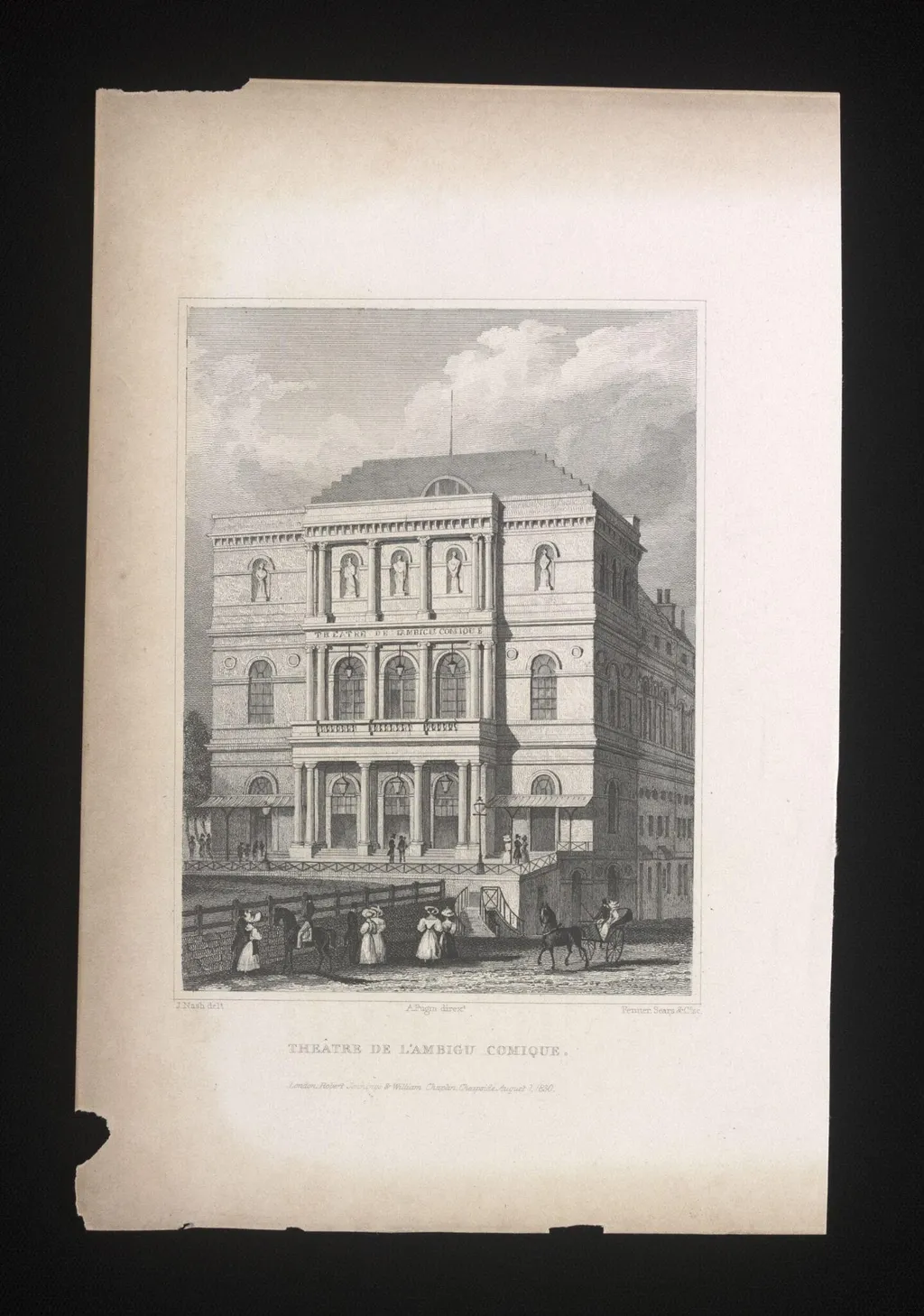
Theatre de L'Ambigu Comique is a print by the Romanticist artist Unknown. It dates from 1 and is held in the collection of the Victoria and Albert Museum.
About this work
Overview
Its clarity and structure reflect a documentary purpose, common in 19th-century urban visual records.
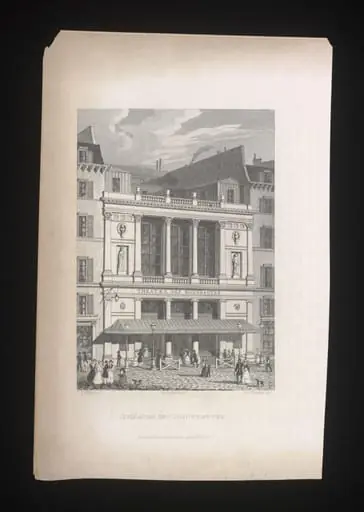
A detailed architectural print captures the façade of the Theatre de L'Ambigu Comique, produced in London on August 1, 1830, by publishers Robert Jennings and William Chaplin. Part of the Harry Beard Collection, the work is a precise lithographic or engraving reproduction, intended to document the building’s appearance rather than to dramatize it. Its clarity and structure reflect a documentary purpose, common in 19th-century urban visual records.
Subject & Meaning
The subject is the physical structure of a Parisian theatre known for popular drama and comedy performances in the early 19th century. The print emphasizes its architectural identity—columns, arches, and fenestration—as symbols of cultural legitimacy. By rendering the façade without figures or activity, the image treats the building itself as the subject, suggesting its role as a fixed landmark in the city’s entertainment landscape.
Technique & Style
The print employs fine linear precision and tonal gradation to render architectural elements with clarity. While not using chiaroscuro in the painterly sense, it relies on controlled line weight and shading to suggest depth and texture in stone and ornamentation. The style aligns with topographical printmaking traditions, prioritizing accuracy over expressive flair, typical of commercial publications documenting foreign landmarks for British audiences.
History & Provenance
The print was issued in London shortly after the theatre’s peak popularity in Paris, likely to satisfy public interest in continental cultural sites. It entered the Harry Beard Collection, a significant assemblage of theatrical ephemera, where it remains as evidence of transnational fascination with European performance spaces. Its publication date places it within a wave of illustrated travel and architectural records circulating in early Victorian Britain.
Context
The Theatre de L'Ambigu Comique, founded in 1769, was one of Paris’s most enduring venues for melodrama and light comedy. By 1830, it was well known across Europe, and prints like this served as visual souvenirs for those who could not travel. The print reflects a broader trend of documenting urban theatres as cultural monuments, paralleling the rise of illustrated periodicals and architectural surveys in the early 19th century.
Legacy
As part of the Beard Collection, the print contributes to the historical record of 19th-century theatre architecture and public taste. It offers researchers a reliable visual reference for the building’s pre-modern appearance, before later renovations or demolition. Its preservation underscores the value placed on ephemeral performance spaces as enduring cultural artifacts.
Artist & collection

 Domestic Scene
 Giacomo and Cardinal Marco, investing Andrea, Abbot of San Zeno, with his Benefice
 The Nymph of Fontainebleau
 Portrait of a Woman
 Madonna and Child with Saints in the Enclosed Garden
 Venus and Minerva
 Family Group of Four on Sofa
 Wall painting from Room H of the Villa of P. Fannius Synistor at Boscoreale