Artwork
Todi Ragini
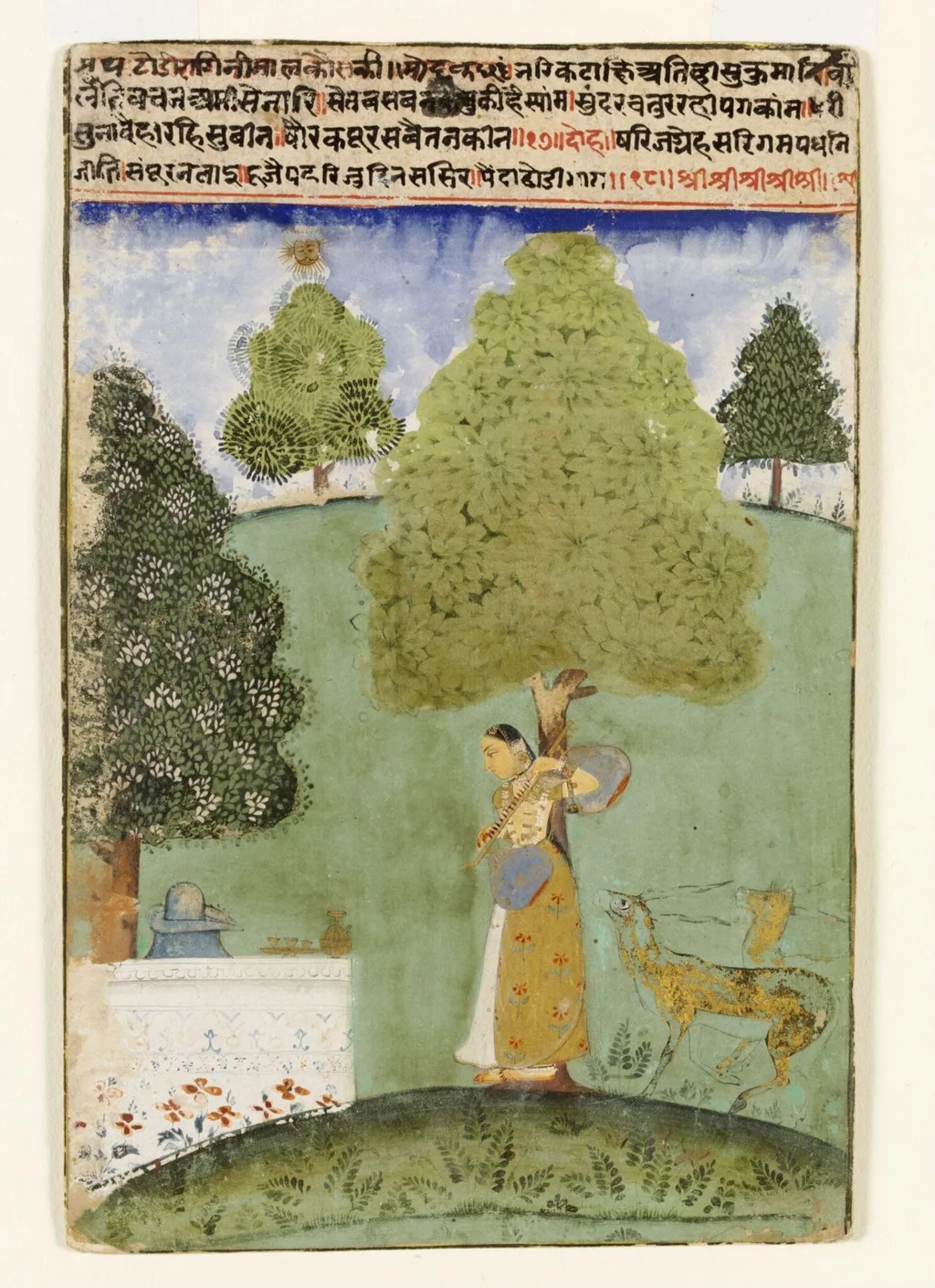
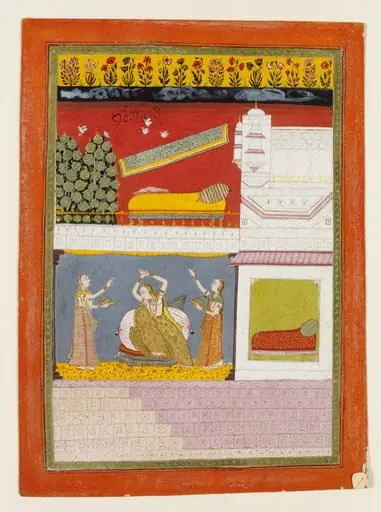
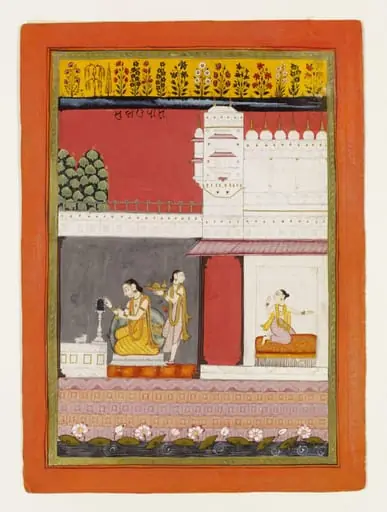
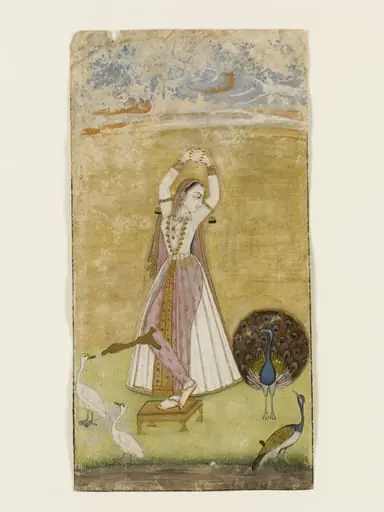
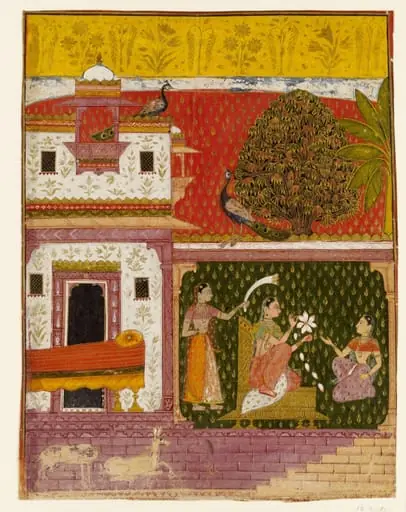
Todi Ragini is a paint painting by the Mughal Painting artist Unknown. It dates from 1750 and is held in the collection of the Victoria and Albert Museum.
About this work
Overview
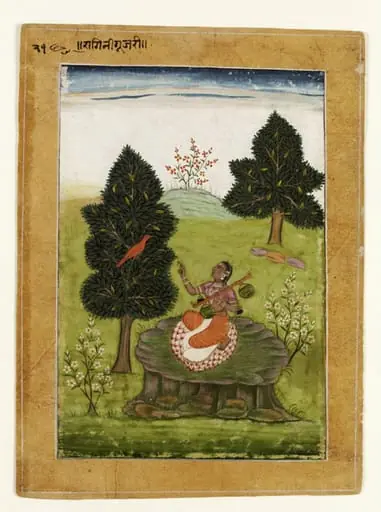
Rendered in flat, unmodulated hues with gold accents, the scene centers on a woman playing a vina beneath a tree.
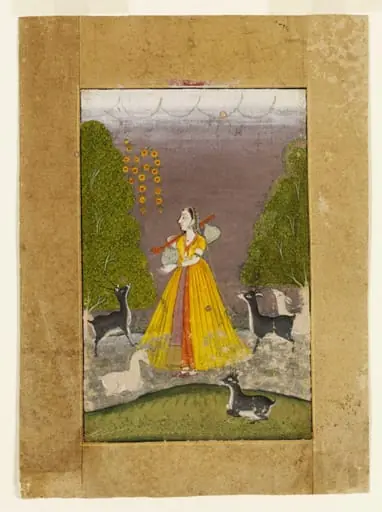
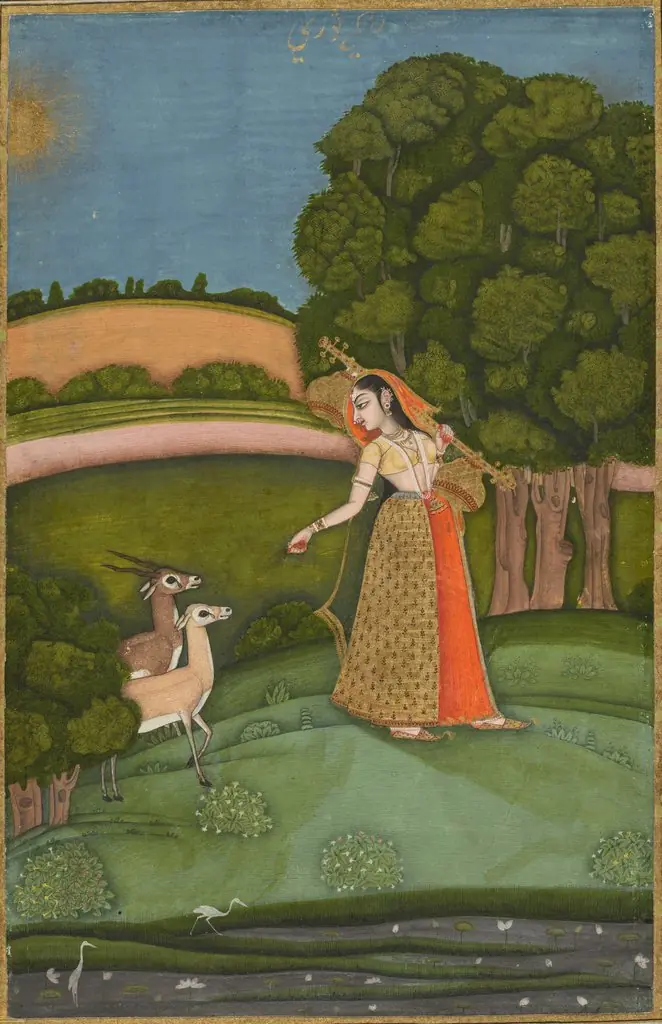
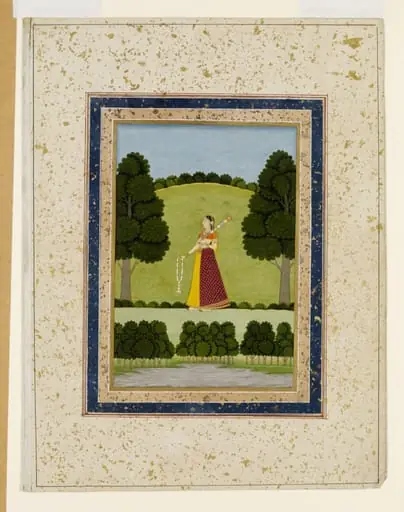
This opaque watercolor on paper depicts the Todi Ragini, a musical mode from the Indian classical tradition. Rendered in flat, unmodulated hues with gold accents, the scene centers on a woman playing a vina beneath a tree. A lingam shrine appears behind her, flanked by two blackbuck drawn toward the sound. The sky holds a stylized sun with a human face, and a Sanskrit text panel above frames the imagery. The original border is absent, and the composition lacks depth or shading.
Subject & Meaning
The painting visualizes Todi Ragini through symbolic elements tied to devotion and nature. The woman’s music, played before a lingam, suggests spiritual resonance, while the blackbuck, traditionally associated with grace and sensitivity, respond to the melody as if moved by divine vibration. The sun with a face implies cosmic awareness, aligning the musical mode with celestial order. The setting, neither palace nor temple, evokes an intimate, natural sacred space.
Technique & Style
The work employs opaque watercolor with minimal shading, relying on flat planes of color and clear outlines. Gold leaf highlights the sun and possibly the animals’ former gilding, though much has faded. Forms are simplified—trees, shrine, and figures rendered with geometric clarity. No perspective or modeling creates depth; instead, spatial relationships are suggested through placement and scale. The script above is in a regional North Indian variant of Devanagari.
History & Provenance
This painting belongs to a series of Ragamala illustrations, likely produced in the late 17th or early 18th century in the Rajasthani or Pahari region. It diverges in iconography from a known 1709 version in the Kanvsoli collection, which places the musician in a palace context. Despite differences in setting, both share identical textual inscriptions, suggesting a common source text adapted to local visual conventions.
Context
Ragamala paintings linked musical modes to visual narratives, often personifying them as figures in specific landscapes or sacred settings. Todi, associated with late morning and devotion, was commonly depicted with ascetic or nature-bound imagery. This version reflects a regional preference for natural shrines over courtly ones, aligning with devotional trends in early modern North India where music and spirituality were intertwined in daily ritual.
Legacy
As part of a broader tradition of Ragamala art, this work exemplifies how abstract musical concepts were made tangible through symbolic imagery. Its simplicity and symbolic focus influenced later regional styles, though few surviving examples retain original borders or gilding. Today, it contributes to scholarly understanding of how Indian musical theory was visually codified outside elite courtly contexts.
Artist & collection

 Domestic Scene
 Giacomo and Cardinal Marco, investing Andrea, Abbot of San Zeno, with his Benefice
 The Nymph of Fontainebleau
 Portrait of a Woman
 Madonna and Child with Saints in the Enclosed Garden
 Venus and Minerva
 Family Group of Four on Sofa
 Wall painting from Room H of the Villa of P. Fannius Synistor at Boscoreale