Artwork
Two figures
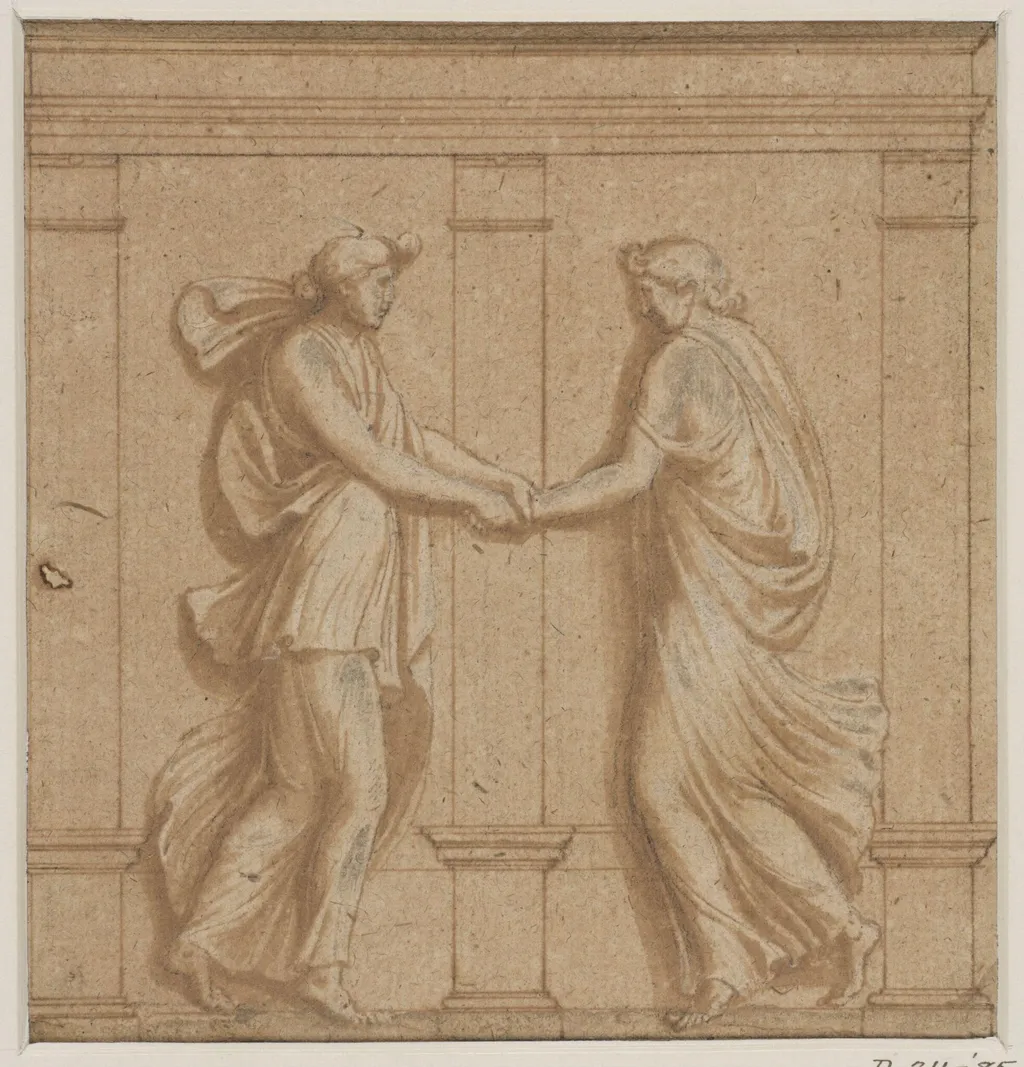
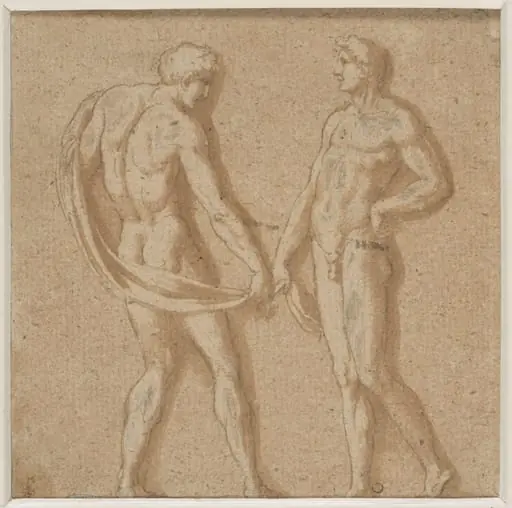
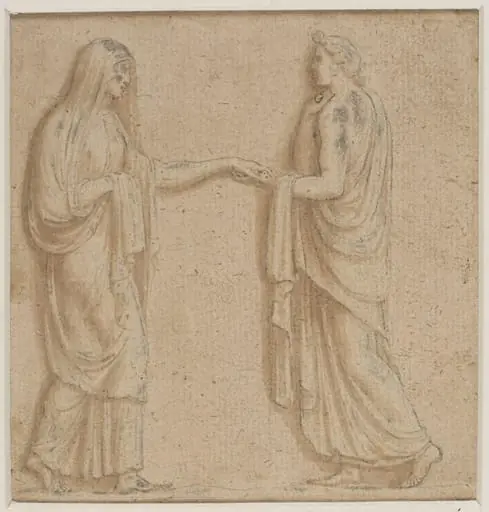
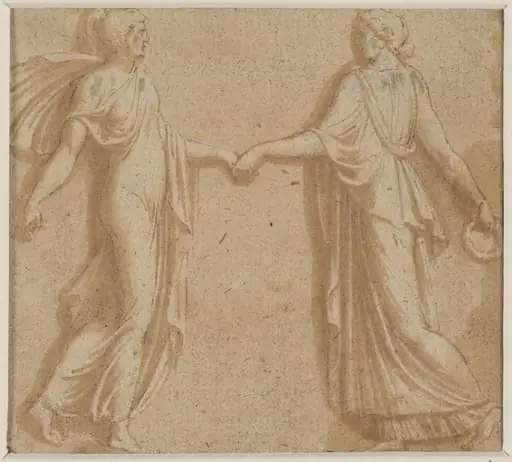
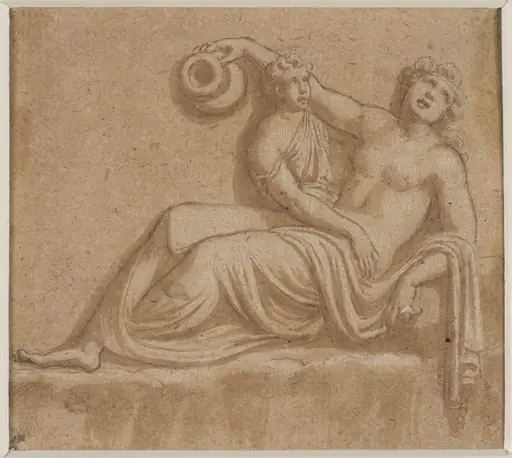
Two figures is a drawing by Unknown. It dates from 1650 and is held in the collection of the Victoria and Albert Museum. This ink drawing depicts two robed figures confronting one another before a simplified architectural setting.
About this work
Overview
The restrained line and spatial clarity reflect the classical ideals Poussin championed, even if the hand is not his own.
This ink drawing depicts two robed figures confronting one another before a simplified architectural setting. Though not executed by Nicolas Poussin, its composition and handling suggest it was produced by an artist closely associated with his circle, likely as a study for a larger sculptural or relief work. The restrained line and spatial clarity reflect the classical ideals Poussin championed, even if the hand is not his own.
Subject & Meaning
The two figures, draped in flowing garments, appear to engage in a moment of formal encounter—possibly a ritual, dialogue, or symbolic meeting. The absence of overt narrative cues leaves the scene open to interpretation, but the architectural backdrop implies a sacred or civic context. Such compositions often alluded to moral or mythological themes common in Poussin’s circle, rooted in antiquity and Renaissance humanism.
Technique & Style
Executed in fine ink lines with minimal shading, the drawing emphasizes contour and spatial economy. The drapery is rendered with rhythmic folds, echoing Poussin’s disciplined approach to form, while the architecture is suggested rather than detailed. The precision and restraint point to a skilled draftsman trained in the master’s methods, likely working from life or earlier studies rather than inventing freely.
History & Provenance
The drawing’s origins remain undocumented, but its stylistic affinities place it within the orbit of Poussin’s workshop in Rome during the mid-17th century. It likely circulated among artists or patrons familiar with his aesthetic, possibly as a model for sculptors or as a teaching aid. Its survival suggests it was valued for its compositional clarity rather than its authorship.
Context
In the decades following Poussin’s move to Rome, his drawings served as foundational references for a generation of French and Italian artists. This piece reflects the broader practice of using preparatory sketches to refine figures and arrangements before executing larger works in stone or paint. Such studies were integral to the classical revival, prioritizing structure over ornament.
Legacy
Though unsigned and unattributed to Poussin, the drawing preserves the visual language he helped define: order, restraint, and intellectual gravity. It stands as evidence of how his influence extended beyond his own hand, shaping the training and output of contemporaries who carried his principles into sculpture and painting across Europe.
Artist & collection

 Domestic Scene
 Giacomo and Cardinal Marco, investing Andrea, Abbot of San Zeno, with his Benefice
 The Nymph of Fontainebleau
 Portrait of a Woman
 Madonna and Child with Saints in the Enclosed Garden
 Venus and Minerva
 Family Group of Four on Sofa
 Wall painting from Room H of the Villa of P. Fannius Synistor at Boscoreale