Artwork
Vishnu
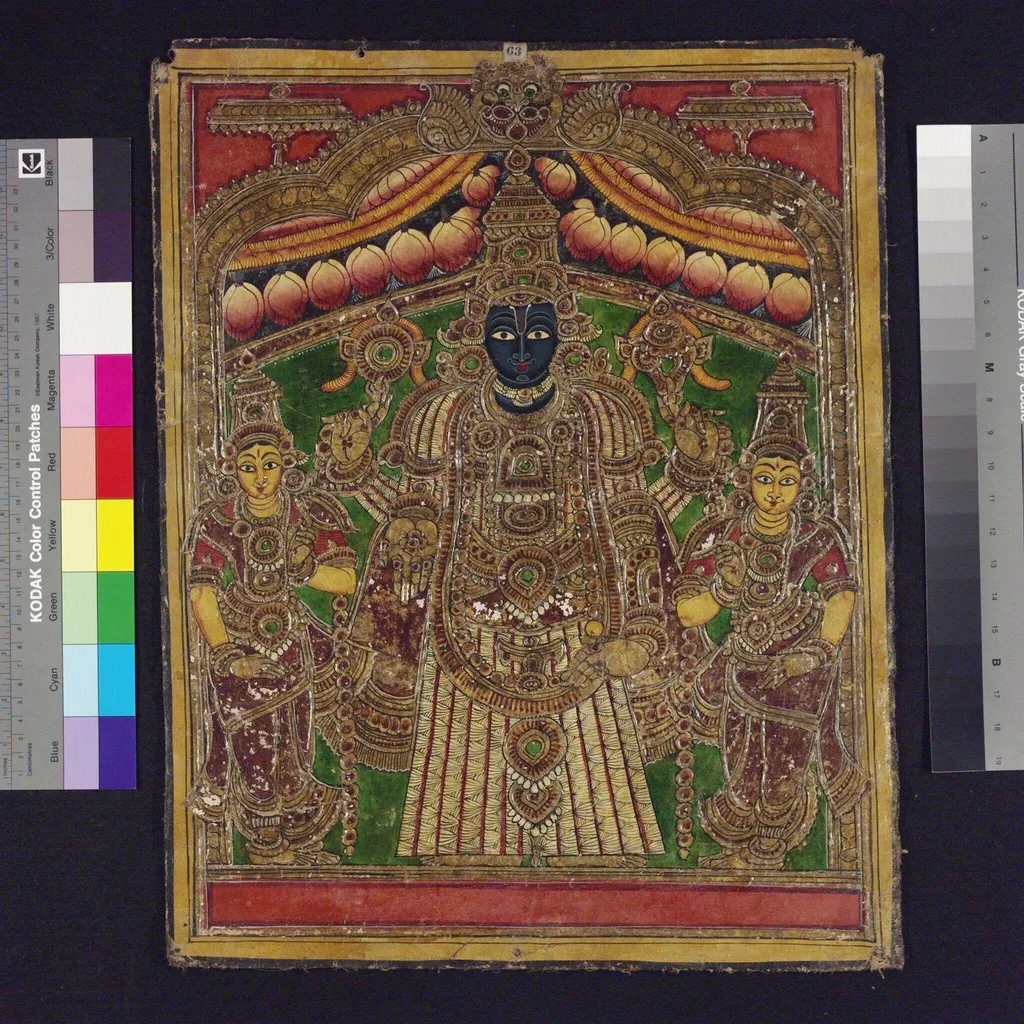
Vishnu is a paint painting by the Patna School of Painting artist Unknown. It dates from 1840 and is held in the collection of the Victoria and Albert Museum.
About this work
Overview
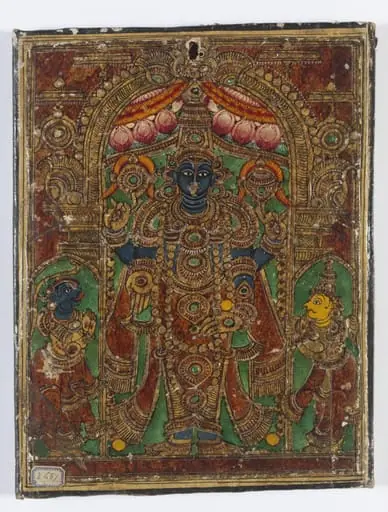
This painting, executed on stiffened card with embedded mica, presents a devotional scene centered on the Hindu deity Vishnu.
This painting, executed on stiffened card with embedded mica, presents a devotional scene centered on the Hindu deity Vishnu. The surface is enriched with reflective particles that catch light, enhancing the luminous quality of the composition. Three figures are arranged symmetrically against a vivid green field, their forms rendered with meticulous detail and a heightened sense of ornamentation characteristic of regional Indian painting traditions.
Subject & Meaning
Vishnu, the preserver in Hindu cosmology, stands centrally, identified by his dark complexion and staff, symbols of authority and cosmic order. Flanking him are two attendants, one holding a ceremonial fan and the other a scroll, suggesting ritual service and the transmission of sacred knowledge. The red arch above, adorned with clustered orange discs, may reference celestial realms or divine radiance, reinforcing the sacred nature of the scene.
Technique & Style
The figures are densely adorned with fine linear patterns resembling embroidery, applied with precision using pigments and metallic leaf. Mica flakes are embedded into the surface to create a shimmering effect, particularly on garments and ornaments. Bold, saturated hues—emerald green, crimson, and gold—dominate the palette, while the flat, unmodulated background emphasizes the decorative richness of the figures.
History & Provenance
The work likely originated in a regional court or temple workshop in western or central India, where devotional paintings on card were produced for private worship or ritual use. Its use of mica and stiffened support aligns with 18th- to 19th-century practices in areas such as Rajasthan or Gujarat. The painting’s survival suggests it was carefully preserved, possibly within a devotional context or collector’s archive.
Context
This painting reflects a broader tradition of Indian miniature and devotional art that emphasized symbolic detail over naturalism. Similar works were created for use in domestic shrines or as offerings in temple settings, where visual splendor served to evoke divine presence. The integration of reflective materials and intricate patterning was not merely aesthetic but intended to elevate the spiritual experience of the viewer.
Legacy
Works of this type contributed to the visual vocabulary of Indian religious art, influencing later regional styles and colonial-era collections. Today, such paintings are studied for their craftsmanship and devotional intent, offering insight into how sacred figures were rendered for intimate worship. Institutions like the Victoria and Albert Museum hold comparable examples, preserving their cultural and artistic significance.
Artist & collection

 Domestic Scene
 Giacomo and Cardinal Marco, investing Andrea, Abbot of San Zeno, with his Benefice
 The Nymph of Fontainebleau
 Portrait of a Woman
 Madonna and Child with Saints in the Enclosed Garden
 Venus and Minerva
 Family Group of Four on Sofa
 Wall painting from Room H of the Villa of P. Fannius Synistor at Boscoreale