Artwork
Proposal for the Trevi Fountain
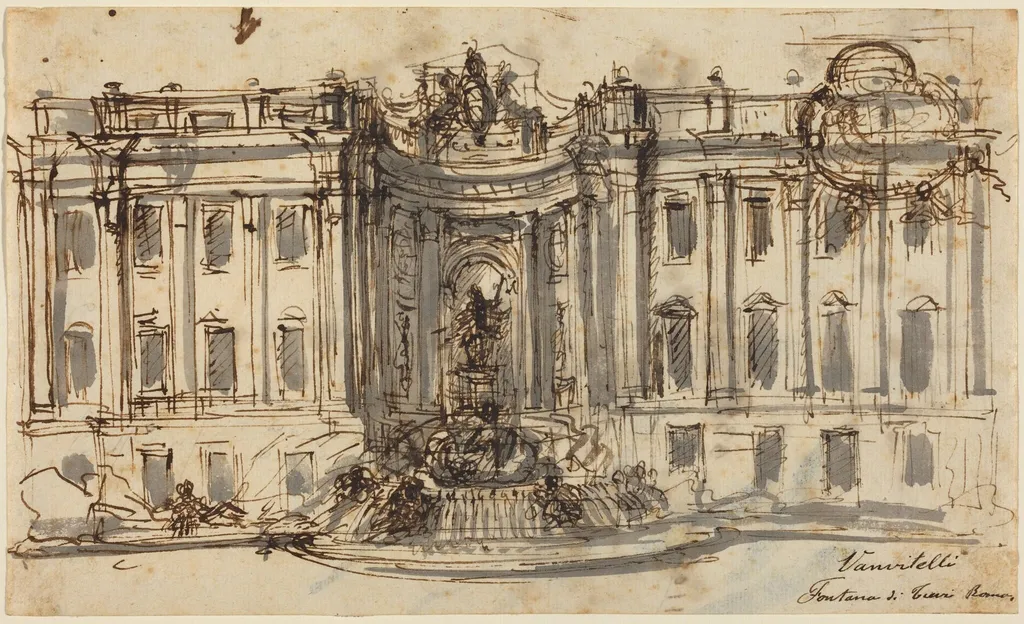
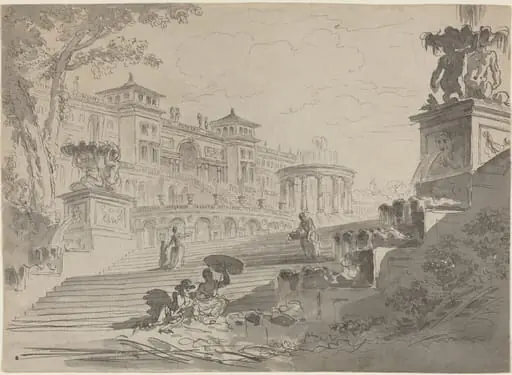
Proposal for the Trevi Fountain is an ink drawing by the Baroque artist Luigi Vanvitelli. It dates from 1731 and is held in the collection of the National Gallery of Art.
About this work
Overview
The composition centers on a monumental, symmetrical structure flanked by stairs, with water emerging from its base and figures scattered along its base.
This 1731 ink and wash drawing by Luigi Vanvitelli presents a conceptual design for the Trevi Fountain in Rome. Executed on laid paper, the sketch combines pen lines with subtle gray tonal washes to suggest volume and shadow. The composition centers on a monumental, symmetrical structure flanked by stairs, with water emerging from its base and figures scattered along its base. Vanvitelli’s signature and the inscription 'Fontana di Trevi' confirm its intended purpose.
Subject & Meaning
The drawing envisions the Trevi Fountain as a theatrical urban monument, merging hydraulic function with architectural grandeur. Central arches framed by columns evoke classical temples, while the cascading water and surrounding figures introduce narrative motion. The design reflects the Baroque ideal of integrating nature, sculpture, and structure into a single immersive experience, transforming a public water source into a symbolic centerpiece of civic pride.
Technique & Style
Vanvitelli employed rapid, fluid pen strokes to define architectural forms, complemented by diluted gray washes that model depth without heavy detail. The loose handling suggests a working sketch rather than a polished presentation, emphasizing spatial relationships over ornamentation. The contrast between precise linear outlines and soft tonal gradients reveals an artist working through spatial and structural problems, characteristic of preparatory studies for large-scale commissions.
History & Provenance
Created during Vanvitelli’s early career, this drawing predates the final construction of the Trevi Fountain by over a decade. Though his design was not fully realized, it influenced later stages of the project under Nicola Salvi. The sketch remained in private hands until entering a public collection, where it now serves as a key document of the fountain’s evolving conception and the transition from concept to built form.
Context
In early 18th-century Rome, monumental fountains were both practical infrastructure and expressions of papal and civic authority. Vanvitelli’s proposal emerged amid a broader revival of classical forms filtered through Baroque dynamism. His design responded to urban planning initiatives that sought to enhance Rome’s public spaces with dramatic, emotionally charged architecture, aligning with contemporary trends in ecclesiastical and civic design.
Legacy
Though Vanvitelli’s specific design was modified by subsequent architects, his sketch preserved the essential spatial logic of the final fountain: axial symmetry, hierarchical elevation, and the integration of water as a sculptural element. The drawing remains a vital record of the design process, illustrating how Baroque ideals were translated from paper to stone through iterative refinement and collaborative execution.
Artist & collection


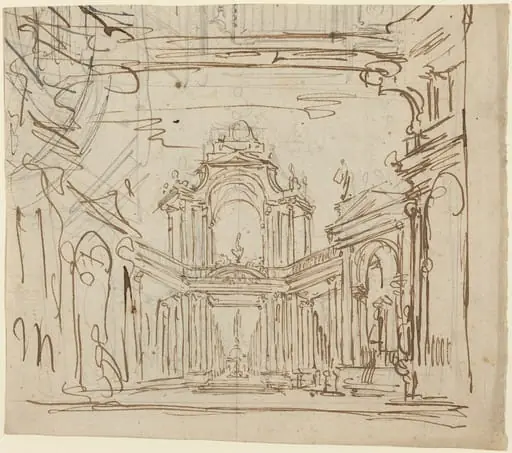 Stage Design
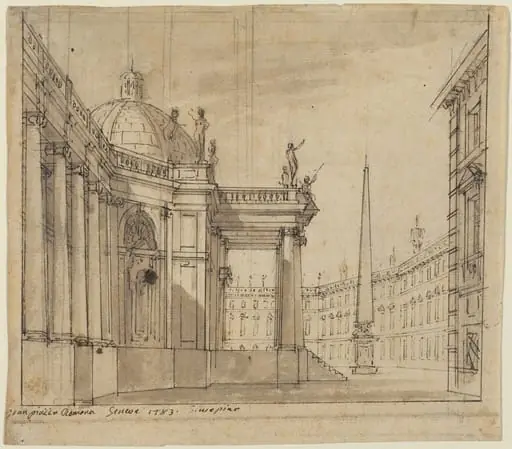 Stage Design: A Piazza with a Domed Church and an Obelisk
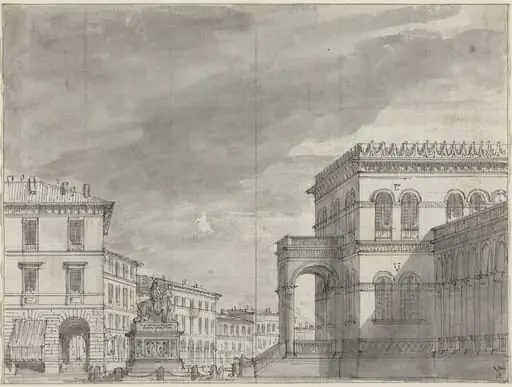 Piazza with an Equestrian Monument and a Palace
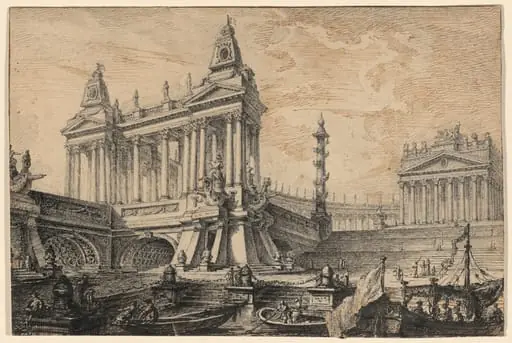 Architectural Fantasy of a Magnificent Ancient Port
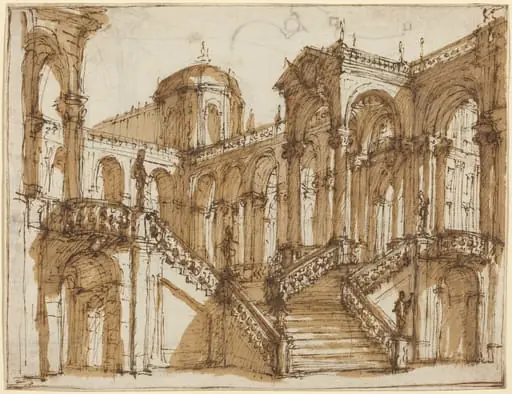 Stage Design
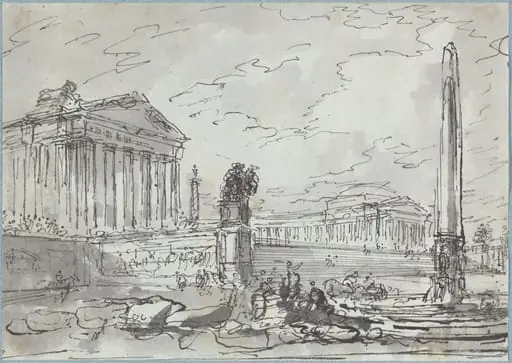 Fantasy on an Ancient Campidoglio
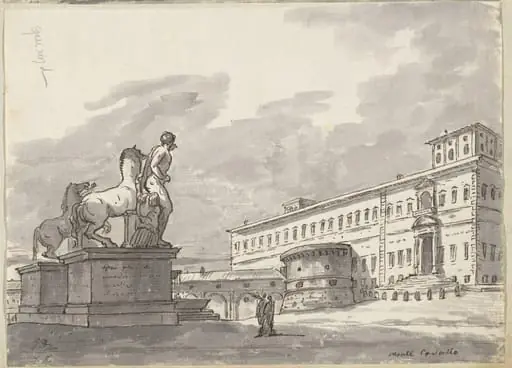 Monte Cavallo, with the Horse Tamers
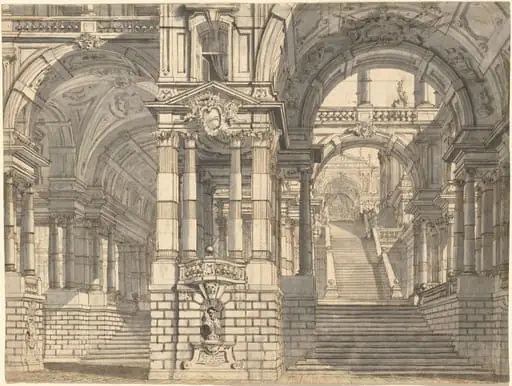 Fantasy of Magnificent Courtyards and Loggie with a Monumental Staircase
 Fantasy on the Villa Medici with Fountains