Artwork
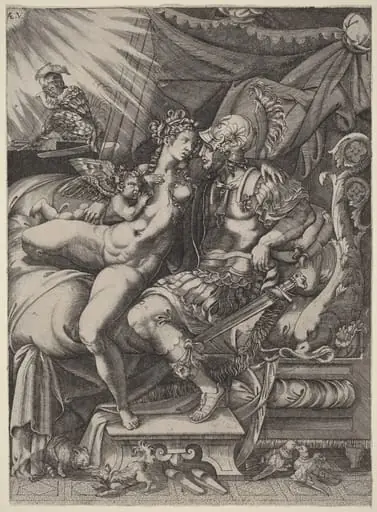
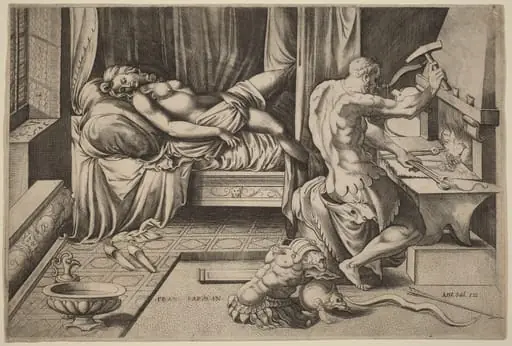
Venus and Mars Embracing with Vulcan at his Forge
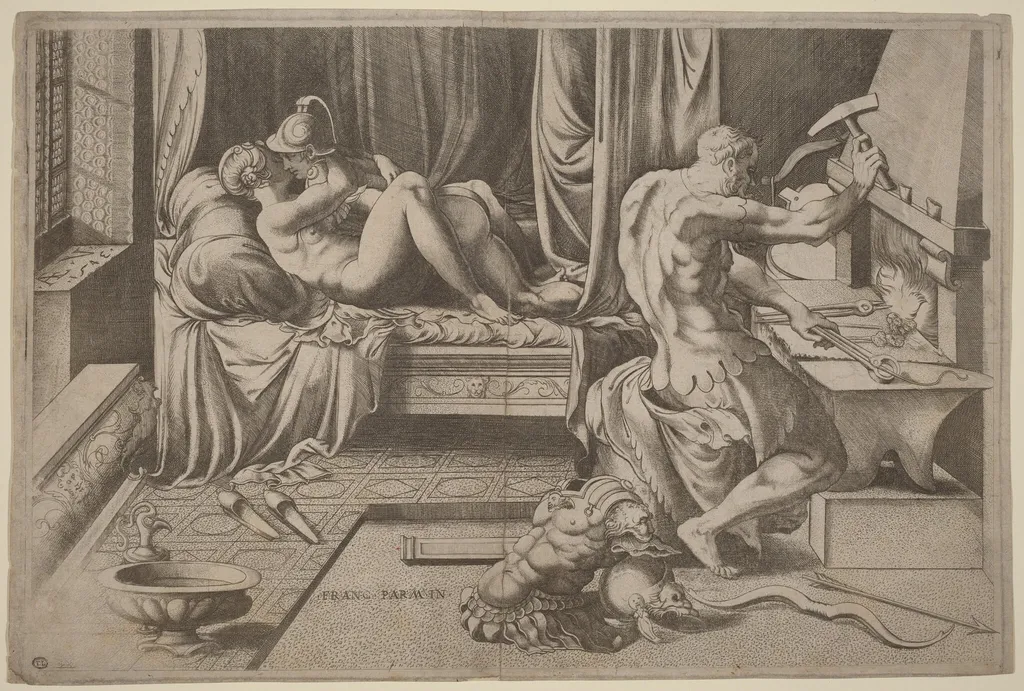
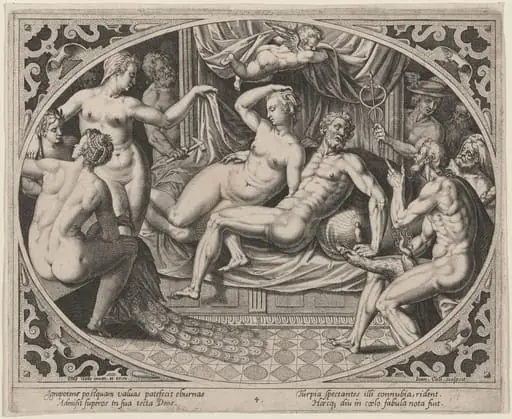
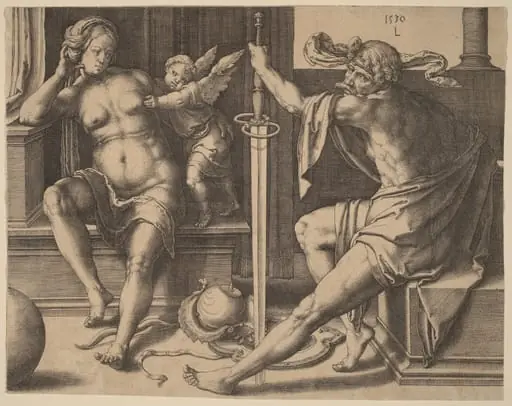
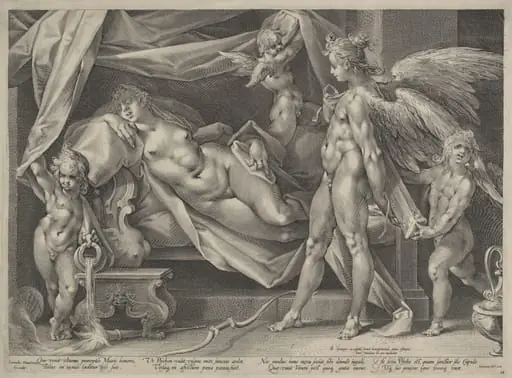
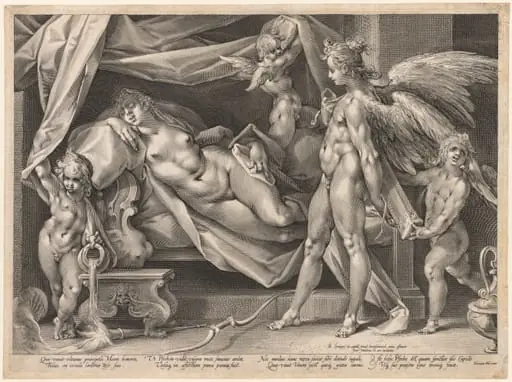
Venus and Mars Embracing with Vulcan at his Forge is an ink print by the Renaissance artist Enea Vico. It dates from 1543 and is held in the collection of the National Gallery of Art.
About this work
Overview
Vico’s technical precision and engagement with classical narratives defined his career, which spanned from Rome to Ferrara before his death in 1567.
Enea Vico, an Italian engraver from Parma, produced this print in 1543 during his active years in printmaking. Executed in engraving on laid paper, the work belongs to a series of mythological subjects he created for elite patrons, including members of the Medici and Este families. Vico’s technical precision and engagement with classical narratives defined his career, which spanned from Rome to Ferrara before his death in 1567.
Subject & Meaning
The scene depicts Venus and Mars in an intimate embrace, referencing their mythological affair, while Vulcan, Venus’s husband, works at his forge nearby. The presence of a child interacting with a hybrid sea creature alludes to the chaotic consequences of divine infidelity. The composition juxtaposes passion and labor, suggesting tension between desire and duty, a common theme in Renaissance interpretations of classical myth.
Technique & Style
Vico employed fine, controlled lines to render muscular forms and dynamic movement, particularly in the entwined bodies of Venus and Mars. The forge is rendered with meticulous detail—hammer strikes, flying sparks, and textured tools convey the heat and labor of Vulcan’s craft. Shading and cross-hatching create depth and volume, demonstrating Vico’s mastery of the engraving medium and his ability to translate sculptural forms onto paper.
History & Provenance
Created during Vico’s time in Rome and later Ferrara, the print likely circulated among humanist collectors and noble patrons who valued mythological imagery. His association with Cosimo I de’ Medici and Alfonso II of Ferrara suggests the work was commissioned or acquired by influential circles. The print’s survival reflects its appeal in Renaissance collections focused on classical revival and technical virtuosity.
Context
In mid-16th-century Italy, mythological prints served both decorative and intellectual functions, appealing to patrons interested in antiquity and moral allegory. Vico’s work aligned with broader trends in printmaking, where artists reinterpreted classical sources through contemporary techniques. His engravings contributed to the dissemination of mythological narratives beyond painting and sculpture, reaching a wider educated audience.
Legacy
Vico’s prints, including this one, influenced later generations of engravers through their refined line work and narrative clarity. Though less celebrated than contemporaries like Dürer or Titian, his contributions helped sustain the Renaissance tradition of mythological printmaking. His technical approach and thematic choices remain studied as examples of how classical stories were visually adapted in early modern Europe.
Artist & collection

Artist
Enea Vico (29 January 1523 – 18 August 1567) was an Italian engraver. Vico was born in Parma. He specialized in grotesque engravings based on antique paintings. Vico made engravings for Cosimo I de' Medici, Grand Duke…

 The Loves of Mars and Venus
![Fragments from Ancient Cameos in the Grimani Collection [Plate I], by Enea Vico](https://artifactworldgallery.com/img/enea-vico--fragments-from-ancient-cameos-in-the-grimani-collection-plat--1f564c058ab46ade-w320.webp) Fragments from Ancient Cameos in the Grimani Collection [Plate I]
Fragments from Ancient Cameos in the Grimani Collection [Plate I] Old Woman with a Distaff
![Fragments from Ancient Cameos in the Grimani Collection [Plate II], by Enea Vico](https://artifactworldgallery.com/img/enea-vico--fragments-from-ancient-cameos-in-the-grimani-collection-plat--6333de7ba7491db7-w320.webp) Fragments from Ancient Cameos in the Grimani Collection [Plate II]
Fragments from Ancient Cameos in the Grimani Collection [Plate II] Giovanni de' Medici
 Rhinoceros
 Venus Reclining with Vulcan at His Forge
![Fragments from Ancient Cameos in the Grimani Collection [Plate III], by Enea Vico](https://artifactworldgallery.com/img/enea-vico--fragments-from-ancient-cameos-in-the-grimani-collection-plat--bf2c0f15852500f8-w320.webp) Fragments from Ancient Cameos in the Grimani Collection [Plate III]
Fragments from Ancient Cameos in the Grimani Collection [Plate III]