Artwork
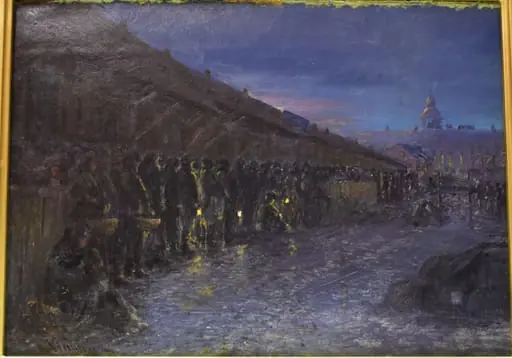
Piața în Iași (Manifestație Piața Spiridon)
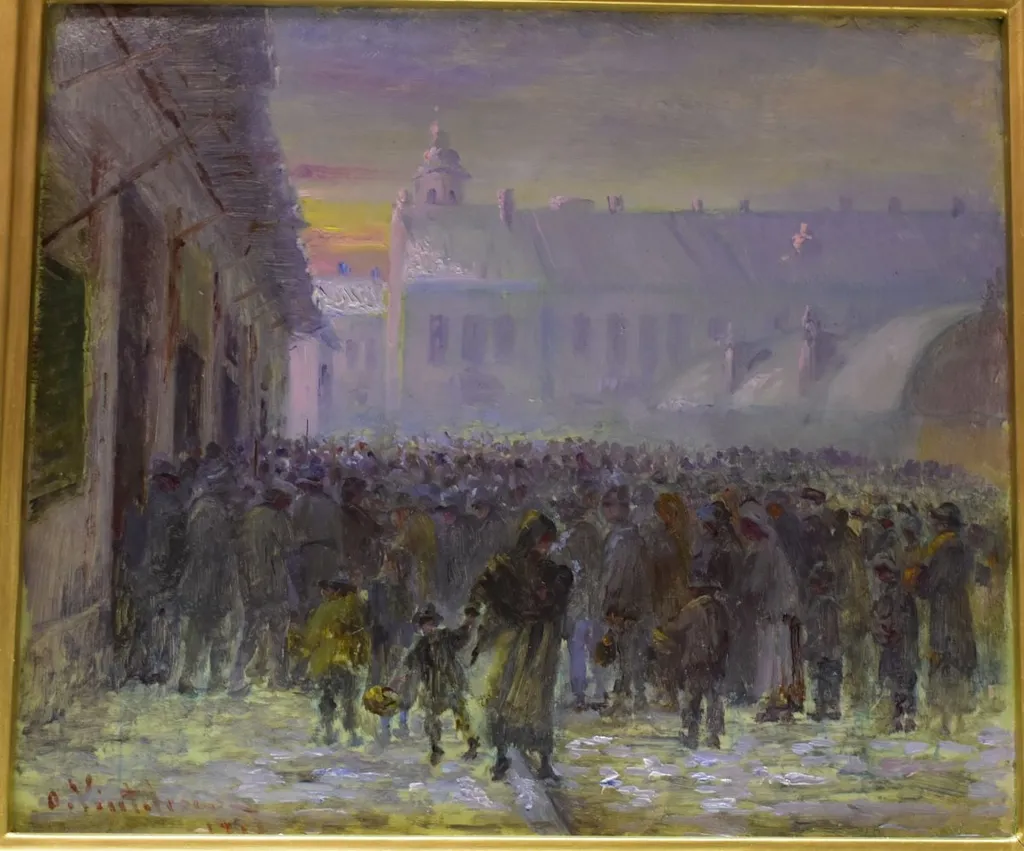
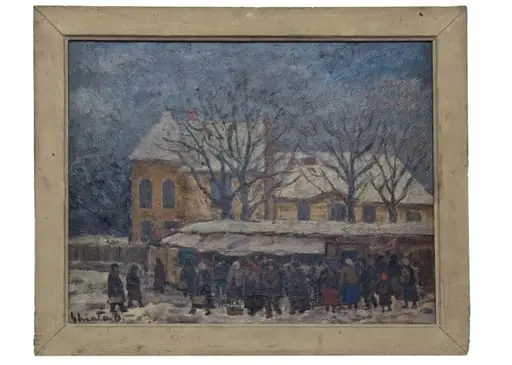
Piața în Iași (Manifestație Piața Spiridon) is an unspecified painting by Aurel Vintilescu. It dates from 1917 and is held in the collection of the Bucharest Municipality Museum.
About this work
Overview
Its raw, energetic composition conveys the rhythm of daily movement amid uncertainty, using texture and tone to evoke atmosphere rather than detail.
Painted in 1917 by Aurel Vintilescu, Piața în Iași (Manifestație Piața Spiridon) captures a public square in Iași during twilight. The work is held in the collection of the Museum of Ethnography and reflects a moment of urban life in Romania during wartime. Its raw, energetic composition conveys the rhythm of daily movement amid uncertainty, using texture and tone to evoke atmosphere rather than detail.
Subject & Meaning
The scene depicts a dense crowd navigating the square at dusk, individuals wrapped in heavy coats, some carrying goods or moving in pairs. The architecture, dominated by a domed building, anchors the composition, suggesting civic presence amid transient human activity. The painting does not idealize the moment but records it as a quiet, unremarkable gathering—emphasizing endurance over spectacle.
Technique & Style
Vintilescu employed thick, rapid brushwork to render motion and mass, using impasto to build tactile surfaces that mimic the texture of woolen coats and uneven pavement. Colors are subdued—grays, browns, and deep blues—except for the dome, which glows faintly pink against the violet sky. This contrast draws the eye without disrupting the painting’s somber mood, reinforcing the quiet dignity of the scene.
History & Provenance
Created during World War I, the painting emerged from a period of social strain and national redefinition in Romania. It entered the Museum of Ethnography’s collection shortly after its completion, likely chosen for its documentation of everyday urban life. Its preservation reflects an early institutional interest in capturing ordinary Romanian experiences beyond formal portraiture or historical narrative.
Context
In 1917, Iași served as Romania’s temporary capital after the occupation of Bucharest. The city swelled with refugees, soldiers, and displaced families, making public spaces like Spiridon Square sites of both congestion and resilience. Vintilescu’s depiction avoids political symbolism, instead focusing on the physical reality of crowded streets—a quiet testament to civilian endurance during upheaval.
Legacy
The painting remains a rare visual record of early 20th-century Romanian urban life, valued for its unembellished observation. While not widely exhibited outside its home institution, it contributes to scholarly understanding of how Romanian artists responded to wartime conditions through intimate, non-heroic imagery. Its technique anticipates later expressive realism in Eastern European painting.
Artist & collection
Artist
Aurel Vintilescu carried a sketchbook everywhere, even on the back of his motorcycle, scribbling Iași street scenes between deliveries.