Artwork
A Meadow with a Shepherd and Goats at the Edge of a Forest
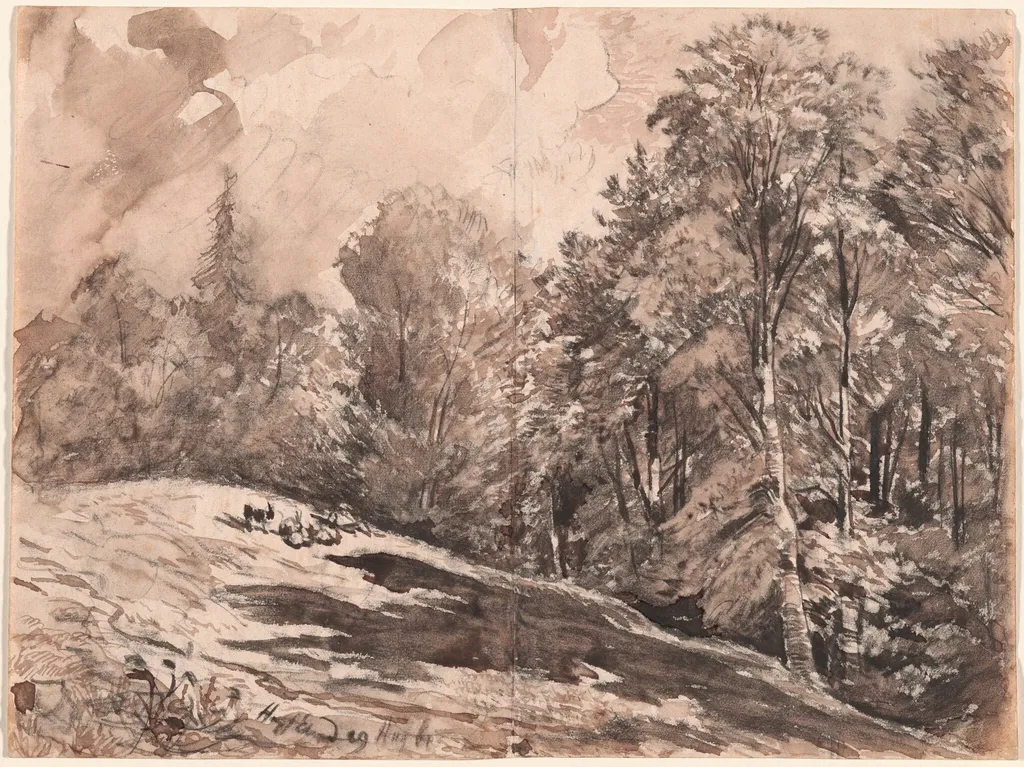
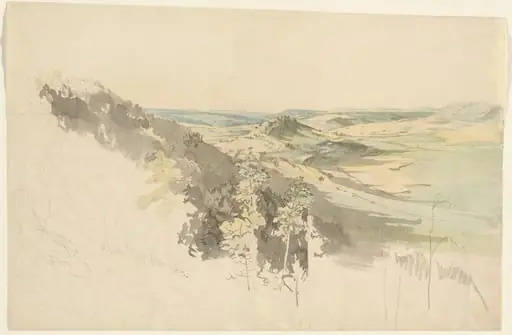
A Meadow with a Shepherd and Goats at the Edge of a Forest is a chalk drawing by the Impressionist artist Carl Wagner. It dates from 1861 and is held in the collection of the National Gallery of Art.
About this work
Overview
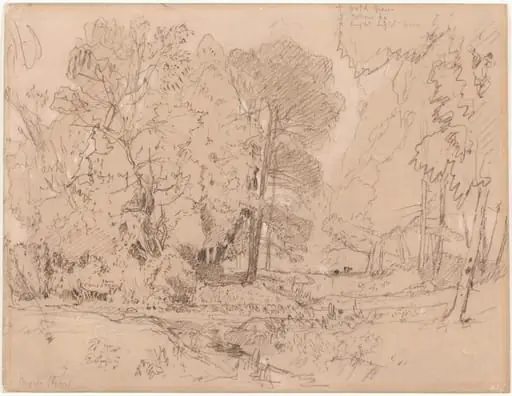
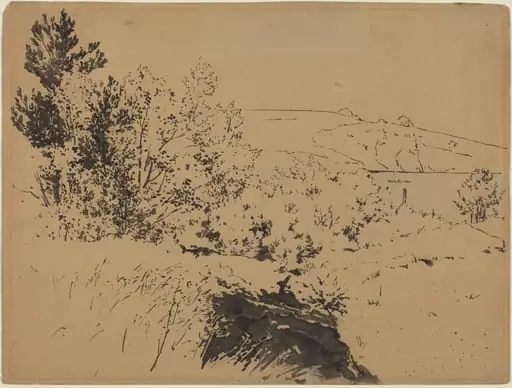
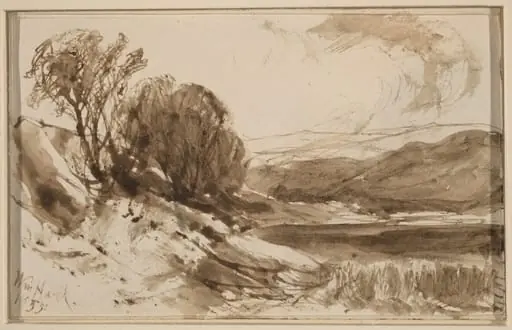
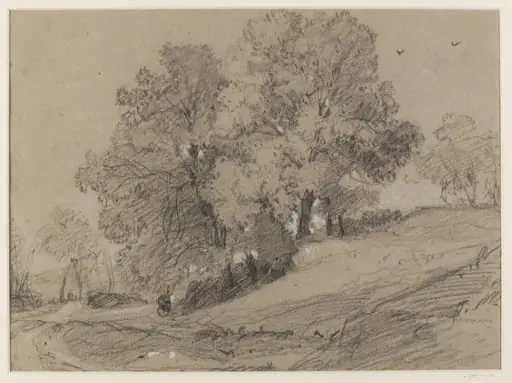
Created in 1861, this drawing by Carl Wagner is a landscape sketch executed in brown ink over black chalk on two joined sheets of wove paper. The work captures a quiet moment at the boundary between open meadow and dense woodland. Its modest scale and unpolished appearance reflect its function as a study rather than a finished composition, emphasizing immediacy over finish.
Subject & Meaning
The stillness of the figures and the muted tones evoke a sense of solitude, characteristic of Romantic-era sensibilities toward rural life.
A solitary shepherd and a small group of goats are positioned near the forest’s edge, their forms suggested with minimal strokes. The scene avoids narrative drama, instead inviting quiet reflection on the relationship between human presence and the natural world. The stillness of the figures and the muted tones evoke a sense of solitude, characteristic of Romantic-era sensibilities toward rural life.
Technique & Style
Wagner employed swift, fluid brushwork and delicate chalk underdrawing to suggest texture and form. Shadows are built through light cross-hatching and soft washes, while the snow-dusted ground and stream are rendered with sparse, suggestive lines. The use of two joined sheets allowed for a broader composition, yet the overall handling retains the spontaneity of an on-site sketch, prioritizing atmosphere over detail.
History & Provenance
The drawing originates from Wagner’s personal sketchbook, likely made during a field study in the German countryside. Its preservation on original paper, with visible seams where sheets were joined, supports its status as a working document rather than a commissioned piece. No significant ownership history beyond the artist’s circle is documented.
Context
Wagner worked within the German Romantic tradition, which valued emotional resonance in nature over idealized grandeur. This drawing aligns with contemporaneous practices among artists who sought authenticity through direct observation. The focus on modest, everyday rural scenes contrasted with the monumental landscapes favored by some of his peers.
Legacy
Though not widely exhibited during his lifetime, Wagner’s sketches like this one contribute to understanding the evolution of German Romantic drawing. Their unpretentious quality influenced later generations of artists who valued the expressive potential of preliminary studies. Today, such works are appreciated for their honesty and sensitivity to natural light and form.
Artist & collection
Artist
Carl Wagner (19 October 1796 in Roßdorf (Thüringen) - 10 February 1867 in Meiningen) was a German painter and representatives of the Romantic landscape painting.

![Forest on Lago Maggiore [Foresta sul Lago Maggiore], by Giberto Borromeo](https://artifactworldgallery.com/img/giberto-borromeo--forest-on-lago-maggiore-foresta-sul-lago-maggiore--6d25270befdb299f-w320.webp)