Artwork
Justice For George Davis
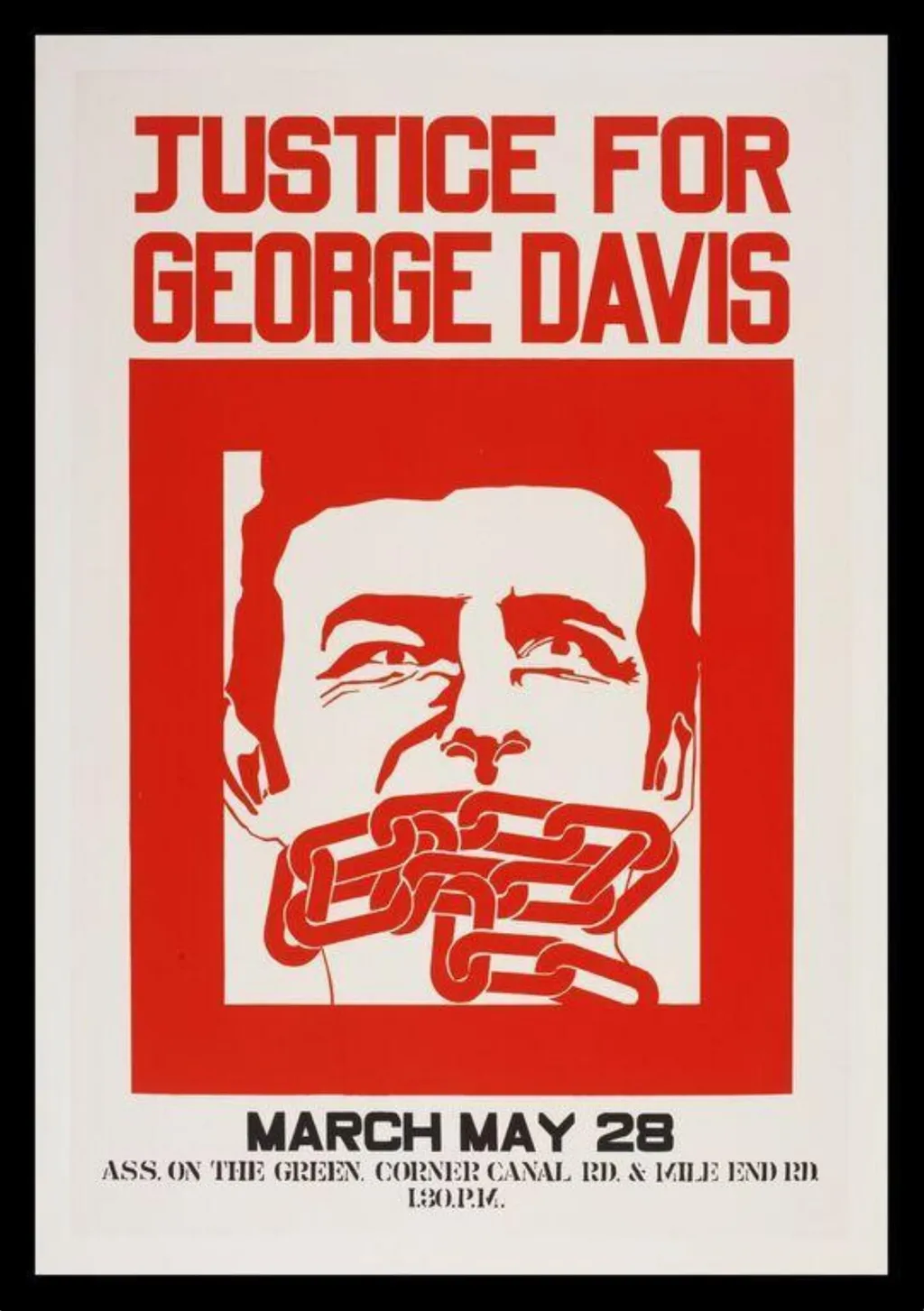
Justice For George Davis is a poster by Martin Walker. It dates from 1974 and is held in the collection of the Victoria and Albert Museum.
About this work
Overview
Created in 1974 by Martin Walker, this screenprint is a political poster advocating for George Davis, a Black man wrongfully imprisoned in the UK.
Created in 1974 by Martin Walker, this screenprint is a political poster advocating for George Davis, a Black man wrongfully imprisoned in the UK. The design employs stark red and white contrasts to draw immediate attention. Text is not merely informational but forms part of the imagery, with the word 'JUSTICE' woven into a rope binding the subject's mouth, transforming language into a symbol of silencing.
Subject & Meaning
The central figure is a calm, closed-eyed face, suggesting resignation or inner strength amid oppression. The rope binding the mouth is constructed from the repeated letters of 'JUSTICE,' visually equating the demand for justice with the act of suppression. The image conveys the contradiction between societal claims of fairness and the reality of systemic injustice faced by Davis, a Black man denied due process.
Technique & Style
Walker used screenprinting to achieve bold, flat areas of color with sharp edges, typical of activist graphics of the era. The uneven, hand-printed lettering of the title adds urgency and imperfection, rejecting polished commercial aesthetics. The rope of letters merges typography with symbolism, turning language into a physical constraint. The limited palette of red and white heightens emotional impact without distraction.
History & Provenance
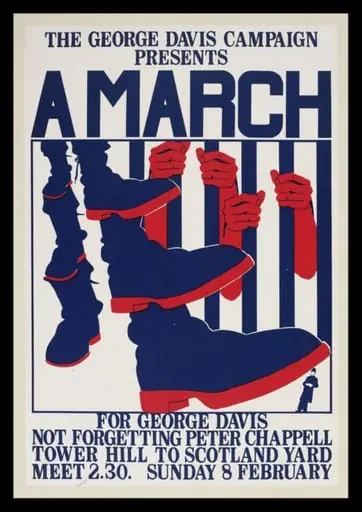
The poster was produced to support the campaign for George Davis, who was convicted in 1973 of a crime many believed he did not commit. It was distributed during protests and community meetings in London, particularly around the dates noted on the poster: March and May 28. Its circulation was tied to grassroots organizing efforts by Black British activists and allies seeking to challenge racial bias in the legal system.
Context
Produced during a period of heightened racial tension in Britain, the poster reflects the growing visibility of anti-racist activism in the 1970s. It aligns with movements like the Black Panther Party’s influence in the UK and campaigns against police brutality and wrongful convictions. The use of direct, graphic language and symbolic imagery was a deliberate strategy to bypass mainstream media silence and mobilize public awareness.
Legacy
Walker’s poster remains a reference point in British political art for its fusion of typography and protest. It exemplifies how design can serve as a tool for marginalized communities to assert visibility. Though not widely exhibited in mainstream institutions, it endures in archives of activist art and is studied for its concise, powerful communication of systemic injustice.
Artist & collection
Artist
British designer Martin Walker turned bold typography and stark slogans into rallying cries on 1970s protest posters.