Artwork
The George Davis Campaign Presents A March
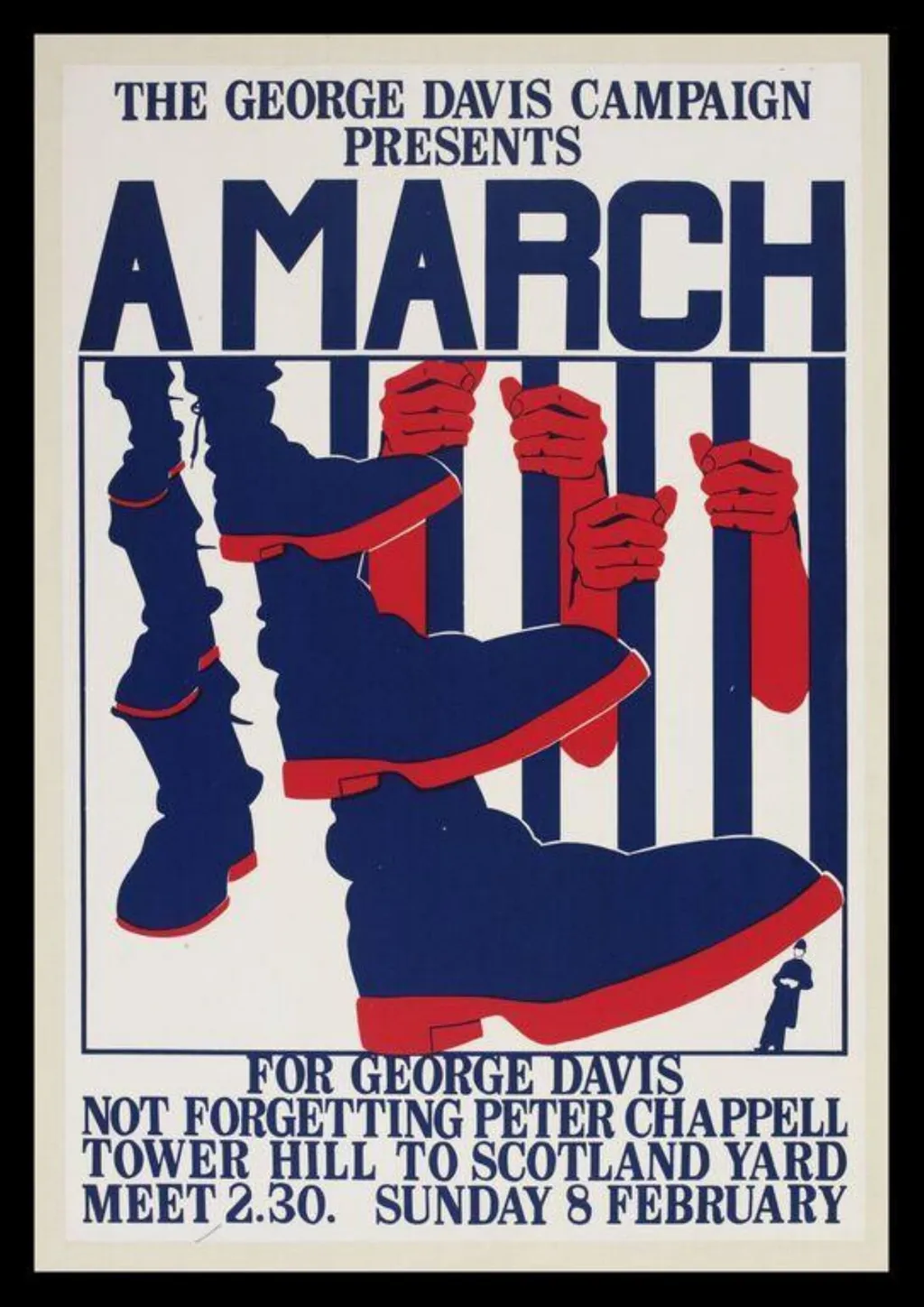
The George Davis Campaign Presents A March is a poster by Martin Walker. It dates from 1976 and is held in the collection of the Victoria and Albert Museum.
About this work
Overview
Produced as a promotional sheet for a public demonstration, the work is part of the Victoria and Albert Museum’s collection of political ephemera.
The poster titled *The George Davis Campaign Presents A March* was designed by British graphic artist Martin Walker in 1976. Produced as a promotional sheet for a public demonstration, the work is part of the Victoria and Albert Museum’s collection of political ephemera. Its purpose was to announce a specific rally supporting the imprisoned figure George Davis and to remind participants of related activist causes.
Subject & Meaning
The image depicts a procession of demonstrators reduced to their limbs—arms linked, legs in step—clad in red and blue garments. The fragmented word “AMARCH” is bisected by the outstretched arms, while a diminutive figure stands beneath, reinforcing the notion of collective movement. The accompanying text invites viewers to assemble at a designated time and place, linking the march to broader campaigns such as the remembrance of Peter Chappell.
Technique & Style
Walker employs a stark, graphic silhouette technique, using high‑contrast black outlines against a plain background to emphasize form over detail. The limited colour palette of red and blue highlights the participants’ unity while maintaining visual clarity for a poster format. The typographic treatment—splitting a word across the figures—creates a dynamic interaction between text and image, a hallmark of 1970s activist design.
History & Provenance
Created amid a wave of civil‑rights and prison‑reform activism in the United Kingdom, the poster was distributed to rally supporters of George Davis, a convicted individual whose case attracted considerable public debate. After its original use, the sheet entered the Victoria and Albert Museum’s holdings, where it is preserved as an example of political graphic art from the mid‑1970s.
Context
The campaign surrounding George Davis emerged in a period of heightened scrutiny of the British criminal‑justice system. Demonstrations often incorporated visual motifs that emphasized solidarity and collective action, as seen in Walker’s composition. The reference to Peter Chappell, another activist figure, situates the march within a network of contemporaneous movements advocating for legal reform and police accountability.
Artist & collection
Artist
British designer Martin Walker turned bold typography and stark slogans into rallying cries on 1970s protest posters.