Artwork
The Trial of Vladimir Bukovsky
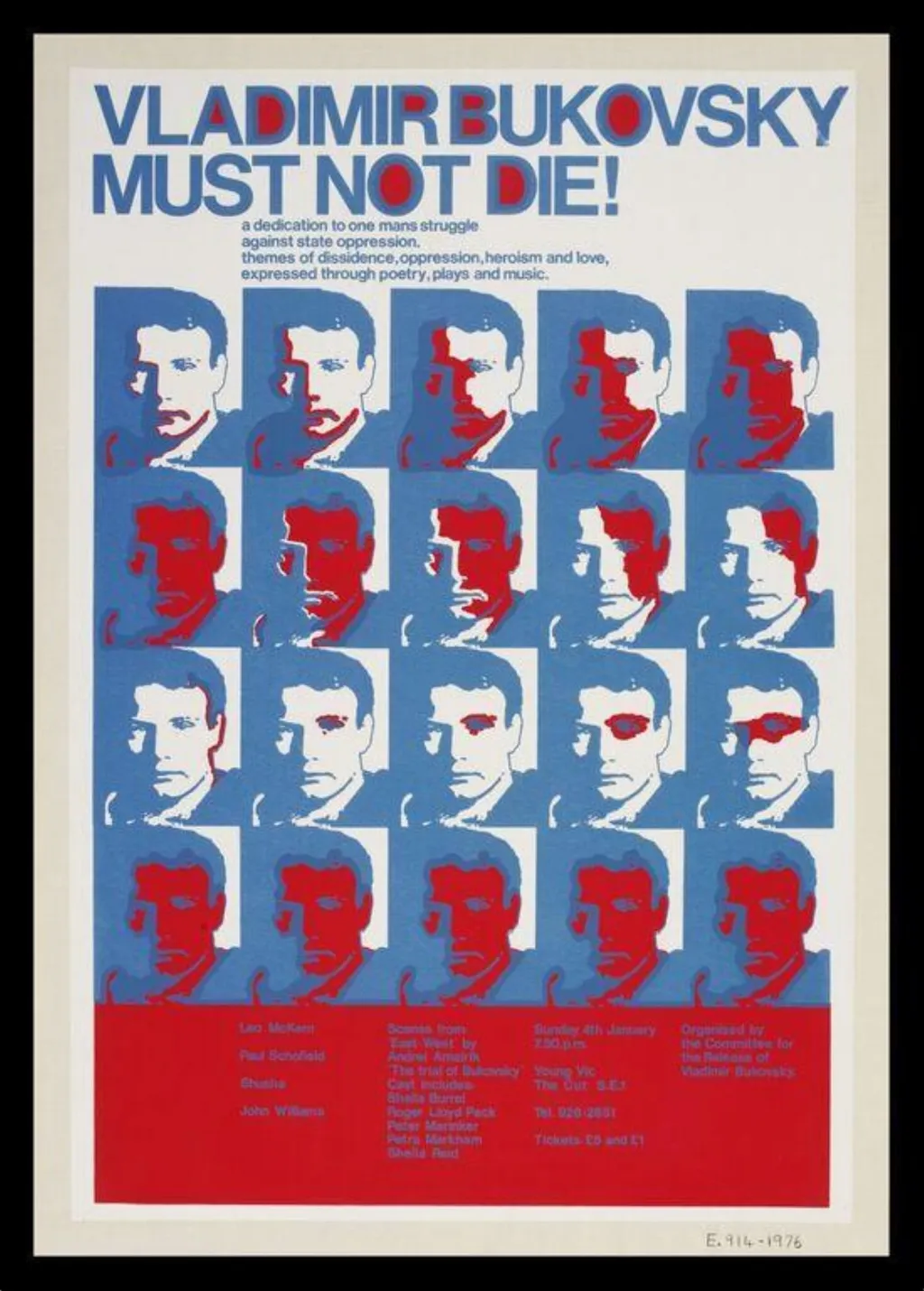
The Trial of Vladimir Bukovsky is a poster by Martin Walker. It dates from 1975 and is held in the collection of the Victoria and Albert Museum.
About this work
Overview
Created in 1975 by Martin Walker, this poster was produced as a political statement in support of Soviet dissident Vladimir Bukovsky. It employs stark graphic contrasts and repetition to convey urgency and collective concern. The work is part of the Victoria and Albert Museum’s collection, where it is preserved as an example of activist design from the Cold War era.
Subject & Meaning
The poster centers on Vladimir Bukovsky, a Soviet dissident imprisoned for exposing human rights abuses.
The poster centers on Vladimir Bukovsky, a Soviet dissident imprisoned for exposing human rights abuses. The repeated faces symbolize his persecution and the dehumanizing effects of state control. The obscured facial features—partially covered in red—suggest censorship, silencing, or erasure. The urgent plea, 'Vladimir Bukovsky Must Not Die!', frames the image as a call for international intervention.
Technique & Style
Walker uses a rigid grid of twenty identical portraits, each rendered in flat blue and red. The limited palette heightens visual impact, while the uniformity of the faces underscores systemic oppression. Red accents—covering eyes, mouths, and parts of the text—act as visual interruptions, mimicking censorship. The design avoids ornamentation, prioritizing clarity and emotional immediacy over aesthetic complexity.
History & Provenance
The poster was produced during a period of heightened Western activism on behalf of Soviet political prisoners. It was distributed by human rights groups to raise awareness of Bukovsky’s case, which drew global attention after his 1972 trial. The Victoria and Albert Museum acquired it as part of its broader effort to document political graphic design, recognizing its role in 20th-century protest movements.
Context
In the mid-1970s, Western activists increasingly used visual media to challenge Soviet repression. Bukovsky’s case became emblematic of this struggle after he smuggled documents detailing psychiatric abuse of dissidents. This poster emerged within a network of solidarity campaigns, aligning with similar efforts by Amnesty International and other groups that employed bold, accessible imagery to mobilize public opinion.
Legacy
The poster remains a reference point in the study of political graphic design for its efficient use of repetition and symbolism. It exemplifies how minimal visual language can communicate complex moral imperatives. While no longer part of active campaigns, it continues to inform contemporary activist art through its directness and unadorned urgency.
Artist & collection
Artist
British designer Martin Walker turned bold typography and stark slogans into rallying cries on 1970s protest posters.