Artwork
A Masque of Days from the Last Essays of Elia
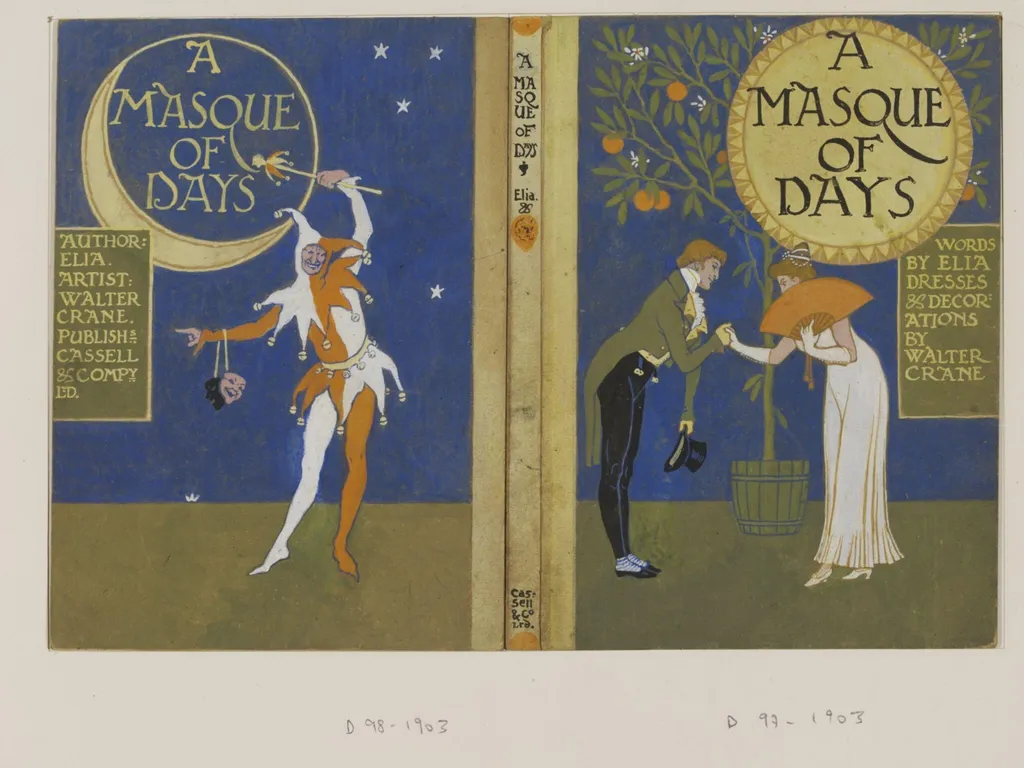
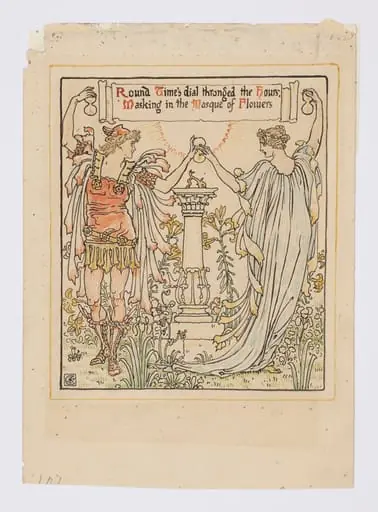
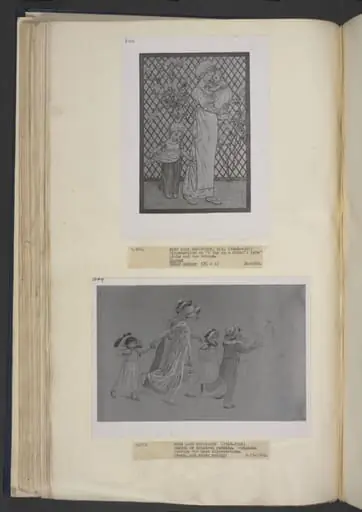
A Masque of Days from the Last Essays of Elia is a drawing by Walter Crane. It dates from 1901 and is held in the collection of the Victoria and Albert Museum.
About this work
Overview
The design reflects Crane’s affinity for decorative arts and his engagement with literary illustration during the fin de siècle.
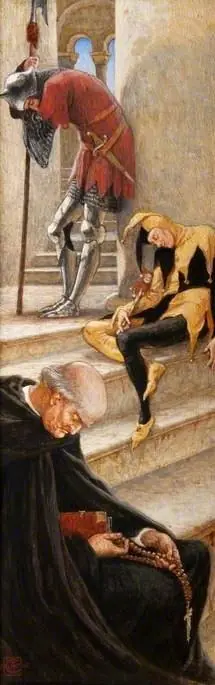
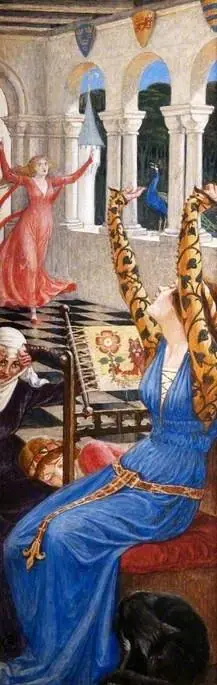
Created in 1901, this watercolor and ink drawing by Walter Crane served as an illustration for Charles Lamb’s *A Masque of Days*, part of his *Last Essays of Elia*. The composition divides the page into two distinct scenes, each rendered with bold outlines and flat, unmodulated color. The design reflects Crane’s affinity for decorative arts and his engagement with literary illustration during the fin de siècle.
Subject & Meaning
The left panel depicts a clown balancing on one leg while juggling torches beneath a night sky marked by a crescent moon and stars. The right shows a man and woman harvesting fruit beneath a golden sun. These contrasting images evoke the duality of day and night, performance and labor, folly and harmony. The scenes suggest a symbolic calendar of human experience, rendered with theatrical simplicity rather than narrative detail.
Technique & Style
Crane employed watercolor and ink to achieve crisp, graphic forms with minimal shading. Outlines are strong and deliberate, echoing the aesthetics of Japanese woodblock prints and medieval manuscript illumination. Colors are applied in flat planes, enhancing the stylized, almost emblematic quality of the figures. The lack of perspective and spatial depth reinforces the image’s symbolic, rather than realistic, intent.
History & Provenance
The drawing was produced as part of a series of illustrations for the 1901 edition of Lamb’s essays, published by J.M. Dent. Crane, known for his work with the Kelmscott Press and the Arts and Crafts movement, was commissioned to provide decorative frontispieces. This piece was likely printed as a frontispiece or title-page illustration, though its original placement within the volume is not definitively recorded.
Context
Crane’s illustration responds to Lamb’s lyrical, nostalgic tone, blending whimsy with melancholy. The Arts and Crafts movement’s emphasis on integrating art into everyday life influenced Crane’s approach, favoring handcrafted aesthetics over industrial reproduction. His work here aligns with contemporaneous efforts to revive illustrative traditions in book design, bridging literature and visual art in a period of growing interest in the Gesamtkunstwerk.
Legacy
Though not widely exhibited independently, the drawing exemplifies Crane’s contribution to early 20th-century book illustration. His synthesis of folk motifs, symbolic imagery, and decorative form influenced later illustrators and designers. The piece remains a representative example of how literary texts were visually reimagined during the Arts and Crafts era, preserving a tactile, hand-made sensibility in an age of mechanical reproduction.
Artist & collection
Artist
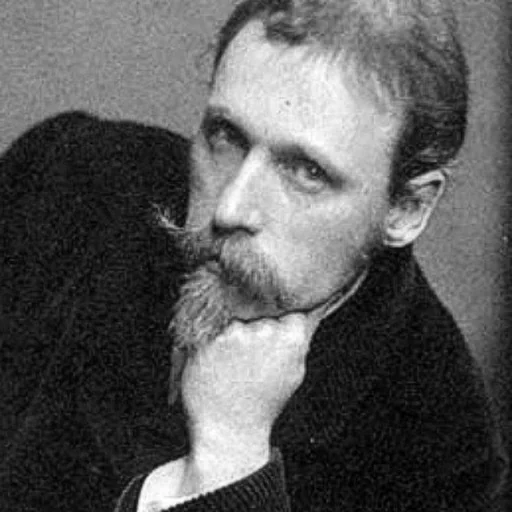
Walter Crane (15 August 1845 – 14 March 1915) was an English artist and book illustrator.

![Sketch of a Couple Seated with Cloud Studies [verso], by Walter Crane](https://artifactworldgallery.com/img/walter-crane--sketch-of-a-couple-seated-with-cloud-studies-verso--bd0c5f7cb1d389b6-w320.webp)
![Kensington Gardens [recto], by Walter Crane](https://artifactworldgallery.com/img/walter-crane--kensington-gardens-recto--dc8c93f0e2ebbd57-w320.webp)