Artwork
Spring Rain Thatched Hut

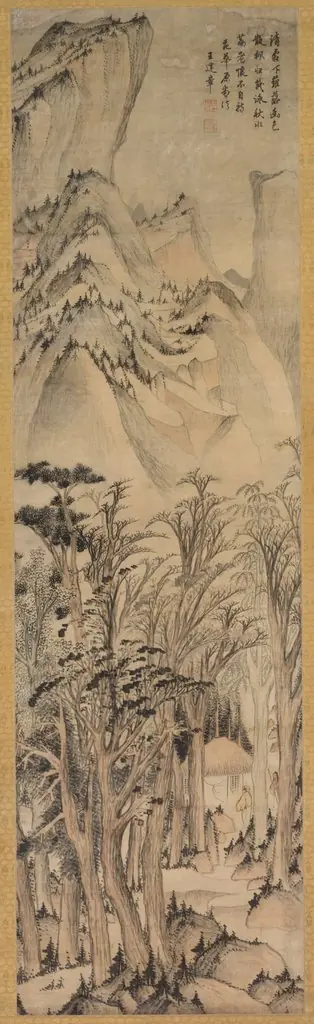
Spring Rain Thatched Hut is a drawing by the Baroque artist Wang Jianzhang. It dates from 1650 and is held in the collection of the Cleveland Museum of Art. This ink-on-paper drawing depicts a solitary thatched hut beside a still river, enveloped in the mist of a spring rain.
About this work
The blank spaces aren’t just emptiness—they let the viewer breathe, like stepping into the cool, damp air yourself.
A thatched hut sits beside a quiet river, wrapped in mist after spring rain. Bare trees and a few rocks frame the scene, leaving most of the paper empty.
Wang Jianzhang painted this for a friend who left politics to build a garden retreat. The blank spaces aren’t just emptiness—they let the viewer breathe, like stepping into the cool, damp air yourself. The artist borrowed this quiet style from an earlier painter, Ni Zan.
To see more works like this, look up *subject: china, qing dynasty (1644-1911)*.
Overview
This ink-on-paper drawing depicts a solitary thatched hut beside a still river, enveloped in the mist of a spring rain. Executed in the restrained aesthetic of Ni Zan, the composition minimizes detail, relying on sparse brushwork and vast empty spaces to evoke quietude. The work was created as a gift for Gong Weiliu, a former Ming official who withdrew from public life after the dynasty’s collapse.
Subject & Meaning
The scene reflects a retreat from political life into personal serenity. The hut, isolated amid bare trees and scattered rocks, symbolizes Gong Weiliu’s withdrawal from court and his embrace of a contemplative existence in his Taizhou garden. The mist and damp air suggest transience and renewal, aligning with Daoist ideals of harmony with nature and detachment from worldly affairs.
Technique & Style
Wang Jianzhang employed monochrome ink washes with minimal brushstrokes, echoing Ni Zan’s late Yuan dynasty approach. The landscape is reduced to essential forms: a hut, a few skeletal trees, rocks, and water. Large areas of untouched paper function as atmospheric space, not absence, inviting the viewer to inhabit the quiet between elements rather than observe them.
History & Provenance
Commissioned by Gong Weiliu, the drawing was part of a larger scroll that included poetic inscriptions from members of his literary circle. These texts, mounted alongside the image, transformed the work into a collective tribute to his reclusive life. The scroll’s integration of painting and calligraphy reflects a Ming-Qing scholarly tradition of combining art and literature as expressions of personal and moral integrity.
Context
Created during the early Qing dynasty, the work emerged amid widespread cultural reorientation after the Ming fall. Many scholar-officials like Gong withdrew from state service, turning to gardens and art as spaces of moral and aesthetic resistance. This drawing embodies the era’s preference for understated expression, where silence and emptiness carried more weight than ornament or narrative.
Legacy
The piece exemplifies how Qing literati adapted Yuan dynasty models to articulate new social realities. Its influence lies in its disciplined restraint, reinforcing a visual language that valued introspection over spectacle. Later collectors preserved such scrolls not merely as art but as artifacts of intellectual and ethical identity, linking painting to the values of cultivated retreat.
Artist & collection