Artwork
'Mr Cattisal's Shropshire Bull
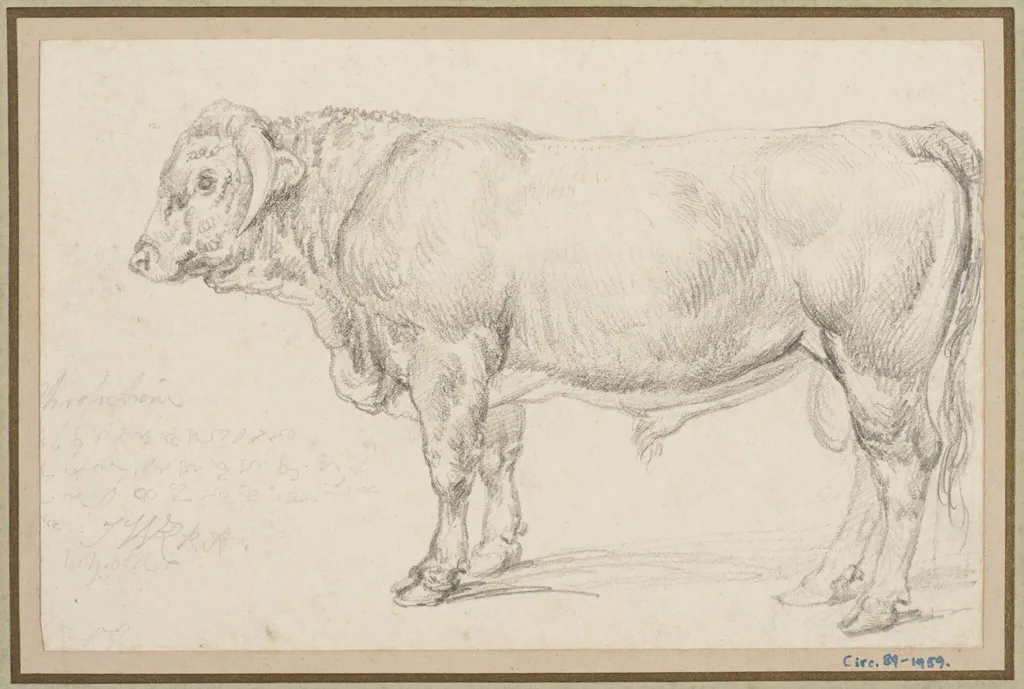
'Mr Cattisal's Shropshire Bull is a drawing by James Ward. It dates from 1834 and is held in the collection of the Victoria and Albert Museum.
About this work
Overview
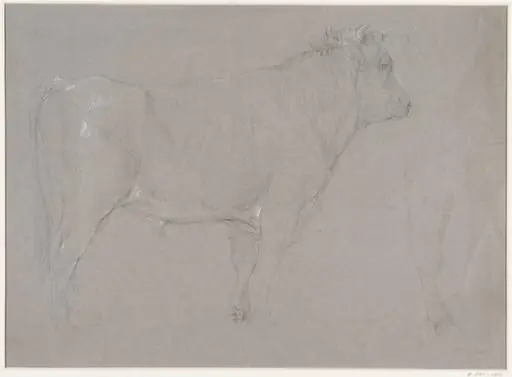
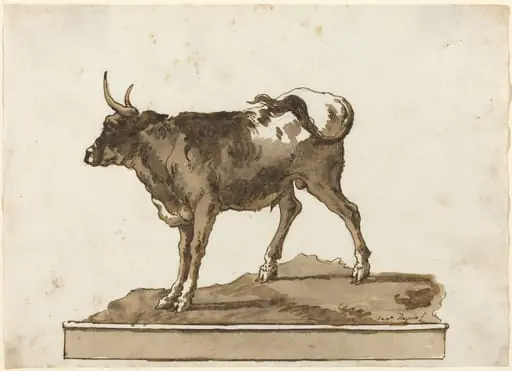
Created around 1834, this ink and wash drawing by James Ward depicts a Shropshire bull as a focused, observational study.
Created around 1834, this ink and wash drawing by James Ward depicts a Shropshire bull as a focused, observational study. Executed on paper, it is part of the Victoria and Albert Museum’s collection. The work lacks elaborate detail but conveys the animal’s presence through economical linework and subtle tonal shifts, suggesting the artist’s interest in capturing form and movement rather than finished presentation.
Subject & Meaning
The subject is a single Shropshire bull, a breed known for its robust build and agricultural importance in 19th-century England. Ward renders the animal in a sideways stance, its head turned slightly to engage the viewer, lending a quiet sense of awareness. The drawing does not idealize or anthropomorphize; instead, it treats the bull as a living, physical entity, reflecting Ward’s broader engagement with animal anatomy and rural life.
Technique & Style
Ward employs loose, fluid lines and light washes to suggest volume without heavy modeling. The shading is applied with restraint, avoiding rigid contours, while the legs and musculature are defined with swift, assured strokes. The paper’s surface retains visible texture, and faint, illegible script in the corner hints at the drawing’s function as a working study. The approach prioritizes immediacy over polish, aligning with observational sketching practices of the time.
History & Provenance
The drawing entered the Victoria and Albert Museum’s collection as part of its long-standing commitment to preserving works on paper from British artists. While its exact provenance before acquisition is undocumented, its date and style place it within Ward’s mature period, when he frequently produced animal studies for both personal practice and potential use in larger compositions.
Context
In the 1830s, British artists increasingly turned to direct observation of animals, driven by scientific curiosity and the rising status of natural history. Ward, known for his detailed depictions of livestock and wildlife, contributed to this trend. This drawing reflects a broader cultural interest in documenting the physical reality of domesticated animals, particularly in rural England, where agriculture shaped daily life.
Legacy
Though not a finished painting, this sketch exemplifies Ward’s skill in translating animal form through rapid, intuitive mark-making. It stands as a representative example of 19th-century British draftsmanship, valued for its honesty and sensitivity to anatomy. Today, it informs understanding of how artists engaged with nature outside the constraints of academic convention.
Artist & collection