Artwork
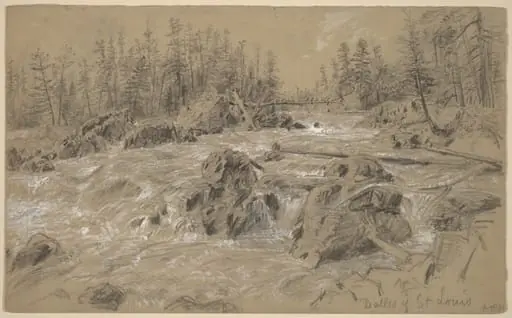
The Dalles of St. Louis
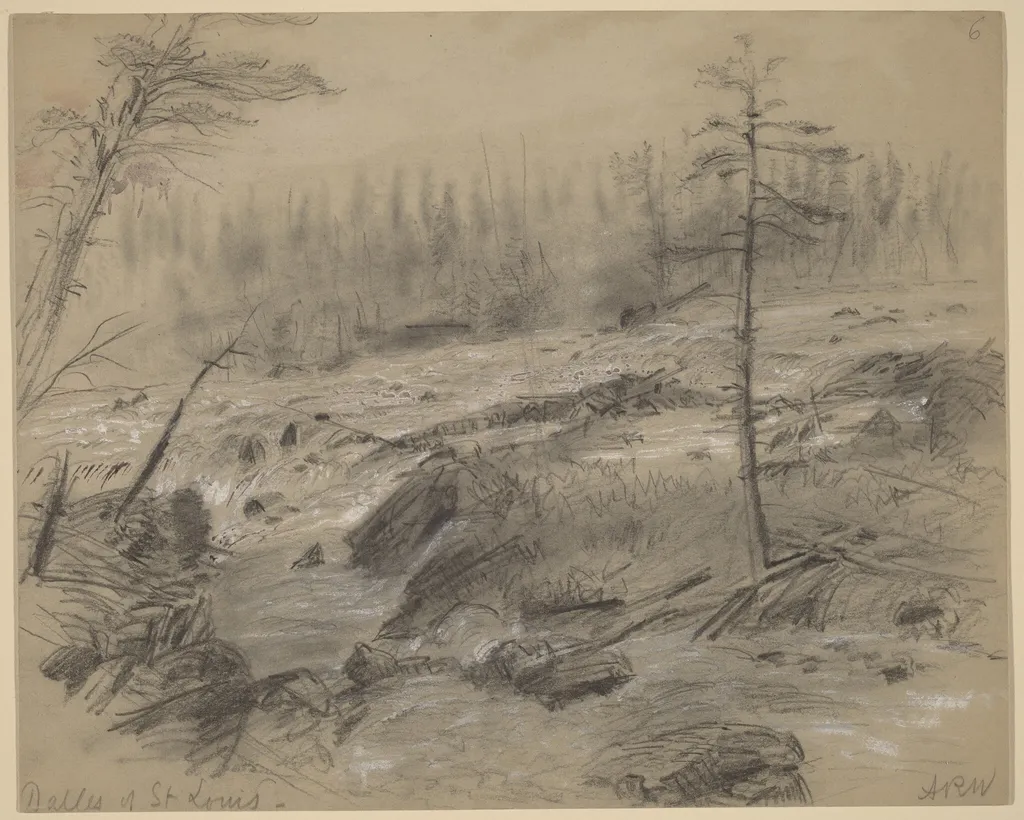
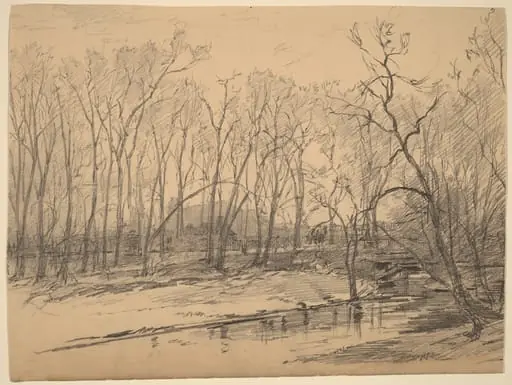
The Dalles of St. Louis is an ink drawing by the Romanticist artist Alfred R. Waud. It dates from 1860 and is held in the collection of the National Gallery of Art. Created in 1860 by Alfred R.
About this work
Overview
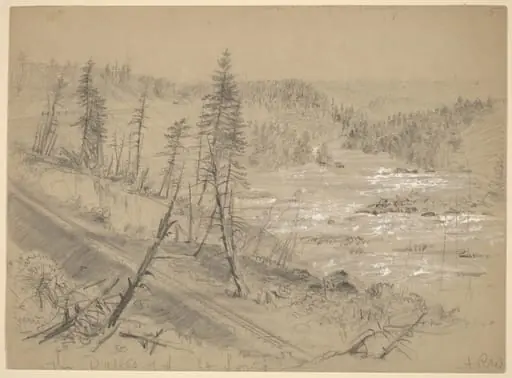
The work belongs to a series of topographical sketches Waud made during travels along the river, documenting its geography before widespread industrial change.
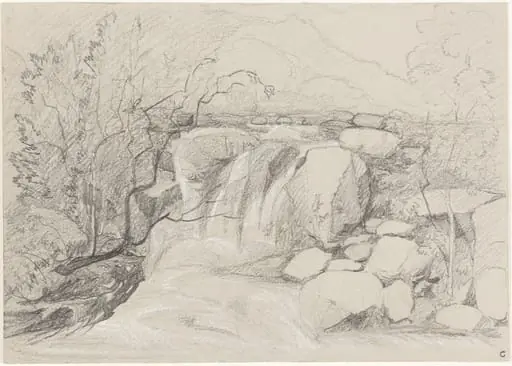
Created in 1860 by Alfred R. Waud, this drawing captures a stretch of the Mississippi River near The Dalles of St. Louis. Executed in graphite, pen, and ink with white highlights, it records a quiet riverscape with careful attention to natural detail. The work belongs to a series of topographical sketches Waud made during travels along the river, documenting its geography before widespread industrial change.
Subject & Meaning
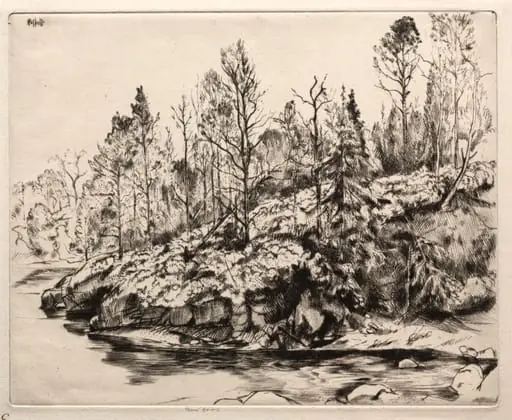
The scene portrays a narrow, winding section of the Mississippi flanked by wooded bluffs and rocky outcrops. The misty distance and still water suggest a moment of pause in the river’s flow, evoking a sense of quiet observation rather than narrative. Waud’s focus on topography implies an interest in the land’s physical character, possibly for cartographic or journalistic purposes rather than purely aesthetic ones.
Technique & Style
Waud employed graphite for broad tonal gradations, using stumping to soften transitions in the foliage and rock surfaces. Pen lines define structural elements like tree trunks and shoreline contours, while white heightening suggests reflected light on water and exposed stone. The restrained palette and precise draftsmanship reflect a documentary approach, blending observational accuracy with subtle atmospheric effects.
History & Provenance
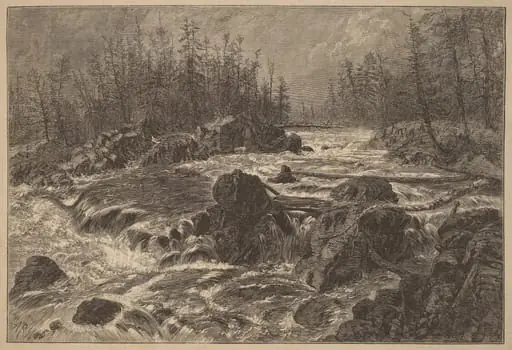
The drawing was made during Waud’s 1860 fieldwork for Harper’s Weekly, commissioned to record scenes along the Mississippi. It was likely produced on-site as part of preparatory studies for later published illustrations. The work remained in private hands until acquired by a major American collection in the mid-20th century, where it is now preserved as an example of pre-Civil War topographical drawing.
Context
In the decades before the Civil War, American artists and illustrators increasingly turned to the nation’s rivers as subjects of both scientific and cultural interest. Waud’s work aligns with a broader trend of documenting natural landscapes amid rapid westward expansion. Unlike romanticized visions of nature, his approach prioritizes fidelity to place, reflecting the growing role of visual journalism in shaping public perception of the American interior.
Legacy
Waud’s drawings from this period are valued for their historical precision and their role in early American visual journalism. Though not widely exhibited during his lifetime, The Dalles of St. Louis and similar works now serve as primary records of the Mississippi’s pre-industrial appearance. They inform contemporary studies of landscape change and the evolution of documentary illustration in the 19th century.
Artist & collection