Artwork
Ma 2 - Peisaj la Măcin (Crâng)
Ma 2 - Peisaj la Măcin (Crâng) is a print by Medi Wechsler Dinu. It dates from 1958 and is held in the collection of the Gavrila Simion Eco-Museum Research Institute Tulcea.
About this work
Overview
The work known as Ma 2 – Peisaj la Măcin (Crâng) is a fragmentary paper surface, likely once bearing a drawing by Romanian artist Medi Wechsler Dinu.
The work known as Ma 2 – Peisaj la Măcin (Crâng) is a fragmentary paper surface, likely once bearing a drawing by Romanian artist Medi Wechsler Dinu. Dated to around 1958, it is now part of the Museum of Ethnography’s collection. Its current state—faded, browned at the edges, and largely blank—suggests prolonged storage or exposure. Only two markings remain: a handwritten 'Ma 2' in the upper left and a stamped number '3454' in the lower right.
Subject & Meaning
The title references a landscape near Măcin, a town in southeastern Romania, and the term 'Crâng' denotes a wooded area. While the visual content is no longer legible, the title implies the work was originally a depiction of local terrain. Its survival as a blank fragment shifts focus from imagery to material history, suggesting the loss of the original drawing and the artifact’s transformation into a relic of artistic process.
Technique & Style
The object is a single sheet of paper, possibly intended as a preparatory sketch or print. The absence of visible marks indicates the original medium—likely pencil, ink, or charcoal—has faded or been removed. The paper’s physical degradation, including fraying and discoloration, reflects its age and handling. The minimal surviving annotations suggest a utilitarian or cataloging function rather than a finished artistic statement.
History & Provenance
The piece entered the Museum of Ethnography’s holdings as part of Medi Wechsler Dinu’s archive, likely transferred after his death. The stamped number '3454' may correspond to an inventory code from the museum’s early cataloging system. Its current condition implies it was stored without conservation care, perhaps overlooked among other works. The handwritten 'Ma 2' could denote a series or sequence within the artist’s output.
Context
In late 1950s Romania, artists like Wechsler Dinu navigated state-imposed artistic norms while maintaining personal expression. Landscape studies, particularly of rural regions like Măcin, were common among artists seeking connection to national terrain. This fragment may have been part of a series documenting regional environments, though its survival as a blank page reflects the fragility of such works amid political and material constraints.
Legacy
Though visually empty, the object endures as evidence of an artist’s engagement with place and the vulnerability of artistic records. Its preservation in a museum collection underscores the value placed on process over product. The fragment invites reflection on what is lost, forgotten, or deemed unworthy of preservation—offering a quiet counterpoint to the permanence often assumed in art history.
Artist & collection
Artist
Margareta "Medi" Dinu, née Wechsler (January 4, 1909 – July 18, 2016) was a Romanian classical painter of Jewish origin.
Museum
Gavrila Simion Eco-Museum Research Institute Tulcea
Continue through works from the same source collection.
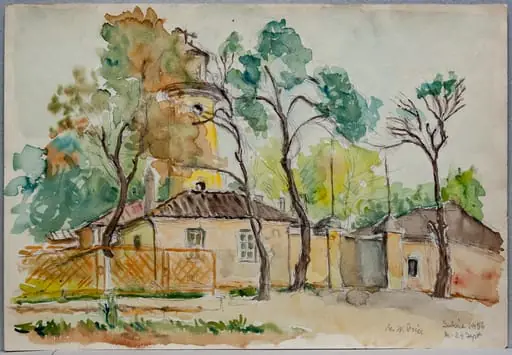 S 38 - Peisaj la Sulina (Stradă cu case și pomi)
 S6 - Peisaj la Sulina (Malul Dunării și case)
 S 28 - Peisaj la Sulina (Intrare de casă cu flori)
 S 9 - Peisaj la Sulina
 S 12 - Peisaj la Sulina (Stradă și 2 case)
 S4 - Peisaj la Sulina (Ochi de apă cu bărci și case)
 S 19 - Peisaj la Sulina (Casă și copaci)
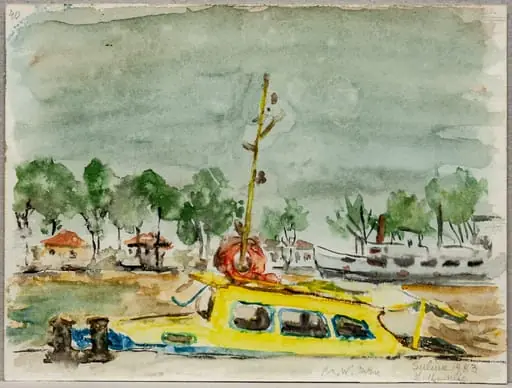 S 27 - Peisaj la Sulina (Dunăre, vapor în prim plan, case în planul doi)
 S7 - Peisaj la Sulina (Stradă cu case și stâlp de telegraf)
 În portul Tulcea
 Peisaj
 Calica
 S 14 - Omagiul meu Sulinei (Mal de Dunăre cu trandafir și bărci)
 Peisaj (cu stradă)
 Personaj fantastic cu flori
 S 33 - Peisaj la Sulina (Dunăre și faleză cu tufe de flori grena)
 Peisaj de iarnă
 Cap de bărbat
 Ma 1 - Peisaj la Măcin (Case, garduri și pomi)