Artwork
Peisaj (cu stradă)

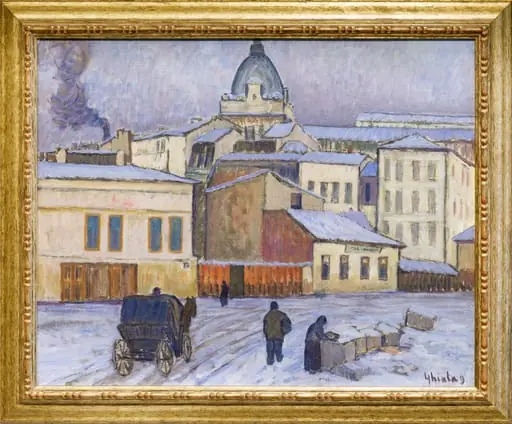
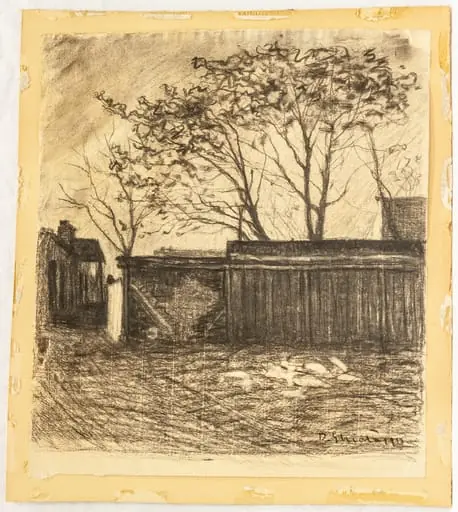
Peisaj (cu stradă) is a drawing by Dimitrie Ghiață. It dates from 1950 and is held in the collection of the Gavrila Simion Eco-Museum Research Institute Tulcea.
About this work
Overview
The work’s apparent absence of imagery invites questions about intention, process, or archival context within the artist’s broader practice.
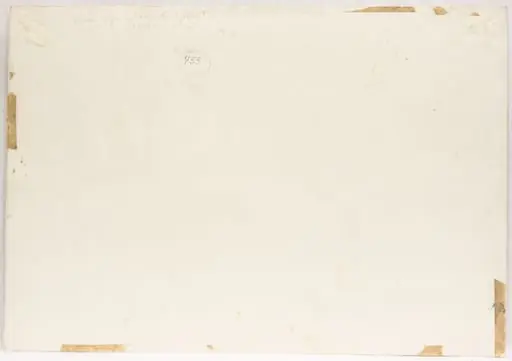
Dimitrie Ghiață’s Peisaj (cu stradă), dated around 1950, is a sheet of pale yellow paper with no figurative or landscape elements. It is cataloged in the Museum of Ethnography under the inventory number INV.0, with a small handwritten '740' in one corner. Faint marks along the edges suggest past handling or adhesive residue. The work’s apparent absence of imagery invites questions about intention, process, or archival context within the artist’s broader practice.
Subject & Meaning
The work presents no recognizable subject—no street, no landscape, no figures. Its title, meaning 'Landscape (with Street)', contrasts sharply with its blank surface. This dissonance may reflect an experimental approach to representation, or perhaps a preparatory state left incomplete. It could signal a conceptual gesture toward absence, or a record of an idea never realized, challenging assumptions about what constitutes a finished artwork.
Technique & Style
The paper’s surface is smooth, with no visible brushwork, ink, or graphite. The faint edge markings suggest physical handling rather than artistic application. There is no evidence of stippling, hatching, or other traditional drawing techniques. The minimalism here is not deliberate mark-making but the result of an unexecuted or erased composition, positioning the piece between artifact and void.
History & Provenance
The work entered the Museum of Ethnography’s collection with minimal documentation. The handwritten number '740' and 'INV.0' imply it was cataloged as part of a larger, possibly unfinished, group of studies. No records confirm whether it was intended as a sketch, a failed attempt, or a deliberate statement. Its preservation suggests institutional recognition of its significance, even in its unresolved state.
Context
Created in the early 1950s in Romania, the work emerged during a period of state-enforced artistic norms. While many artists adapted to socialist realism, Ghiață’s unexecuted piece may reflect quiet resistance, personal experimentation, or the constraints of limited materials. Its emptiness stands in contrast to the era’s demand for overtly political or narrative imagery, offering a subtle counterpoint to official aesthetics.
Legacy
Peisaj (cu stradă) remains an enigma within Ghiață’s oeuvre and mid-century Romanian art. It has not been widely exhibited or analyzed, yet its persistence in the museum’s holdings signals a quiet acknowledgment of ambiguity as a valid artistic condition. It invites viewers to consider the value of the unfinished, the archival, and the unmade as forms of expression in their own right.
Artist & collection
Artist
Romanian printmaker whose work gathers everyday life into scenes of towns and landscapes.
Museum
Gavrila Simion Eco-Museum Research Institute Tulcea
Continue through works from the same source collection.