Artwork
S 26 - Pe Dunăre la Sulina (Dunărea și valuri pierdute în ceață)
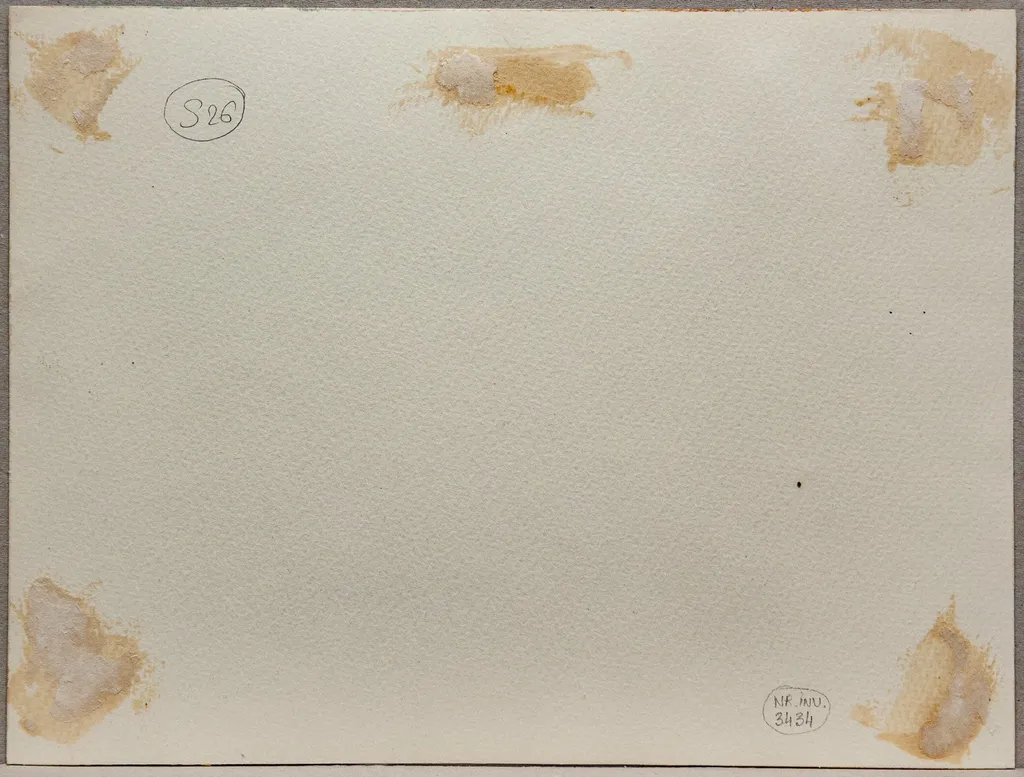
S 26 - Pe Dunăre la Sulina (Dunărea și valuri pierdute în ceață) is an unspecified painting by Medi Wechsler Dinu. It dates from 1958 and is held in the collection of the Gavrila Simion Eco-Museum Research Institute Tulcea.
About this work
Overview
It is part of the Museum of Ethnography’s collection and presents a minimalist interpretation of the Danube near Sulina.
S 26 - Pe Dunăre la Sulina is a small, unassuming work attributed to Medi Wechsler Dinu, created around 1958. It is part of the Museum of Ethnography’s collection and presents a minimalist interpretation of the Danube near Sulina. The surface is dominated by a pale beige ground with faint texture, suggesting watercolor or mixed media. Four brown stains in the corners and handwritten annotations mark its physical history, reinforcing its status as a quiet, personal study rather than a public display piece.
Subject & Meaning
The title references a riverscape where waves dissolve into mist, evoking the transient nature of the Danube’s estuary. Yet the image contains no literal depiction of water, sky, or land. Instead, the absence of form invites contemplation of atmosphere and memory. The work may reflect the artist’s internal response to place—less a record of landscape than an impression of solitude, silence, and the fading of boundaries between earth and air.
Technique & Style
The piece employs subtle layering of watercolor or diluted pigment on a textured support, allowing the canvas’s natural grain to show through. Brushwork is restrained, with no defined forms—only stains and washes suggest elemental presence. The four corner marks appear accidental or environmental, not compositional. Handwritten numerals, likely inventory codes, are integrated into the surface, blurring the line between artwork and archival object.
History & Provenance
The work carries the inventory number N.R. inv. 3434 and the designation S26, indicating it was cataloged within a larger series, possibly a personal or academic project. Its presence in the Museum of Ethnography suggests it was acquired as part of a broader cultural documentation effort. The stains and wear imply prolonged storage or exposure, and its unassuming nature may reflect its role as a private sketch rather than a finished exhibition piece.
Context
Created in late 1950s Romania, the work emerges during a period of state-enforced artistic conformity. Wechsler Dinu, a Jewish artist navigating political pressures, often turned to introspective, non-representational forms. This piece aligns with quiet, contemplative practices among artists who avoided overt political themes. Its ambiguity may reflect both aesthetic restraint and the necessity of coded expression under a repressive regime.
Legacy
Though not widely exhibited, S 26 stands as an example of understated modernism in Romanian art. Its minimalism and material sensitivity resonate with postwar European tendencies toward abstraction and material presence. It endures not through grandeur but through its quiet authenticity—offering a glimpse into an artist’s private engagement with landscape, memory, and the limits of representation.
Artist & collection
Artist
Margareta "Medi" Dinu, née Wechsler (January 4, 1909 – July 18, 2016) was a Romanian classical painter of Jewish origin.
Museum
Gavrila Simion Eco-Museum Research Institute Tulcea
Continue through works from the same source collection.
 S 38 - Peisaj la Sulina (Stradă cu case și pomi)
 S6 - Peisaj la Sulina (Malul Dunării și case)
 S 28 - Peisaj la Sulina (Intrare de casă cu flori)
 S 9 - Peisaj la Sulina
 S 12 - Peisaj la Sulina (Stradă și 2 case)
 S4 - Peisaj la Sulina (Ochi de apă cu bărci și case)
 S 19 - Peisaj la Sulina (Casă și copaci)
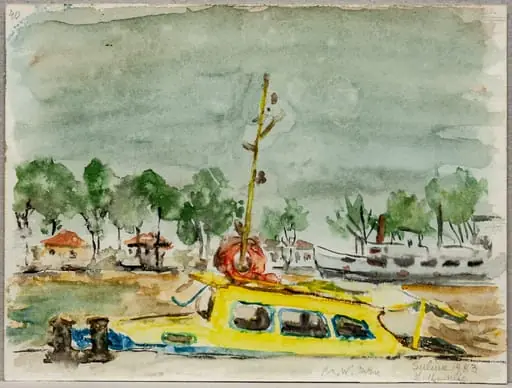 S 27 - Peisaj la Sulina (Dunăre, vapor în prim plan, case în planul doi)
 S 18 - Peisaj la Sulina (Răsărit de soare pe Dunăre)
 S 33 - Peisaj la Sulina (Dunăre și faleză cu tufe de flori grena)
 S7 - Peisaj la Sulina (Stradă cu case și stâlp de telegraf)
 S5 - Peisaj la Sulina (Stradă cu pomi și casă)
 S 14 - Omagiul meu Sulinei (Mal de Dunăre cu trandafir și bărci)
 S 29 - Peisaj la Sulina (Vas pe Dunăre)
 S 21 - Pervaz cu flori la Sulina