Artwork
S 29 - Peisaj la Sulina (Vas pe Dunăre)
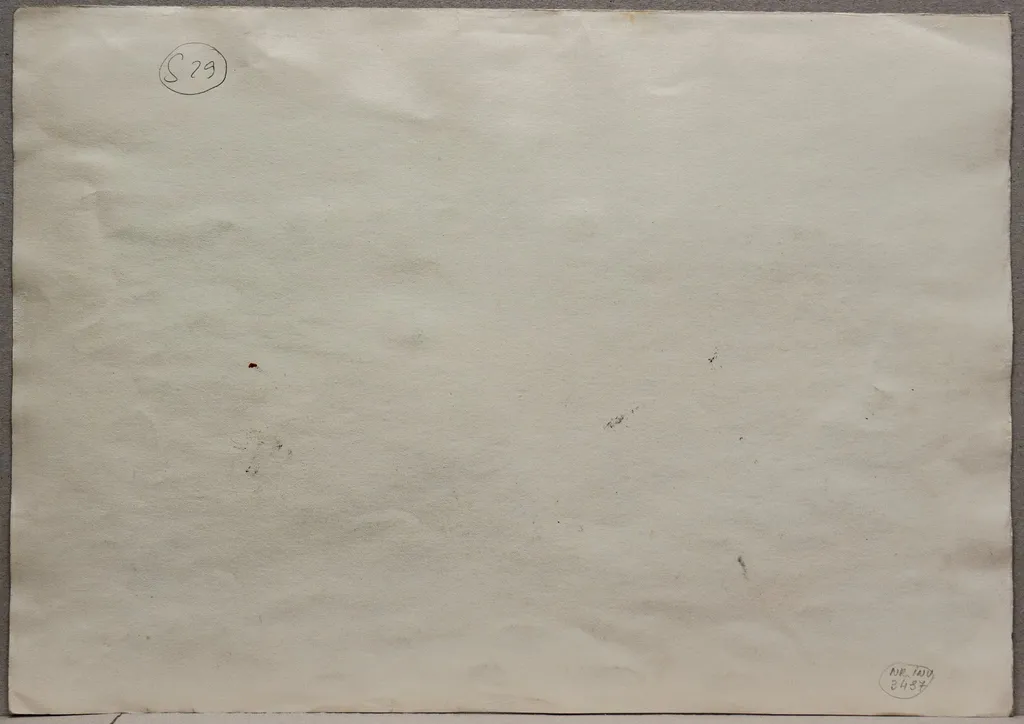
S 29 - Peisaj la Sulina (Vas pe Dunăre) is an unspecified painting by Medi Wechsler Dinu. It dates from 1958 and is held in the collection of the Gavrila Simion Eco-Museum Research Institute Tulcea.
About this work
Overview
Its physical state suggests it was used as a preparatory sketch or experimental surface rather than a finished composition.
S 29 - Peisaj la Sulina (Vas pe Dunăre) is a sheet of paper bearing minimal, non-representational marks, attributed to Romanian artist Dinu Medi Wechsler circa 1958. Though cataloged as a landscape painting, the surface reveals no figurative imagery. Instead, it presents subtle smudges, faint creases, and a small labeled circle in the top-left corner. Its physical state suggests it was used as a preparatory sketch or experimental surface rather than a finished composition.
Subject & Meaning
The title references a Danube riverscape at Sulina, yet the paper holds no visual depiction of water, land, or vessels. The disconnect between title and surface implies the work may have been an early stage of observation—perhaps a notation of light, texture, or spatial memory. Its ambiguity invites interpretation as a record of the artist’s process rather than a representation of place, emphasizing the act of looking over the act of rendering.
Technique & Style
The surface shows evidence of dry media—possibly charcoal or graphite—applied lightly and unevenly. Wrinkles and stains suggest the paper was handled repeatedly, possibly outdoors or in transit. The absence of defined lines or shading indicates a focus on tactile response rather than formal composition. This restrained approach aligns with studies where the artist tested materials or recorded fleeting impressions before committing to a larger work.
History & Provenance
Dinu Medi Wechsler, a Jewish Romanian artist trained at Bucharest’s National University of Arts, taught drawing and painting during the mid-20th century. This sheet entered the Museum of Ethnography’s collection, likely as part of a broader archive of his working materials. Its preservation reflects institutional interest in the artist’s process, not just completed pieces, offering insight into the quiet, often overlooked stages of artistic production.
Context
In postwar Romania, artists like Wechsler navigated constrained cultural environments where realism was often favored. Yet this fragment suggests a personal, introspective practice—unconcerned with public expectations. The simplicity of the sheet may reflect a private ritual: a moment of pause, a trial of mark-making, or a response to the landscape’s elusive qualities, detached from official artistic mandates.
Legacy
Though not a finished painting, S 29 endures as a testament to the artist’s private engagement with his surroundings. Its preservation in a museum setting elevates the study to the status of historical artifact, challenging conventional hierarchies between finished works and preparatory fragments. It invites viewers to consider the value of uncertainty, imperfection, and the unseen labor behind artistic creation.
Artist & collection
Artist
Margareta "Medi" Dinu, née Wechsler (January 4, 1909 – July 18, 2016) was a Romanian classical painter of Jewish origin.
Museum
Gavrila Simion Eco-Museum Research Institute Tulcea
Continue through works from the same source collection.
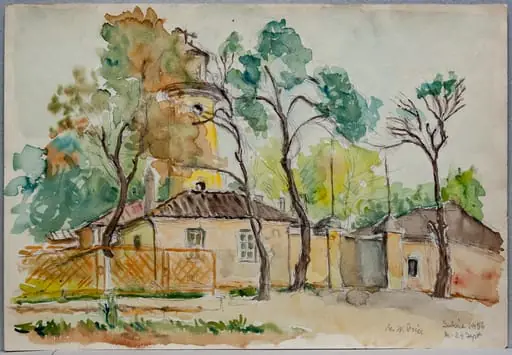 S 38 - Peisaj la Sulina (Stradă cu case și pomi)
 S6 - Peisaj la Sulina (Malul Dunării și case)
 S 28 - Peisaj la Sulina (Intrare de casă cu flori)
 S 9 - Peisaj la Sulina
 S 12 - Peisaj la Sulina (Stradă și 2 case)
 S4 - Peisaj la Sulina (Ochi de apă cu bărci și case)
 S 19 - Peisaj la Sulina (Casă și copaci)
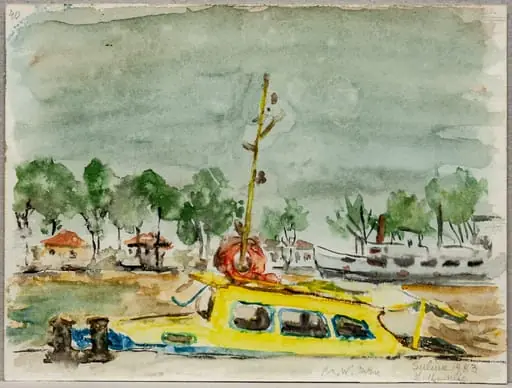 S 27 - Peisaj la Sulina (Dunăre, vapor în prim plan, case în planul doi)
 S 33 - Peisaj la Sulina (Dunăre și faleză cu tufe de flori grena)
 S 35 - Peisaj la Sulina (Maluri de Dunăre la răsărit)
 S5 - Peisaj la Sulina (Stradă cu pomi și casă)
 S 32 - Peisaj la Sulina (Dunăre și maluri pierdute în pete de culoare)
 S8 - Peisaj la Sulina (Casă, gard și copac)
 S 18 - Peisaj la Sulina (Răsărit de soare pe Dunăre)