Artwork
The Great Red Dragon and the Woman Clothed with the Sun (Rev. 12: 1-4)
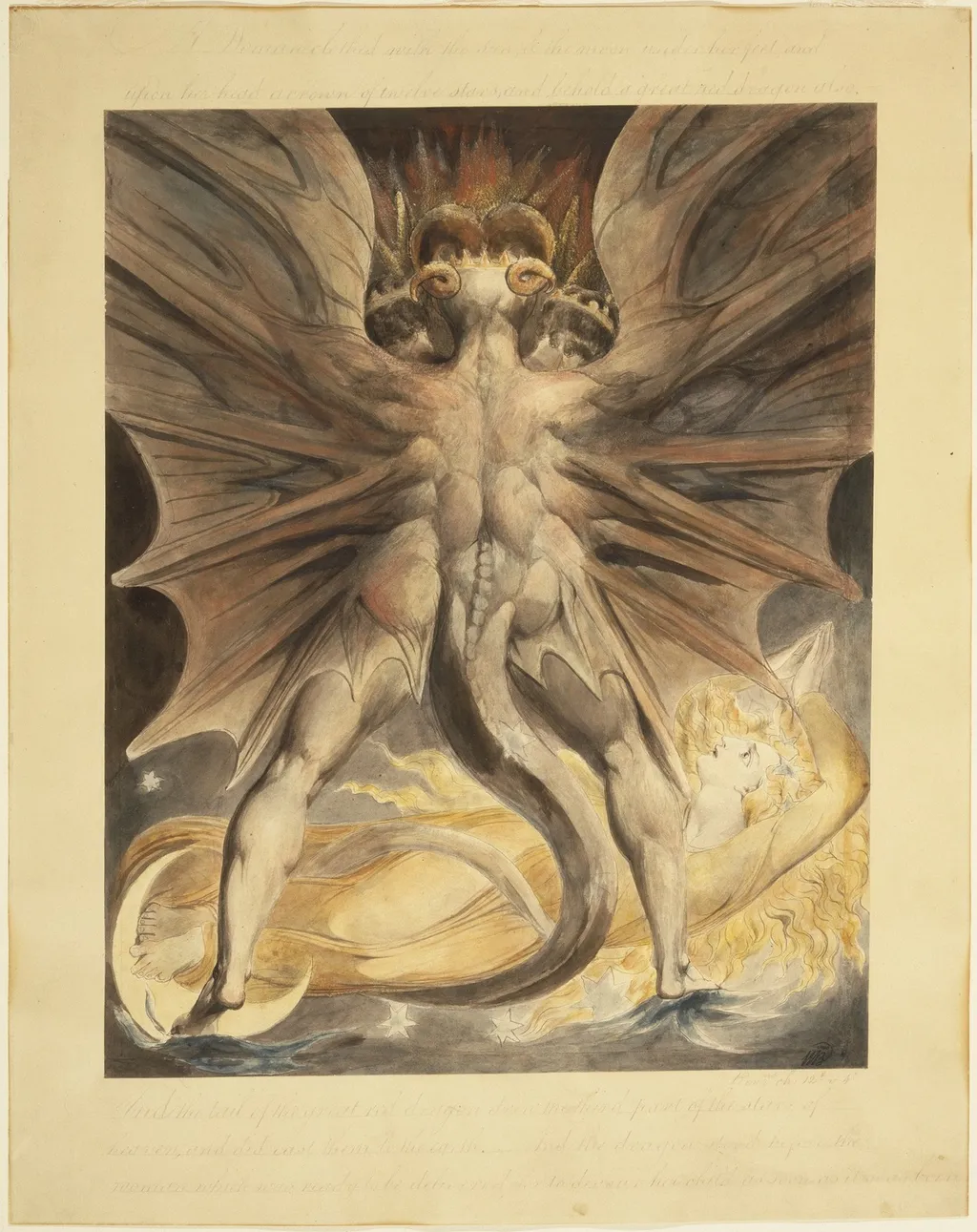
The Great Red Dragon and the Woman Clothed with the Sun (Rev. 12: 1-4) is an unspecified painting by William Blake. It dates from 1800 and is held in the collection of the Brooklyn Museum.
About this work
Overview
Created around 1800, this painting is one of a series of watercolor illustrations William Blake produced for the Book of Revelation.
Created around 1800, this painting is one of a series of watercolor illustrations William Blake produced for the Book of Revelation. Though largely unrecognized in his time, Blake fused poetic vision with visual art to interpret biblical prophecy. The work is executed in watercolor and graphite on paper, part of a private commission that later entered the Brooklyn Museum’s collection, where it remains today.
Subject & Meaning
The scene illustrates Revelation 12:1–4, depicting a celestial woman pursued by a monstrous dragon symbolizing evil. The woman, crowned with stars and clothed in the sun, represents divine protection or the Church; the dragon, with its human-like form and crown, embodies Satan’s attempt to destroy the sacred. Despite the dragon’s menacing posture, the woman’s calm expression suggests spiritual resilience amid chaos.
Technique & Style
Blake employed watercolor and graphite with deliberate restraint, using muted browns, grays, and faint golds to evoke a somber, otherworldly atmosphere. Chiaroscuro heightens the drama: the dragon’s shadowed bulk contrasts with the faint luminosity around the woman. His linear precision and elongated forms reflect a personal aesthetic, blending Renaissance composition with visionary distortion to convey spiritual conflict.
History & Provenance
Commissioned by the patron Thomas Butts, this painting was part of a larger set of biblical illustrations Blake produced between 1805 and 1810. It remained in private hands until the early 20th century, when it was acquired by the Brooklyn Museum. Unlike many of Blake’s contemporaries, he did not seek public exhibition, and this work’s significance emerged posthumously through scholarly interest in his symbolic system.
Context
Blake worked during a period of political upheaval and religious reevaluation in Britain. His illustrations diverged from conventional biblical art by rejecting naturalism in favor of symbolic, personal visions. Influenced by mysticism and radical theology, he saw scripture not as literal history but as an inner spiritual drama—this painting reflects his belief that divine truths are revealed through imagination, not dogma.
Legacy
Though obscure in his lifetime, Blake’s biblical illustrations later became foundational to Romantic and modernist art. This painting, with its intense symbolism and emotional gravity, influenced 20th-century artists exploring myth and the subconscious. Its presence in a major American museum underscores its role as a key example of visionary art that transcends its time, offering a unique lens into the intersection of faith, imagination, and visual language.
Artist & collection
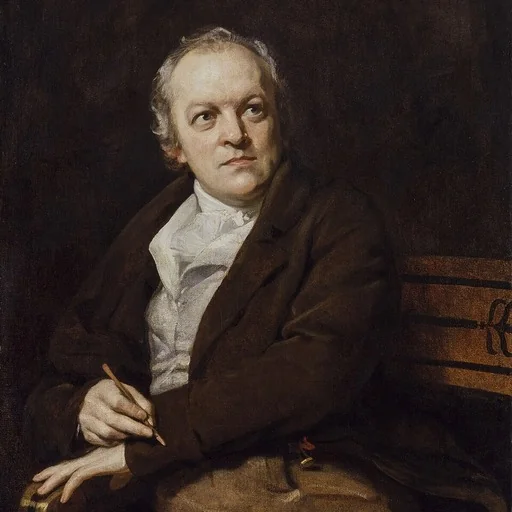
Artist
William Blake (28 November 1757 – 12 August 1827) was an English poet, painter and printmaker.

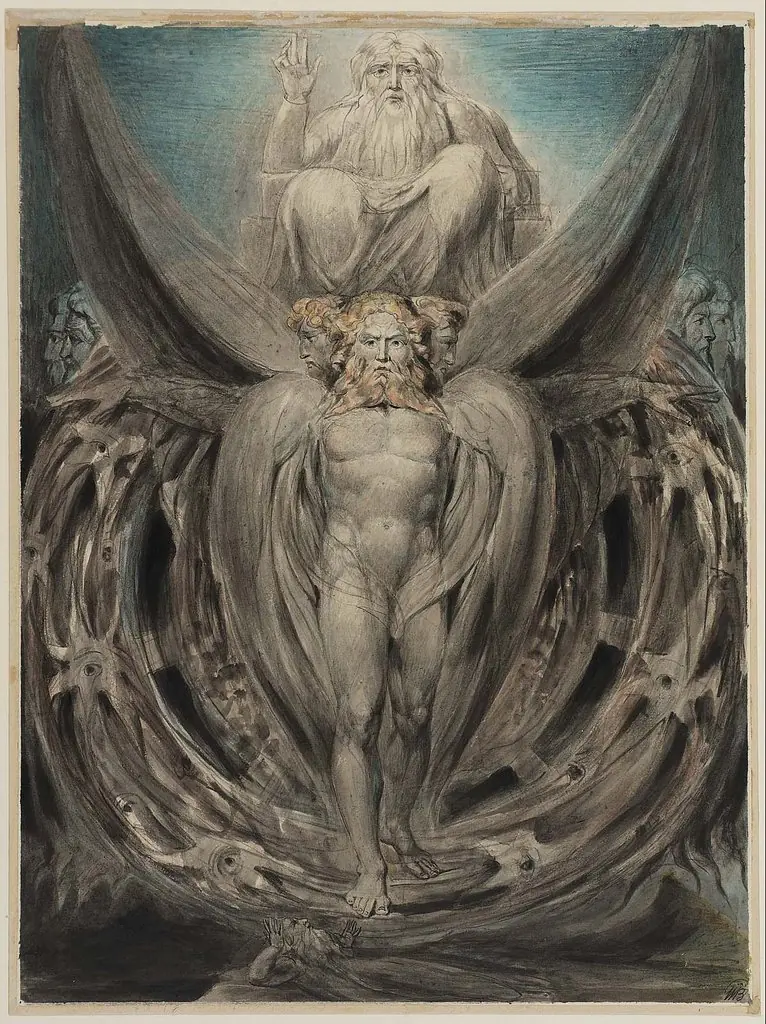 Ezekiel's Wheels
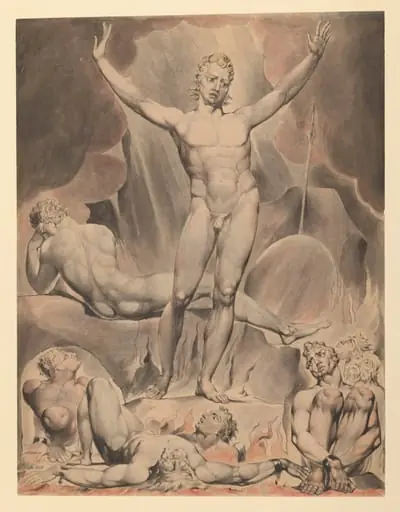 Satan arousing the rebel angels
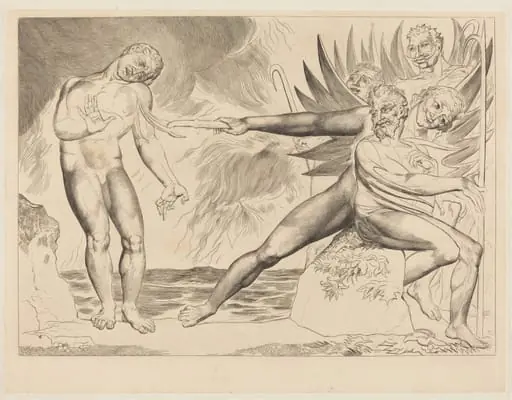 The Circle of the Corrupt Officials; the Devils Tormenting Ciampolo
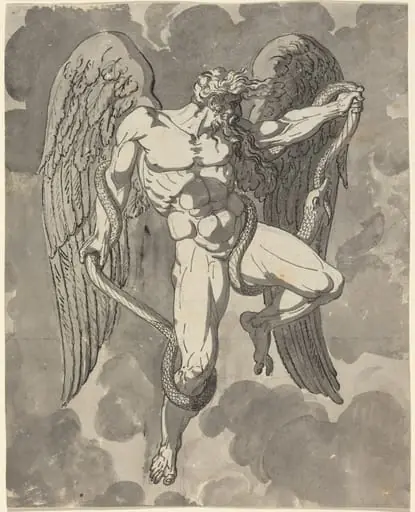 Saturn Wrestling with a Snake
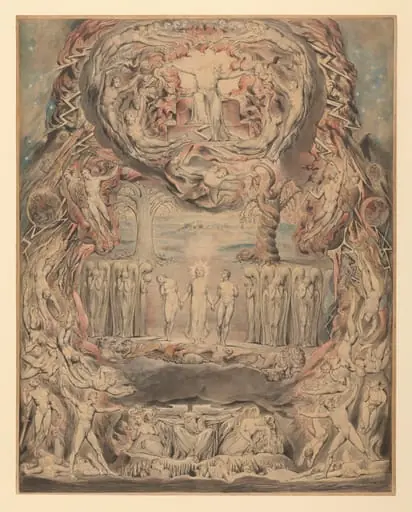 The Fall of Man
 The Circle of the Corrupt Officials; the Devils Tormenting Ciampolo
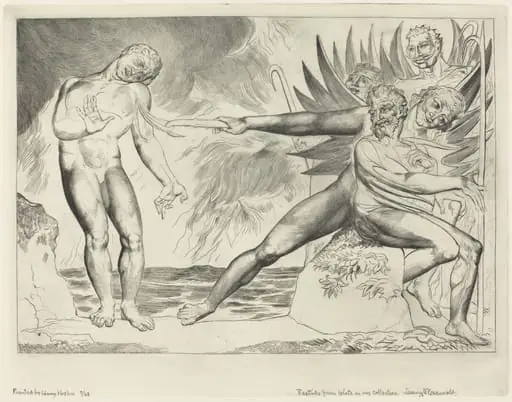 The Circle of the Corrupt Officials; The Devils Tormenting Ciampolo
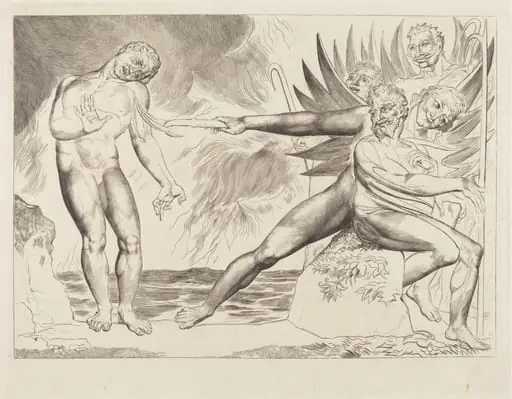 The Circle of the Corrupt Officials; the Devils Tormenting Ciampolo
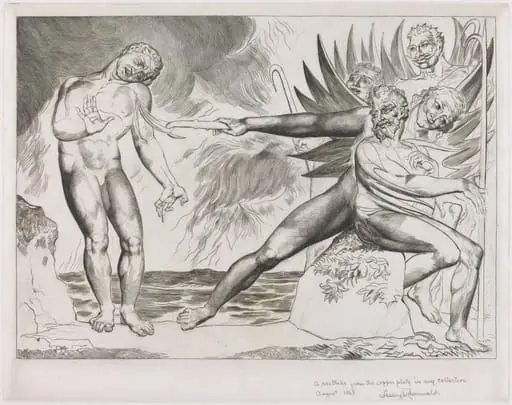 The Circle of the Corrupt Officials; the Devils Tormenting Ciampolo
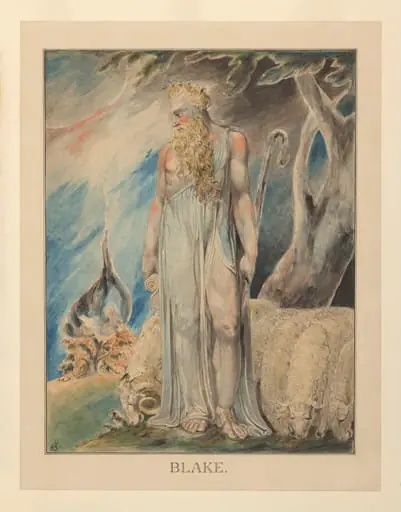 Moses and the Burning Bush