Artwork
Untitled
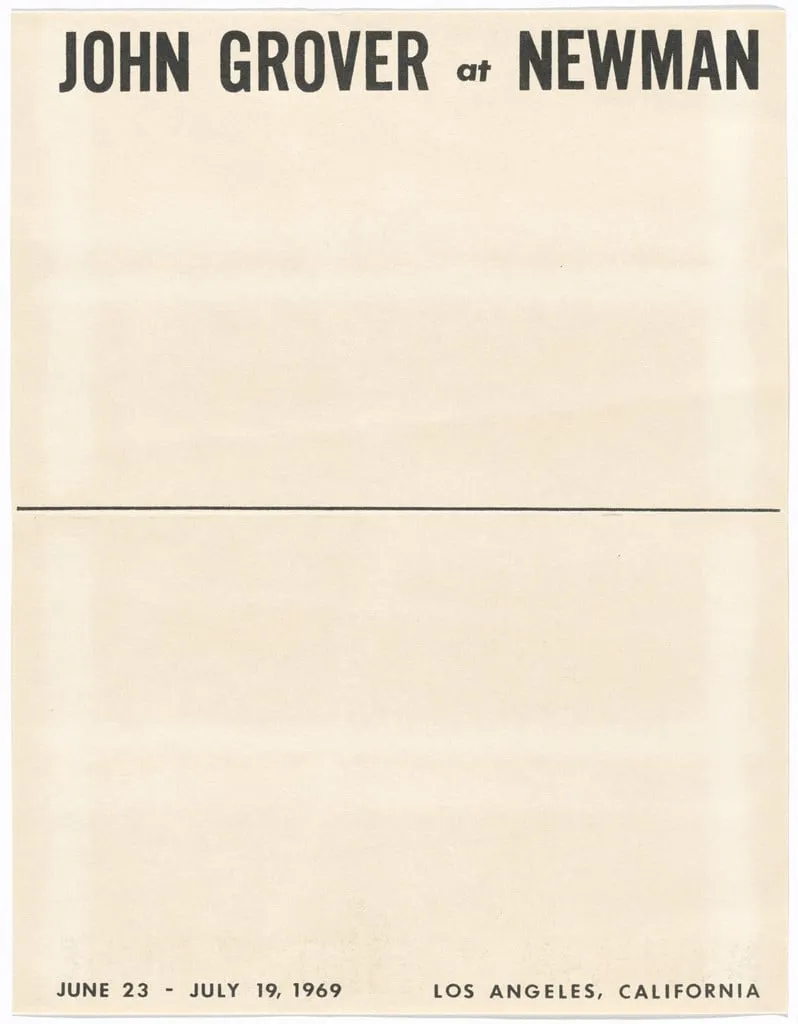
Untitled is a print by Bas Jan Ader William Leavitt. It dates from 1969 and is held in the collection of the Museum of Modern Art. This 1969 work by William Leavitt consists of a mimeographed sheet enclosed in an envelope, classified as a print.
About this work
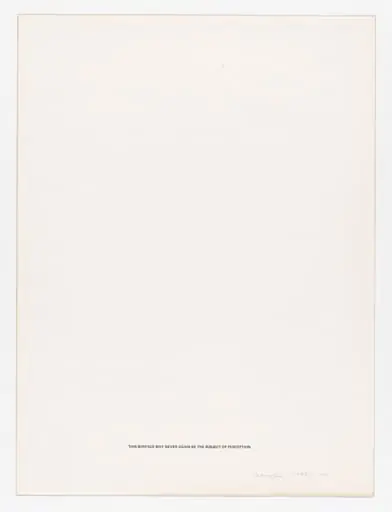
The image features a beige sheet of paper with black text, displaying the name "JOHN GROVER" at the top and "at NEWMAN" below it.
The image features a beige sheet of paper with black text, displaying the name "JOHN GROVER" at the top and "at NEWMAN" below it. A thin black line separates the top section from the bottom, which contains additional text.
The text at the bottom reads "JUNE 23 - JULY 19, 1969" on one line, followed by "LOS ANGELES, CALIFORNIA" on the next. The overall design is simple and minimalist, with a focus on clean typography and negative space.
If you're interested in learning more about the artist behind this piece, you might want to look up William Leavitt, who is known for his work in the field of conceptual art.
Overview
This 1969 work by William Leavitt consists of a mimeographed sheet enclosed in an envelope, classified as a print. Its design is deliberately restrained, using only black ink on beige paper. The composition features two distinct textual blocks separated by a thin horizontal line, emphasizing clarity and spatial balance over decorative elements. The piece functions as a minimal documentation of an event, aligning with conceptual art’s interest in information over visual spectacle.
Subject & Meaning
The text identifies 'JOHN GROVER' and 'at NEWMAN,' suggesting a person associated with a gallery or venue. Below, the dates 'JUNE 23 - JULY 19, 1969' and location 'LOS ANGELES, CALIFORNIA' frame a specific time and place. The work does not illustrate the event but records its parameters, inviting viewers to infer context. Its ambiguity reflects conceptual art’s tendency to prioritize idea over imagery, leaving narrative open to interpretation.
Technique & Style
Produced via mimeograph, the piece employs a low-fidelity reproduction method common in underground publishing. The typography is uniform, unadorned, and centered, with generous margins that enhance legibility and quietness. The absence of imagery or color reinforces a documentary aesthetic. This restrained approach aligns with 1960s conceptual practices that valued process and institutional critique over traditional artistic craftsmanship.
History & Provenance
Created in 1969, the work entered the collection of The Museum of Modern Art, where it is held as part of its documentation of conceptual art from the period. Its preservation in an envelope underscores its original function as a mailed or distributed object, possibly tied to a gallery exhibition or artist project. The envelope and sheet together suggest an ephemeral, non-monumental mode of art distribution characteristic of the era.
Context
Leavitt’s work emerged alongside other Southern California conceptual artists who used language, institutional frameworks, and everyday materials to question art’s boundaries. This piece reflects a broader interest in the gallery as a site of information rather than display. The reference to 'NEWMAN' may allude to a Los Angeles gallery or individual, situating the work within a local network of experimental art practices during a period of institutional redefinition.
Legacy
The work exemplifies how conceptual artists in the late 1960s redefined art as a system of signs and contexts rather than physical objects. Its inclusion in MoMA’s collection signals its recognition as a significant artifact of the movement. Leavitt’s use of mundane formats—mimeograph, envelope, plain text—challenged conventional notions of artistic value and permanence, influencing later generations focused on dematerialization and institutional critique.
Artist & collection