Artwork
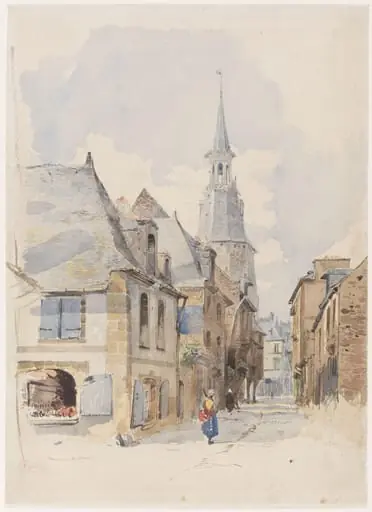
Street in Dinan, France
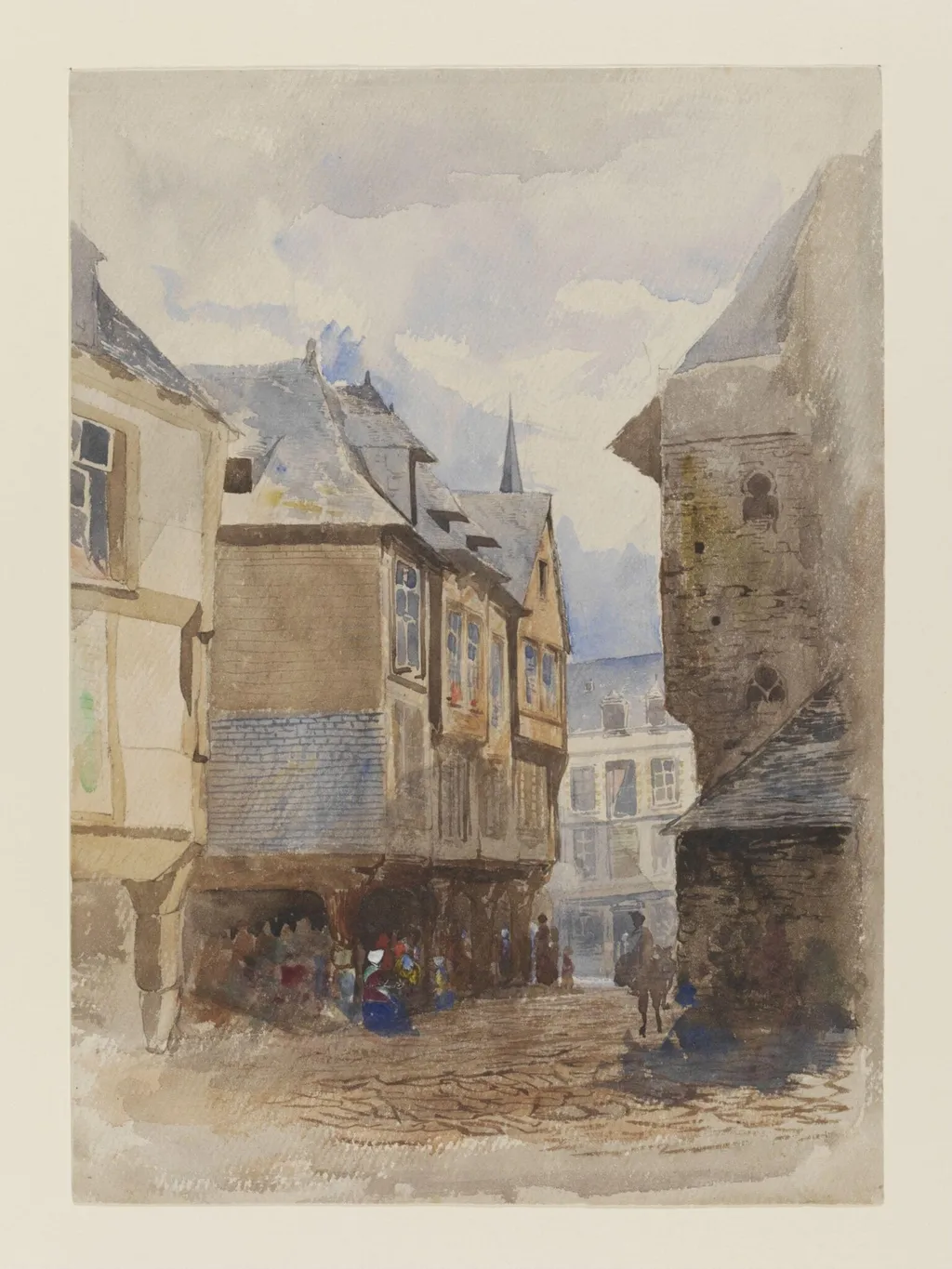
Street in Dinan, France is a drawing by the Impressionist artist William Linnaeus Casey. It dates from 1862 and is held in the collection of the Victoria and Albert Museum.
About this work
Overview
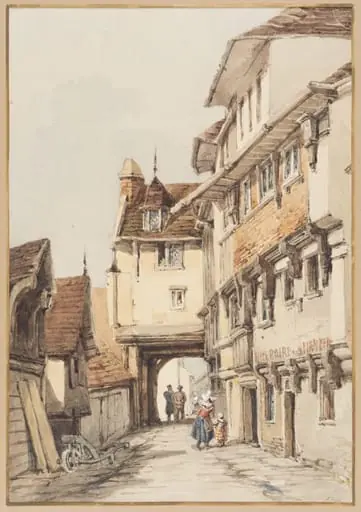
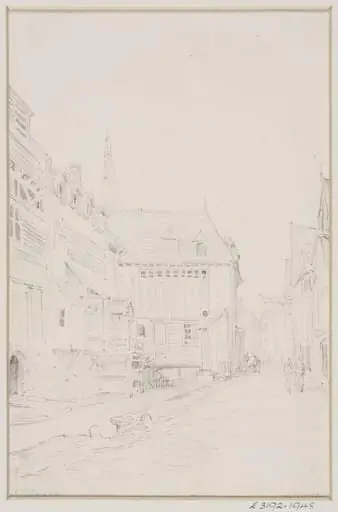
Created around 1862, this pencil drawing by William Linnaeus Casey depicts a quiet street in the Breton town of Dinan, France.
Created around 1862, this pencil drawing by William Linnaeus Casey depicts a quiet street in the Breton town of Dinan, France. Executed in a spontaneous, observational style, the work is part of the Victoria and Albert Museum’s collection. It reflects the artist’s interest in everyday urban life during his travels in northern France, rendered with minimal detail and a focus on atmosphere rather than precision.
Subject & Meaning
The scene captures a modest, uneventful moment in a provincial town: residents move slowly along a cobbled lane, figures linger near an arched entrance, and a solitary walker heads toward the right edge. The absence of dramatic action emphasizes the rhythm of daily life. The towering stone structure in the background suggests the presence of a church or civic building, anchoring the composition in a specific place and time.
Technique & Style
Casey employed light, fluid pencil strokes to suggest texture and form without heavy shading. The roughness of cobblestones, the smoothness of plastered walls, and the angularity of steep roofs are implied through varying line weight and pressure. The loose handling conveys immediacy, as if the sketch was made on-site, preserving the transient quality of light and movement in a quiet corner of Dinan.
History & Provenance
The drawing entered the Victoria and Albert Museum’s collection as part of its broader acquisition of 19th-century British drawings. While little is documented about Casey’s time in Dinan, the work aligns with a trend among British artists of the period who traveled to France to study vernacular architecture and rural life. Its preservation suggests it was valued as a record of regional character rather than a finished artwork.
Context
In the 1860s, British artists increasingly turned to continental Europe for subject matter, drawn to towns like Dinan for their preserved medieval character. Unlike grand historical scenes, Casey’s focus on ordinary streets reflected a growing interest in realism and the dignity of everyday environments. This work fits within a broader movement that valued direct observation over idealized composition.
Legacy
Though not widely exhibited, the drawing remains a quiet example of 19th-century British topographical sketching. It contributes to the understanding of how artists documented regional architecture and social life outside major urban centers. Its presence in the V&A underscores the institutional recognition of such works as valuable records of cultural and visual history.
Own this work as a print
Artist & collection