Artwork
Self-Portrait
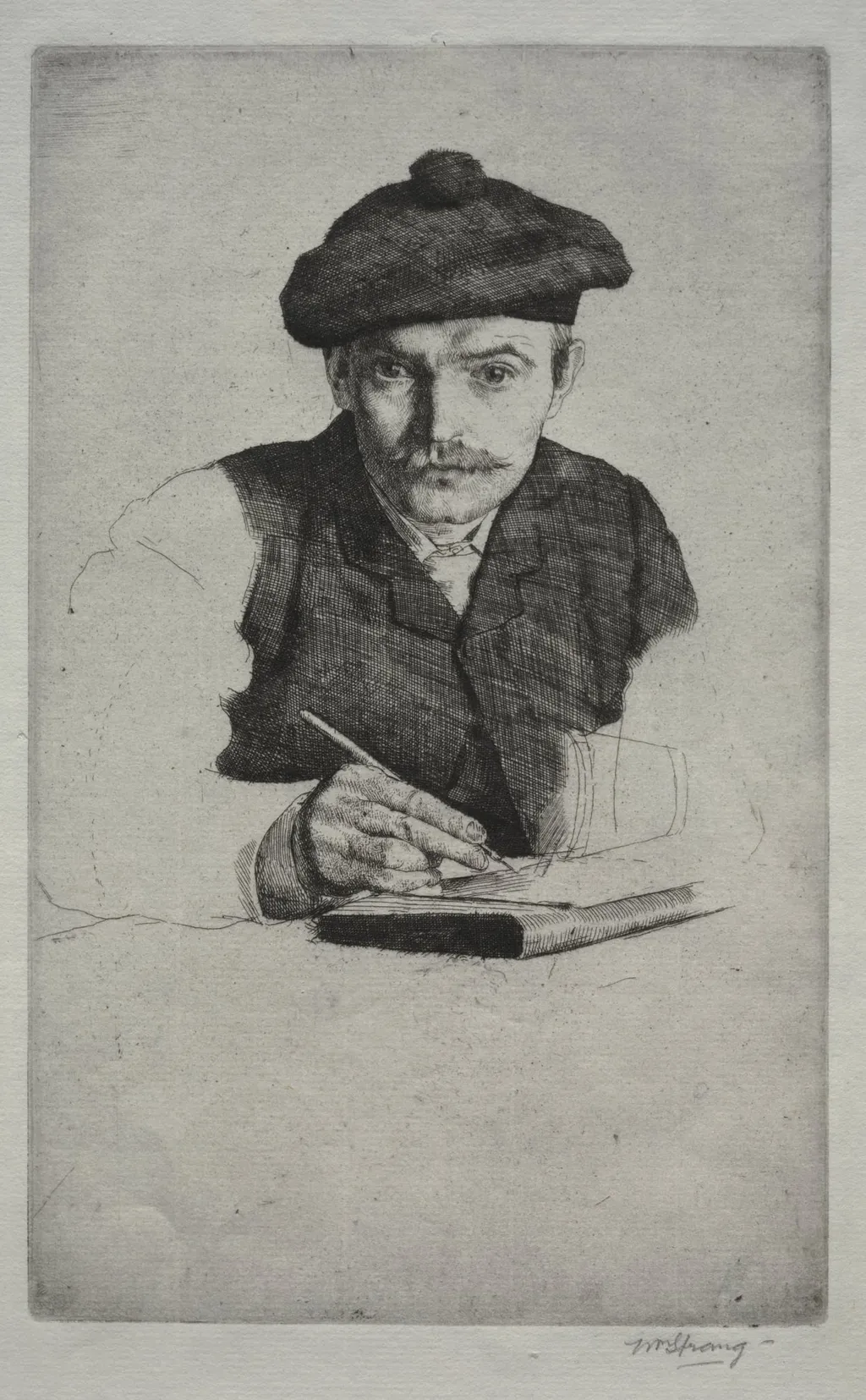
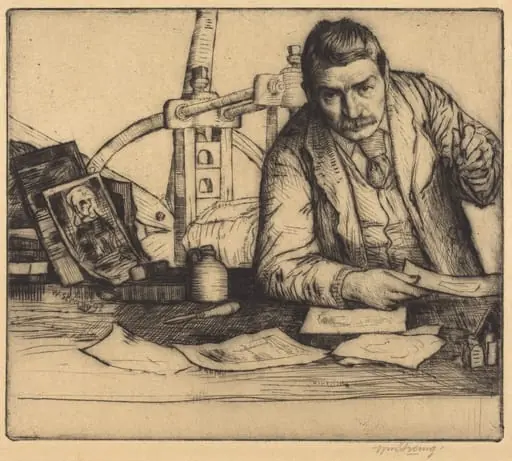
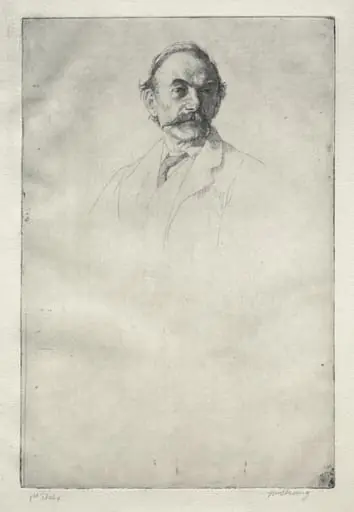
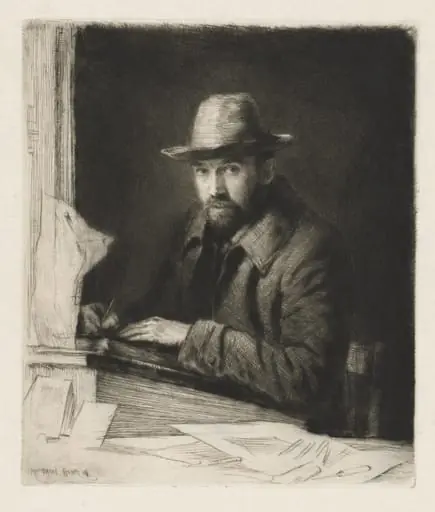
Self-Portrait is a print by the Impressionist artist William Strang. It dates from 1885 and is held in the collection of the Cleveland Museum of Art.
About this work
Overview
Strang presents himself in a moment of quiet focus, capturing not just his likeness but the act of artistic creation.
Created in 1885, this print by William Strang is a self-representation in which the artist depicts himself at work. The image is held in the collection of The Cleveland Museum of Art. Strang presents himself in a moment of quiet focus, capturing not just his likeness but the act of artistic creation. The medium is a drypoint etching, emphasizing fine lines and tonal contrast rather than broad brushwork.
Subject & Meaning
The subject is Strang himself, shown in profile with a mustache and a dark beret, dressed in a vest over a white shirt. He holds a pencil poised above a sheet of paper, suggesting an instant of deliberation. The absence of a completed drawing implies the process of creation is the focus, not the product. The pose conveys introspection, aligning the artist’s identity with the act of drawing.
Technique & Style
Strang employed drypoint etching to achieve rich, velvety blacks and subtle gradations of tone. Light falls from the left, casting deep shadows across the beret and vest, while the shirt and paper catch the glow. This chiaroscuro effect models form with precision, enhancing the three-dimensionality of the figure. The background is left deliberately pale, isolating the figure and directing attention to his hands and tools.
History & Provenance
The print was made in 1885 during Strang’s early career, a period when he was refining his printmaking skills after training in Paris. It entered The Cleveland Museum of Art’s collection in the 20th century, likely through a donation or acquisition focused on British graphic art. Its preservation reflects its significance as an example of late 19th-century etching practice in Britain.
Context
Strang worked within a revival of interest in etching during the 1880s, when artists sought to elevate printmaking beyond reproduction to a fine art form. His self-portrait aligns with contemporary European trends that portrayed artists as thoughtful, solitary figures. Unlike theatrical self-images of earlier eras, this work emphasizes quiet labor, reflecting changing ideals of artistic identity.
Legacy
This print remains a key example of Strang’s contribution to British printmaking. It demonstrates his technical mastery and his ability to convey psychological presence through minimal means. While not widely reproduced, it is studied for its restrained composition and its embodiment of the artist’s engagement with his craft, influencing later generations of printmakers.
Own this work as a print
Artist & collection

Artist
William Strang (13 February 1859 – 12 April 1921) was a Scottish painter and printmaker, notable for illustrating the works of Bunyan, Cervantes, Coleridge, Kipling, and others.