Artwork
Self-Portrait
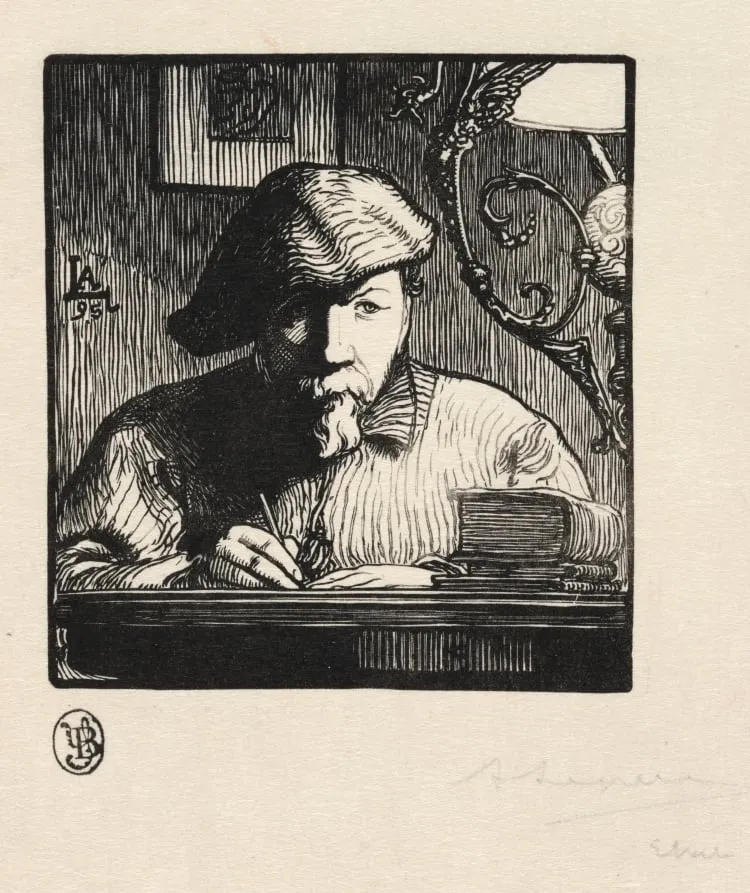
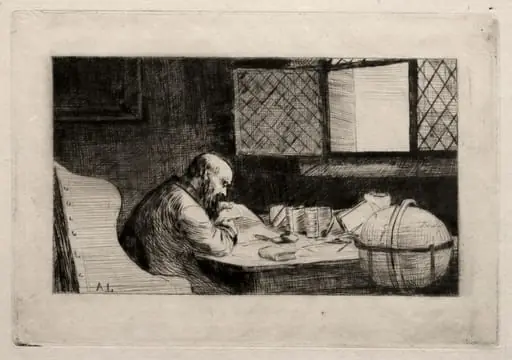
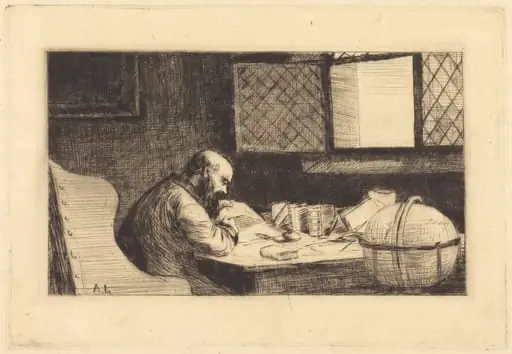
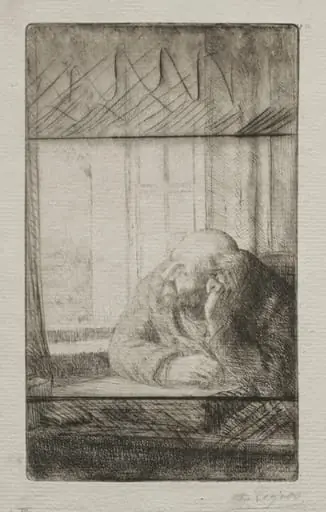
Self-Portrait is a print by the Impressionist artist Auguste Lepère. It dates from 1895 and is held in the collection of the Cleveland Museum of Art. Auguste Louis Lepère created this 1895 etching as a personal reflection, capturing himself in quiet contemplation.
About this work
Overview
A central figure in the revival of wood engraving in Europe, Lepère employed the precision of etching to convey introspection.
Auguste Louis Lepère created this 1895 etching as a personal reflection, capturing himself in quiet contemplation. A central figure in the revival of wood engraving in Europe, Lepère employed the precision of etching to convey introspection. The work resides in The Cleveland Museum of Art’s print collection, representing his technical mastery and the broader resurgence of printmaking in late 19th-century France.
Subject & Meaning
The figure, dressed in a draped robe with a hood shadowing his face, sits at a desk with minimal props: a small box and a sheet of paper. His chin rests on his hand, suggesting deep thought or creative pause. The setting is sparse, emphasizing solitude and inner focus. Lepère presents himself not as a public figure but as a quiet artisan, immersed in the solitary act of making art.
Technique & Style
Lepère used fine, controlled lines and tonal contrasts to model form and atmosphere. The interplay of light and shadow—chiaroscuro—defines the contours of his face and the folds of his robe, while the dim window light and dark curtains frame the scene with quiet drama. The etching’s sharp detail and restrained palette reflect the precision valued in late-century printmaking, prioritizing mood over narrative.
History & Provenance
Created in 1895, the etching emerged during Lepère’s active years promoting wood engraving as a fine art medium. It entered The Cleveland Museum of Art’s collection through established acquisition channels typical of the early 20th century. Its preservation reflects the museum’s early commitment to prints as significant artistic expressions, not merely reproductive works.
Context
In the 1890s, French artists sought to elevate printmaking beyond commercial use, embracing it for personal expression. Lepère was part of this movement, aligning with contemporaries who revived traditional techniques. His self-portrait aligns with broader trends in fin-de-siècle art, where introspection and craftsmanship replaced grand historical themes in favor of intimate, quiet moments.
Legacy
Lepère’s self-portrait endures as a testament to his role in redefining printmaking’s artistic potential. It exemplifies how etching could convey psychological depth with minimal means. Though not widely reproduced, the work remains a reference point for scholars studying the transition of printmaking into modern artistic practice in Europe.
Artist & collection
Artist
Louis-Auguste Lepère (30 November 1849 – 20 November 1918) was a French painter and etcher. Lepère is also considered a leader in the creative revival of wood engraving in Europe.