Artwork
The Red Fez: Self Portrait
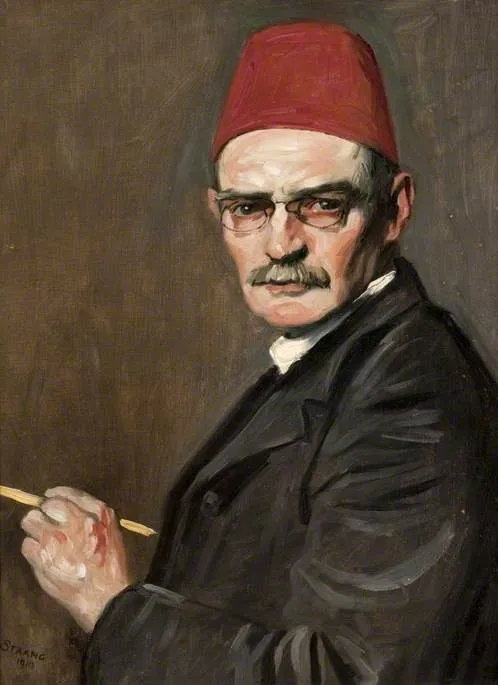
The Red Fez: Self Portrait is an oil painting by the Post-Impressionist artist William Strang. It dates from 1910 and is held in the collection of the Kelvingrove Art Gallery and Museum.
About this work
Overview
The background is a subdued brown, allowing the figure and his headwear to dominate the composition with quiet intensity.
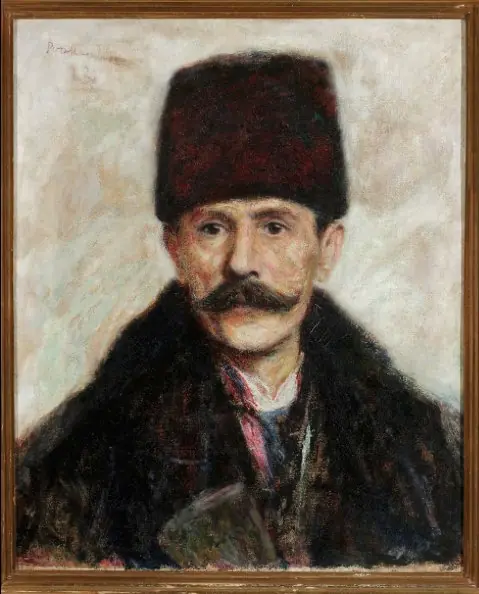
Painted in 1910, The Red Fez: Self Portrait is an oil on canvas work by Scottish artist William Strang. It presents the artist in a contemplative pose, dressed in a black jacket and white shirt, wearing a red fez. His left hand holds a paintbrush, subtly identifying him as a creator. The background is a subdued brown, allowing the figure and his headwear to dominate the composition with quiet intensity.
Subject & Meaning
Strang portrays himself not as a formal gentleman but as a working artist, the fez suggesting an interest in exotic or non-Western aesthetics. The direct gaze invites the viewer into a moment of self-reflection. The brush, held but not in motion, implies pause rather than action—perhaps a meditation on identity, craft, or the artist’s role beyond the canvas.
Technique & Style
Strang employs loose, confident brushwork, particularly in the rendering of fabric and the fez’s texture. The red of the hat contrasts sharply with the muted tones of the clothing and background, drawing attention without flamboyance. The paint is applied with deliberate economy, avoiding excessive detail in favor of expressive form and tonal harmony, reflecting his printmaking background and affinity for simplified structure.
History & Provenance
The painting remained in Strang’s possession until his death in 1921. It entered the collection of the Kelvingrove Art Gallery and Museum in Glasgow in 1922, acquired through the bequest of his widow. Its presence there reflects the institution’s early commitment to documenting Scottish artistic practice beyond academic conventions.
Context
Created during a period when British artists were increasingly exploring personal identity and non-traditional dress, the fez may reference Orientalist trends or Strang’s own travels. Unlike many self-portraits of the era, this one avoids grandeur or symbolism, favoring intimacy and quiet self-awareness, aligning with broader shifts toward psychological realism in early 20th-century portraiture.
Legacy
The Red Fez: Self Portrait stands as a quiet testament to Strang’s introspective approach to self-representation. It is rarely exhibited as a central work, yet it endures as a nuanced example of how artists used personal attire and gesture to convey professional identity without theatricality. Its modest scale and restrained palette continue to resonate with viewers seeking authenticity over spectacle.
Artist & collection

Artist
William Strang (13 February 1859 – 12 April 1921) was a Scottish painter and printmaker, notable for illustrating the works of Bunyan, Cervantes, Coleridge, Kipling, and others.