Artwork
Bangor Cathedral : Penmaenmawr in the distance
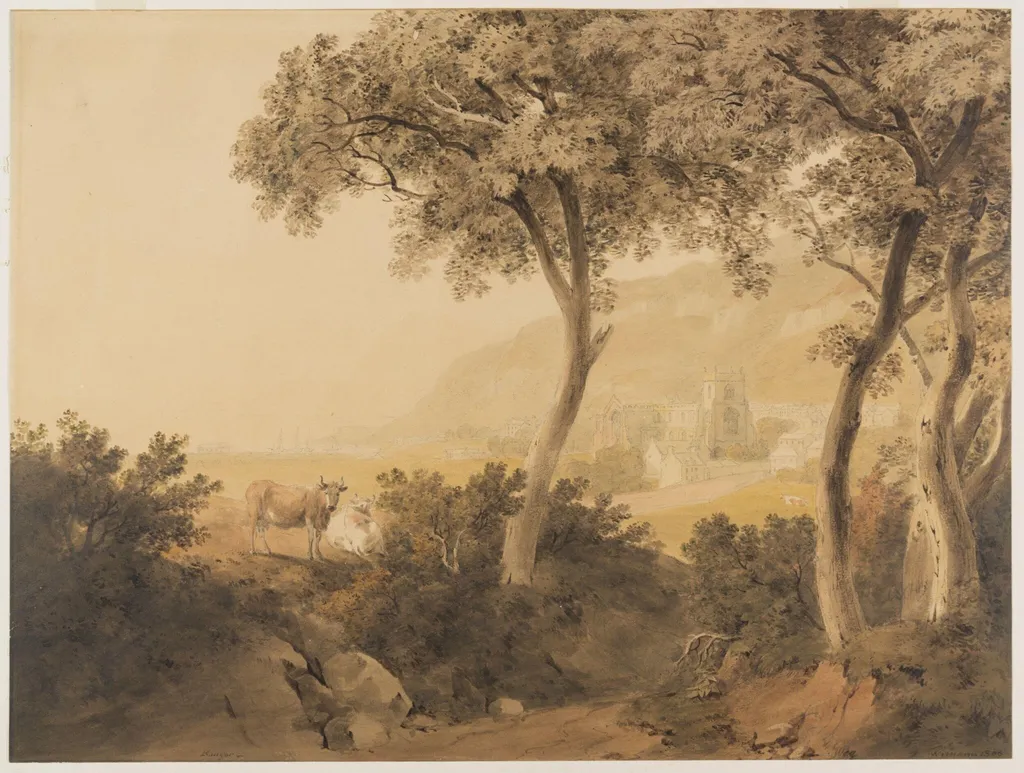
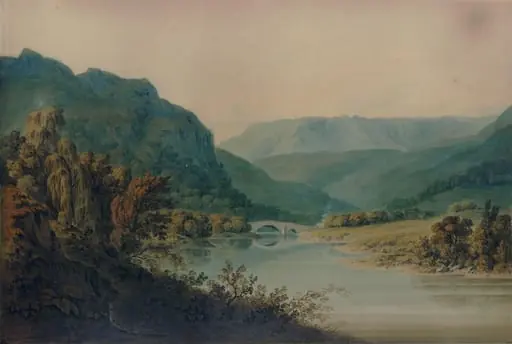
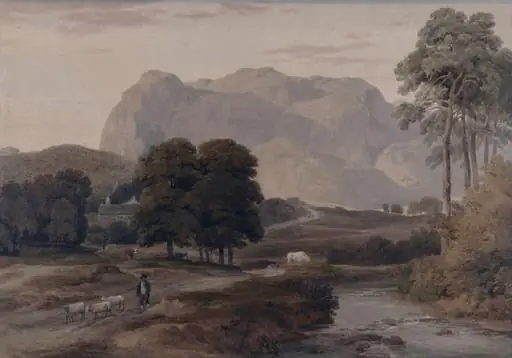
Bangor Cathedral : Penmaenmawr in the distance is a watercolor work on paper by the Romanticist artist Hugh William Williams. It dates from 1806 and is held in the collection of the Victoria and Albert Museum.
About this work
Overview
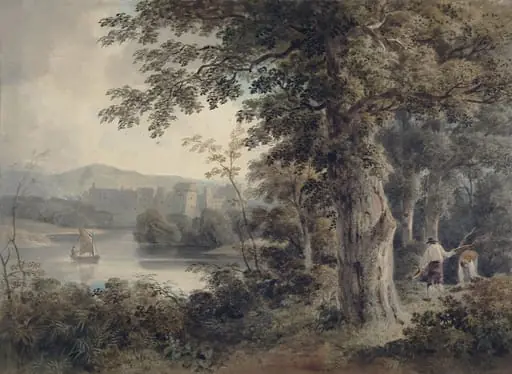
The work is a watercolour created in 1806 by the British landscape painter Hugh William Williams. It portrays the silhouette of Bangor Cathedral’s tower set against a distant view of the Penmaenmawr mountain, framed by a pastoral foreground. The composition balances architectural detail with a tranquil countryside, offering a snapshot of early‑19th‑century North Wales.
Subject & Meaning
In the foreground, two cows rest beneath a mature tree, suggesting everyday rural life. Beyond them, the cathedral’s spire rises above a modest settlement near water, while the far‑off Penmaenmawr peak anchors the scene within the regional topography. The juxtaposition of human activity, religious architecture, and natural landscape conveys a harmonious coexistence of the sacred and the agrarian.
Technique & Style
Williams employs a restrained palette of muted greens, blues, and earth tones, applying washes that render atmospheric depth and soft illumination. Delicate brushwork defines the foliage and distant hills, while finer lines delineate the cathedral’s structural elements. The overall effect is one of calm clarity, characteristic of his lyrical, topographically accurate watercolours.
History & Provenance
Signed and dated by the artist, the piece reflects Williams’s early career, when he was establishing his reputation for serene Welsh vistas. The watercolour has remained in private collections before entering a public holding, where it is catalogued as an example of his documented travels across North Wales during the Napoleonic era.
Own this work as a print
Artist & collection

Artist
Hugh William Williams, known as "Grecian Williams," was a Scottish landscape painter.